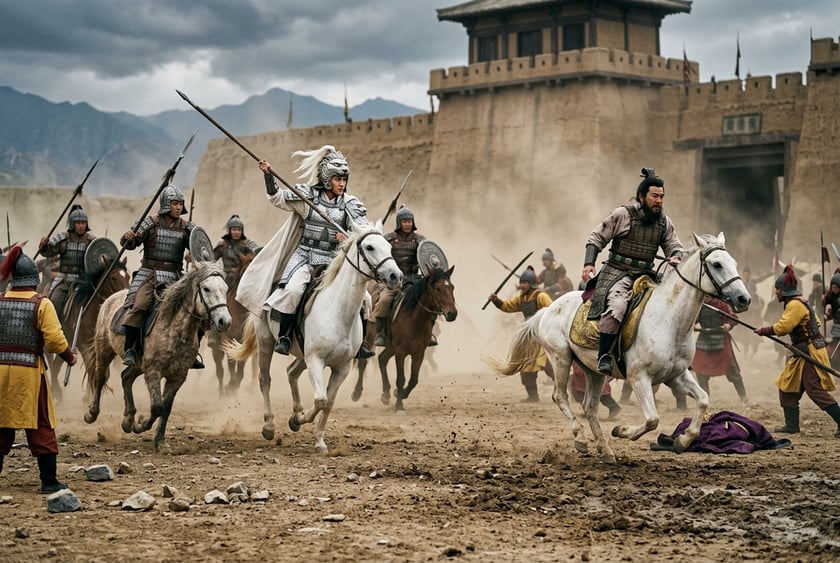
Strategic Background
The central issue in the Battle of Tong Pass was not merely control of a fortified pass. It was whether Cao Cao could secure the gateway to the Guanzhong region during his westward campaign, maintain his river crossings and supply lines, and prevent the allied forces of Ma Chao and Han Sui from extending their control of the battlefield east of the Wei River. In the Romance of the Three Kingdoms, Ma Chao and Han Sui first seize Chang'an, forcing Zhong Yao to retreat to Tong Pass. Cao Cao therefore abandons his plan to campaign south, orders Cao Hong and Xu Huang to defend the pass ahead of him, and leads his main force west. This shows the pressures of a multi-front strategy: Cao Cao must allocate troops among the crisis in Guanzhong, the security of his rear, and other fronts, while Ma Chao’s side hopes to keep Cao Cao’s forces east of the pass and force them to fight on unfavorable terrain.
These materials come from a fictional narrative and are suited to analyzing the logic of warfare as the novel portrays it; they should not be treated as a day-by-day campaign record or as undisputed historical fact. The narrative places Ma Chao’s enmity toward Cao Cao alongside Han Sui’s longstanding ties to the Ma family, giving the allied forces a shared military objective but also leaving them vulnerable to a crisis of trust. Cao Cao, for his part, has greater capacity to redeploy his forces, but must solve the problems of crossing the river, establishing camps, and avoiding cavalry attacks. In other words, the strategic focus gradually shifts from “holding the pass” to “controlling the crossings and camps, and maintaining the stability of the alliance.”
Deployment of the Two Sides
The allied forces operate from Tong Pass and the Guanzhong region. Ma Chao’s mobile cavalry forms their main striking force, while Han Sui helps coordinate operations and offers his judgment on when to cross the river. Ma Chao advocates crossing the river to intercept Cao Cao’s forces on the north bank; Han Sui argues that they should wait until Cao Cao’s army is halfway across before attacking. Their differing views show that although they share the same objective, they understand timing and risk differently. Cao Cao assigns Cao Hong and Xu Huang to hold the pass while organizing his main force to cross the Wei River. Xu Huang and Zhu Ling then lead an elite force across to the west bank and establish a camp, intending to create a supporting position to the flank and rear that complements Cao Cao’s frontal advance.
Terrain and engineering conditions shape the effectiveness of these deployments. Cao Cao at one point uses boats, rafts, pontoon bridges, and a riverside road to support the crossing and maintain communications between camps, while Cao Ren links wagons together to form a barrier. Ma Chao and Han Sui use fire attacks to destroy the camps and bridges, at one point making it difficult for Cao Cao’s forces to establish a foothold. Cao Cao then orders his troops to build an earthen wall, but the sandy soil is unstable and repeated cavalry raids make it difficult to complete the fortifications quickly. The novel also describes the use of horse traps to lure the enemy and ambushes to counterattack, showing how Cao Cao’s forces try to make up for their disadvantage in cavalry mobility through engineering and carefully prepared battlefields. The emphasis is on adapting deployments, not simply comparing troop strength.
Key Decision Points
The first decision point is whether Cao Hong should leave the pass and engage the enemy. Xu Huang judges that Ma Chao’s insults are a trap and advises holding the position until Cao Cao’s main force arrives. On the ninth day, however, Cao Hong takes advantage of the enemy’s fatigue and sallies out, only to be lured away from the pass. Cao Cao then reprimands him severely. The lesson is not that “defending a city is always better than attacking.” Rather, if a garrison lets the enemy dictate its pace and leaves its strong position without adequate reconnaissance or reserves, it may trade the advantages of a fortified position for the risks of pursuit. Through Cao Hong’s punishment, the novel stresses that commanders in a theater of war must follow the overall plan.
The second decision point is Cao Cao’s choice to break the deadlock at the pass with a river crossing and a flanking maneuver. Xu Huang proposes crossing at Pubanjin while Ma Chao’s main force is concentrated at Tong Pass and defenses on the west bank are relatively weak. The value of this move lies in forcing the allied forces to guard both the front and the flank and rear, rather than relying solely on a frontal assault against the pass. Cao Cao’s forces subsequently sustain pressure through lures, ambushes, and a camp on the west bank. Although they suffer setbacks from fire attacks, they continue trying to restore their fortifications and lines of communication. The tactic does not succeed all at once. The key is that Cao Cao’s forces keep shifting their axis of action, while the allied forces must continually judge whether he intends to attack the pass, cross the river, or strike at their rear.
The third decision point is how to manage trust within the alliance. Cao Cao speaks with Han Sui before the two armies, and Cao Hong relays their conversation, prompting Ma Chao to suspect that Han Sui is colluding with Cao Cao. Commanders on Han Sui’s side also discuss surrender, and Yang Qiu is ultimately portrayed as the one who goes to make contact. The narrative presents the alliance’s breakdown as part of the military struggle: without reliable channels of communication, ambiguous signals can turn into suspicions among commanders and undermine coordination. It is important to note that the cited passages do not describe Jia Xu carrying out a specific scheme to “sow discord between Ma Chao and Han Sui,” nor do they include a corresponding episode of “Xu Chu Fights Ma Chao Bare-Chested.” These popular episodes cannot be treated as decision-making facts established by this set of materials simply because they appear in summaries of the campaign.
Outcome and Legacy
In the passages from the novel, the course of the fighting swings back and forth locally. Ma Chao at one point attacks Cao Cao’s forces and drives Cao Cao to a hasty escape; Cao Cao’s forces also suffer a fire attack and lose their bridge and camp. Later, Cao Cao’s forces use ambushes, establish a camp on the west bank, and maintain their pursuit, forcing Ma Chao to retreat west with the remnants of his army. Li Kan is shot dead in combat, while Cheng Yi is killed by Xiahou Yuan after a night raid falls into an ambush, showing the considerable risks of both cavalry assaults and night operations. Ding Fei scatters cattle and horses to distract the pursuers, an example of an improvised ruse that saves the commander. But this is an escape episode in the novel and cannot be taken as proof that the campaign as a whole has already been decided.
Accordingly, if we follow the stipulated outcome of “unclear,” the safest conclusion is that the available material shows Cao Cao stabilizing the battlefield for a time, Ma Chao’s forces suffering losses and retreating west, but does not suffice to characterize the Battle of Tong Pass as the complete destruction of Ma Chao’s power or the establishment of lasting control over Liangzhou. At the end of the narrative, Cao Cao returns to the east because of affairs in the Central Plains and the south, leaving Yang Fu to keep watch for the threat posed by Ma Chao. This exposes the gap between military pursuit and strategic consolidation: the enemy’s retreat does not mean that the frontier problem is solved. Any short-term advantage on the Guanzhong battlefield still requires subsequent administration and the commitment of troops.
Counterfactual Analysis
If Cao Hong had followed Xu Huang’s advice and held the pass throughout, Cao Cao’s forces might have avoided the danger of the garrison being lured out and losing the security of its position. But Ma Chao’s repeated insults and waves of pressure were intended precisely to make the defenders lose patience. A purely defensive stance might also have given the allied forces more time to retain control of Guanzhong and threaten Cao Cao’s lines of communication. The more reasonable alternative is not “never go out to fight,” but to set clear limits for reconnaissance, sorties, and withdrawal, with steady commanders such as Xu Huang in control of the reserves, so that local actions do not become detached from the main force’s deployment. This counterfactual suggests that discipline and clear limits on delegated authority may matter more than whether a commander is brave or timid.
If Ma Chao and Han Sui had established reliable channels of communication and imposed unified rules on contact before the armies, the transmission of orders, and the actions of their respective forces, Cao Cao would have had less room to exploit suspicion and create divisions. But this would not have resolved the allied forces’ other problems: Cao Cao could change his crossing point and build a flanking camp, while the allied cavalry, though skilled at striking, would have to divide its forces to respond to multiple crossings and camps. Conversely, if Cao Cao had failed to establish a foothold on the west bank with Xu Huang and Zhu Ling, or if fire attacks had continued to disrupt his river-crossing works, his supply lines and camps would have been more vulnerable, allowing Ma Chao to retain the initiative in close-range raids. Both counterfactuals point to the same conclusion: the course of the Battle of Tong Pass depended on the interplay of allied coordination, mobility across the river network, and the support provided by fortifications—not on a single duel or charge.