Background
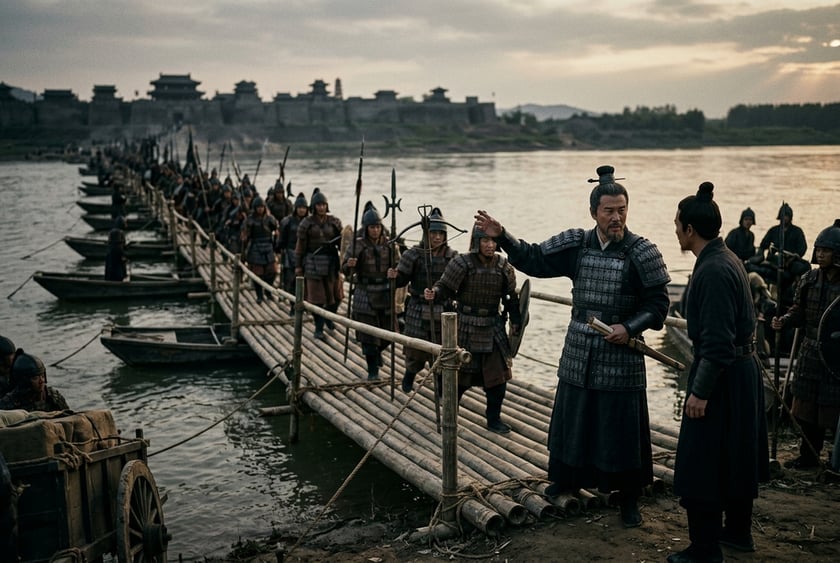
This chapter of the Romance is a critical hinge point. Looking backward, it follows from the defeat at Shiting: Cao Xiu, tricked by Zhou Fang's feigned surrender, advanced deep into the east of Wancheng at Shiting and was crushed by a three-pronged pincer of Lu Xun, Zhu Huan, and Quan Cong [c:17402]. Looking forward, it anticipates Zhuge Liang's Second Northern Expedition (Diercibeifa): Sima Yi, calculating that Shuhan would certainly exploit the vacuum left by the defeat of Caowei's main eastern force to advance on Guanzhong, proactively abandoned his plan to continue pursuing into Longyu. The Romance links these two events within a single chapter not merely as chronicle but to foreground a structural reality — that after Cao Pi's death, Caowei's eastern front (the Cao Xiu system) and western front (the Cao Zhen and Sima Yi system) were in fact two independent commands with no coordination between them. Whenever one front collapsed, the strategic options on the other front would be immediately forced to contract.
Key Figures
Although the chapter title is "Wanchengpocaoxiu," the figures who actually carry the analytical function in the novel's narrative are not Cao Xiu himself — he is merely the passive recipient of disaster on the Wancheng front — but rather Sima Yi, Lu Xun, and Cao Rui. Cao Xiu was a leading general of the imperial clan and representative of the first generation of Caowei's military aristocracy; his death signified that the capacity of Caowei's imperial clan to independently command the southeastern theater was in practice extinguished. Cao Rui's imperial edict for a lavish state funeral was a ritual gesture to soothe the clan faction, but in real personnel terms the court had already begun tilting toward Sima Yi [c:17402]. Lu Xun, as the true victor on the Sunwu side, is left as background music in the Romance; Zhou Fang, though he does not appear in this chapter, provided the detonator of the entire victory with his "cutting off his own hair to prove his sincerity in surrendering." The image of Sima Yi in this chapter is sculpted as pivotal: he held firm against the ridicule of the other commanders and alone perceived the fragility of Caowei's overall strategic position — this capacity for "whole-board situational awareness" runs through all his later actions [c:17402].
Core Issue
The core issue of this chapter is: when two fronts of a great power operate under independent commands, how does the collapse of one front trigger "defensive folding" on the other. From a strategic theory standpoint, Cao Xiu's defeat at Shiting and the extravagant Luoyang state funeral sent a clear signal to the outside world — that the southeastern front would be incapable of offensive action in the short term. If Zhuge Liang chose this moment to move north, the Guanzhong-Longyu line would have to independently bear the full weight of a Shuhan offensive with no eastern diversionary threat whatsoever. What Sima Yi derived from this signal was not "Zhuge Liang will definitely come" but "if he comes, Caowei will lose its buffer, so I must first abandon the current small gain and withdraw to defend Changan." This is a decision-making model of "designing deployments around the worst-case assumption" — more robust than the conventional approach of planning around the highest-probability event, and also better suited to Caowei's political circumstances of the time, where another major defeat could not be afforded.
Political Consequences
The most direct consequence was a sharp drop in the power of the imperial-clan military faction. After Cao Xiu's death, the pace at which the first-generation Caowei imperial-clan generals were dying off accelerated markedly — Cao Zhen died of illness within a few years as well, and by the Cao Rui era military command was progressively being divided among non-clan senior ministers such as Chen Qun, Sima Yi, and Man Chong. The second consequence was the irreversible rise of Sima Yi's authority: his "holding firm against the crowd" judgment in this event was subsequently proven entirely correct (Zhuge Liang did in fact launch a second northern expedition), and this kind of accumulated "prophetic fact" — proving one right when everyone else was wrong — builds prestige more effectively than any political maneuvering, laying political capital for the Gaopinglingzhibian to come. The third consequence was the real-world validation of the Shu-Wu coordinated two-front model: the Romance handles the eastern defeat and the western contraction in a single chapter, which is itself telling the reader — Sunwu's offensive can create space for Shuhan's offensive; this structural tacit coordination of "dual-front linkage" was the strategic prerequisite underpinning Zhuge Liang's repeated northern campaigns.
Counterfactual Analysis
If Sima Yi had not immediately withdrawn to Changan and had instead continued pursuing into Longyu by conventional reasoning, how would events have unfolded? The most probable path: Zhuge Liang's second northern expedition would have coincided with a window in which Changan's defenses were relatively thin and the relief force was deployed elsewhere, opening potential opportunities along the Chencang Road or even the Wuguan Road direction; with Caowei under simultaneous pressure at Wancheng and Changan, Cao Rui's political pressure would have spiked, forcing him to accelerate the devolution of power to non-clan ministers. An even more extreme counterfactual: if Cao Xiu had not died and had simply returned to Luoyang under punishment and retained his command, the Caowei imperial clan's military authority might have been preserved for another generation, pushing back Sima Yi's rise by five to ten years — with knock-on effects on the entire political timeline of the subsequent Simashi supplanting of Wei. Viewed from this angle, the true historical weight of the defeat on the Wancheng front — the defeat of Cao Xiu — lay not in the number of troops lost but in the removal of a key imperial-clan commander, definitively tilting the scales of Caowei military authority one more notch toward the Simashi.