Strategic Context
The Battle of Jiangling was a "victory-carving war" that came immediately on the heels of Chibi — determining who would inherit the fruits of the Chibi triumph and laying down the basic pattern of the Jingzhou succession dispute for the next seventy years [c:17216]. Geographically, the seat of Nanjun, Jiangling, was the largest strategic hub on the mid-Yangtze: northward it opened to Xiangyang and the Central Plains; southward it controlled the Dongting and radiated influence across Jingnan's four commanderies; eastward it abutted Jiangxia as a shield for Jiangdong; westward it held the Three Gorges as the gateway to Shu. To lose Jiangling was to forfeit all strategic initiative across the middle Yangtze. Viewed from the situation immediately after Chibi: though defeated, Cao Cao left Cao Ren and Xu Huang to hold Jiangling and Le Jin to hold Xiangyang, hoping to use Jiangling as a forward anchor to continue pressing Jiangdong. Within the Sun-Liu alliance, Liu Bei held the field before Chibi with only Liu Qi's ten thousand Jiangxia troops and a remnant of Jingnan forces; Sun Quan commanded thirty thousand elite water-land troops — a vast disparity. But after Chibi, Liu Bei rapidly absorbed the routed Jing-Xiang soldiers and his strength ballooned, and the internal jostling between Sun and Liu began immediately [c:17218].
Deployment of Forces
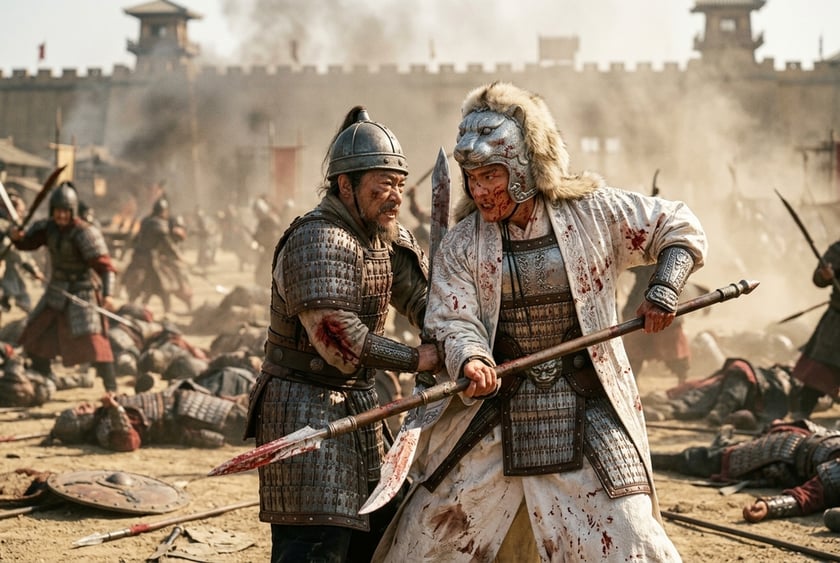
The core of Sunwu's deployment was Zhou Yu's "converging-arms advance": Zhou Yu and Cheng Pu led the main force, flanking Cao Ren across the river; Gan Ning held Yiling in advance to divert Cao Ren's attention; and Lv Meng, Ling Tong, Xu Sheng, Ding Feng, Pan Zhang, Han Dang, and Chen Wu each commanded a separate unit to handle mobile tasks [c:17216] [c:17220]. This was the standard battle method of Jiangdong's naval forces in their mature period — pin the enemy with the central main force, harass the flanks with subsidiary units, use the reserve against relief columns. On the Caowei side: Cao Ren was chief commander holding Jiangling; Cao Hong, Cao Chun, and Niu Jin assisted; Le Jin held Xiangyang as rear support. The tactical core of Cao Ren's defense was "expending the Wu army against Jiangling's fortifications while waiting for relief forces from the Central Plains" — the fatal weakness of this deployment being that "time was not on his side": Caowei's supplies and reinforcements required mobilization across a thousand li from the north, while Wu forces on the Yangtze maneuvered far more nimbly. Liu Bei's side adopted a "tail-along scavenger" strategy: he encamped at Youjiangkou (Gong'an), nominally cooperating with Zhou Yu in attacking Nanjun, but in practice waiting for Zhou Yu and Cao Ren to exhaust each other and then entering through the breach [c:17218].
Key Decision Points
The first decision point is Zhou Yu sending Gan Ning to take Yiling. This step forcibly divided Cao Ren's troops — Cao Ren had no choice but to divert his cavalry to besiege Gan Ning, walking directly into Zhou Yu's prearranged "converging-arms advance" [c:17216] [c:17220]. The second decision point is Lv Meng's proposal to "leave Ling Tong to guard the rear and personally lead a relief force to Yiling." In this engagement Lv Meng for the first time acted in the role of a "strategist-commander," devising a plan for Zhou Yu — this move both rescued Gan Ning and preserved the stability of the main battlefront, and marks the pivotal moment in Lv Meng's transformation from "assault fighter" to "supreme commander" [c:17220]. The third decision point is Zhou Yu personally braving arrows and stones to supervise the battle. In the direct frontal engagement on the north bank of Jiangling, Zhou Yu was struck in the right side by a stray arrow and suffered a grave wound, forcing him to withdraw. In the novel, this wound is dramatized into the episode of "feigning death after the crossbow wound," but historically it was genuinely one of the direct causes shortening Zhou Yu's lifespan — whether the wound contributed to his death from illness at Baqiu three years later is not stated in any source, yet the severity of the wound is undeniable [c:17216] [c:17222]. The fourth decision point is Zhou Yu's resolve to "personally tour the camp" after his wound. When Cao Ren learned that Zhou Yu "had not yet risen from his sick bed" and began forming his troops to press the advantage, Zhou Yu endured extreme pain and rose to walk through the ranks, rallying and inspiring his officers and soldiers — this action reversed Cao Ren's judgment that Wu's fighting spirit was broken, and ultimately convinced him to withdraw [c:17216]. This detail is in factual terms the true "decisive move" of the Battle of Jiangling — Zhou Yu's personal will rewrote the outcome of the campaign. The fifth decision point is Zhuge Liang seizing three cities while the other side was occupied. This is a passage unique to the novel: Zhuge Liang used a military tally taken from the captured Chen Jiao to seize Nanjun first, then fraudulently summoned Xiahou Dun out of Xiangyang and ordered Guan Yu to capture it, with Liu Bei gaining three cities "without the slightest effort" [c:17225]. Historically the four Jingnan commanderies (Wuling, Changsha, Guiyang, and Lingling) were seized by Liu Bei personally leading his various generals on separate campaigns, not masterminded entirely by Zhuge Liang; but the novel dramatizes it as "winning through wit," which better highlights Zhuge Liang's unparalleled genius.
Outcome and Resonance
From a historical-results standpoint, the Battle of Jiangling concluded with Zhou Yu taking Nanjun and Liu Bei taking Jingnan's four commanderies — each side getting what it needed, though the distribution was far from equal. Zhou Yu exchanged a severe wound to gain one Jiangling; Liu Bei gained the four commanderies of Wuling, Changsha, Guiyang, and Lingling at almost no cost in blood [c:17225]. This pattern of "Sunwu does the fighting while Liu Bei reaps the gains" is the fundamental origin of the subsequent "borrowing Jingzhou" dispute — Sun Quan argued that Nanjun was won with Wu soldiers' lives and should together with Jingnan properly all belong to Wu; Liu Bei insisted he too had contributed at Chibi and had personally conquered the four Jingnan commanderies. This allocation dispute fermented over the following ten years, culminating in the Xiangshui border demarcation in Jianan year 20 and the Baiyidujiang operation by Lv Meng in Jianan year 24; the Jiejingzhou controversy had already buried a permanent fissure in the Sun-Liu alliance at this first instance of "cooperation and spoils-sharing." Looking deeper, the Battle of Jiangling's resonance had four dimensions. First, Zhou Yu's grave wound created the hidden vulnerability that led to his death from illness at Baqiu three years later, depriving Jiangdong of a strategic-caliber figure who might otherwise have brought Shu under Wu's control. Second, from this engagement Lv Meng began his journey as a strategist-commander, ultimately becoming the planner of the Baiyidujiang seizure of Jingzhou. Third, although Cao Ren was defeated, he preserved his main forces and withdrew north, allowing Caowei to hold the strategic anchor at Xiangyang. Fourth, Liu Bei for the first time participated in the three-way contest as an independent strategic actor, from this point leaving behind the role of "guest general" and entering his role in the "three-legged stool."
Counterfactual Analysis
The most imaginative counterfactual is: if Zhou Yu had not been struck by the stray arrow in the Battle of Jiangling, his plan to lead the campaign to pacify Shu in Jianan year 15 could very possibly have succeeded — according to Zhou Yu's own proposal to Sun Quan on his deathbed, Jiangdong after obtaining Jiangling should have sailed upriver west to seize Yizhou and form a north-south standoff with Cao Cao. On this divergent path there is no Liu Bei entering Shu; San Guo becomes a "two-power standoff" between Wei and Wu. Second, if after taking his wound Zhou Yu had not endured the pain to rise and tour the camp, Cao Ren might well have succeeded in his counterattack and recaptured the initiative; Jiangling would not have gone to Wu, and the fruits of the Chibi victory would have been drastically diminished — Sunwu's strategic depth would have been permanently confined to the lower Yangtze. A third scenario: if Zhuge Liang had not seized the three cities while Zhou Yu was engaged at Jiangling (the historical reality that the novel's dramatized episode reflects), Liu Bei's clique would have had no base in Jingnan, and the possibility of advancing into Shu in the next step would likewise have fallen sharply; Shuhan as a political entity might not have appeared at all, and San Guo would have become two powers. The true weight of the Battle of Jiangling is to be read backward along the counterfactual line of "Zhou Yu unwounded, Liu Bei without four commanderies, Shuhan not established" — tactically it was a grinding siege campaign, yet strategically it was the final crystallization of the San Guo map.