Background
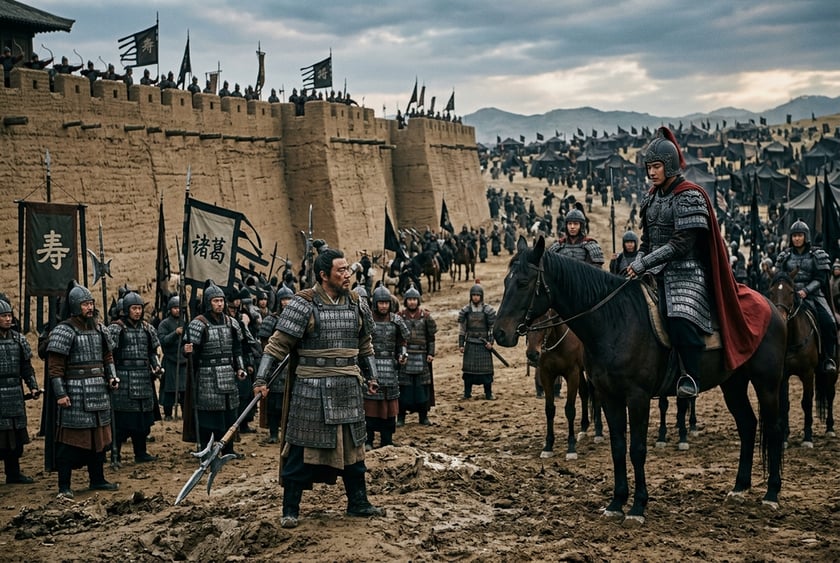
After Chibi, Cao Cao withdrew north and left Cao Ren to hold Nanjun (with its seat at Jiangling). Jiangling was the political, military, and economic heart of western Jingzhou; whoever seized Jiangling held actual control over the whole of Jingzhou. In the framework of the Romance of the San Guo, the outcome of the Battle of Jiangling was the true starting point of the unraveling of the Chibi alliance — this strategic prize was the first item in the "spoils-sharing" between the Sun-Liu coalition, but no distribution scheme could leave both sides satisfied [c:17872]. From a political-economy perspective, Chibi was cooperation "in the name of survival"; the Battle of Jiangling moved the relationship into a "competition for interests" phase. The tension at this turning point is the root of every subsequent friction.
Key Figures
Zhuge Liang is the true architect throughout this sequence. His read on Zhou Yu was precise: he foresaw that Zhou Yu would come under the guise of "expressing gratitude" but in reality to reclaim Nanjun [c:17871], so he arranged in advance for Zhao Yun to enter the city. Zhou Yu's role in this sequence is complex: he was the commander-in-chief at Chibi, the meritorious officer who genuinely fought the brutal campaign and ground Cao Ren down to exhaustion — and yet he was the loser in this "spoils" competition. From his perspective, Jiangling was a prize of war that Sunwu had purchased with blood; the Liu Bei faction's approach of "standing down and waiting for both Wu and Cao Ren to bleed each other dry, then picking up the pieces" was freeloading in essence. Yet Zhou Yu's verbal concession — "let Eastern Wu go first; if we cannot take it, you are welcome to try, so why not?" [c:17872] — this "take first, yield if needed" oral promise was seized upon by Zhuge Liang and turned inside out into a verbal-letter trap reading "let Eastern Wu fight first; if they cannot take it, Liu Bei takes it." Zhao Yun's role in the sequence is comparatively simple, but he bears the critical execution: rapid decision-making, occupation, and withholding fire.
Core Issues
The true issue in this seizure of the city was "how, within an alliance, to convert a verbal distribution of spoils into an accomplished fact." Zhuge Liang's strategy can be broken into three steps: first, force Zhou Yu to publicly commit to "take first, yield if needed," converting the oral agreement into binding language [c:17872]; second, stand down and let Zhou Yu and Cao Ren continue to exhaust each other until both sides had lost the capacity to fight, at which point the city's defenses would be naturally depleted; third, enter first and occupy the city, so that Sunwu's only options were "accept the accomplished fact" or "go to war against an ally" — the former being a political humiliation, the latter a strategic catastrophe. This was a textbook move of "seizing the initiative while exploiting the opponent's political cost." Zhuge Liang's choice of this step was not accidental: he understood clearly that the Liu Bei faction's position within the alliance was always that of the "junior partner," and that if he did not actively maneuver to seize a strategic base, the Liu Bei faction would be permanently subordinated to Sunwu as "a guest that merely borrows space."
Political Consequences
In the short term, Zhao Yun successfully occupied Nanjun; the subsequent back-to-back moves of Zhang Fei seizing Jingzhou and Guan Yu seizing Xiangyang gave the Liu Bei faction, for the first time since Chibi, a complete cluster of prefectural and city strongholds — the true beginning of the transformation from "roving general" to "regional lord." In the medium term, Zhou Yu came to harbor deep resentment toward the Liu Bei faction from that point forward; his relationship with Zhuge Liang was completely severed, and the serial "three provocations of Zhou Yu" in the Romance of the San Guo is the continuous fermentation of this rift. In the long term, "borrowing Jingzhou without returning it" became the deepest political wound in the Sun-Liu relationship — a wound that erupted ten years later when Guan Yu pushed his northern campaign, when Sun Quan secretly collaborated with Caowei to trap and kill Guan Yu, and the Sun-Liu alliance definitively broke down; Shuhan lost Jingzhou, and after the defeat at Yiling effectively lost the strategic possibility of a successful northern campaign. In a single formulation: Zhao Yun's seizure of Nanjun by exploiting the vacancy was the Liu Bei faction's first "political victory" — and simultaneously the Sun-Liu alliance's first "political fracture." The two are one and the same.
Counterfactual
The two counterfactual paths most worth developing are the following. The first: if the Liu Bei faction had chosen to honorably wait for "Zhou Yu to take it and yield it," as the alliance arrangement seemed to suggest — what would have happened? The core question on this path is: would Sunwu actually have yielded after capturing Nanjun? Historical logic gives a negative answer — after Chibi, Zhou Yu would not in the near term have willingly given up so important a city; he needed it as a springboard for his next strategic objective of "taking Shu." All of Zhuge Liang's stratagems were grounded on the judgment that "Eastern Wu will not actually yield" — he was not stealing the fruits of Zhou Yu's victory; he was collecting the account before Zhou Yu could default on it. The second: if Zhou Yu had chosen to go to war against the Liu Bei faction after Zhao Yun's entry into the city and forcibly retaken it — what would have happened? The cost of this path was the immediate collapse of the Sun-Liu alliance: with Cao Cao watching hungrily from the north, once Sun and Liu began fighting each other he could descend at leisure and destroy them one by one. Zhou Yu understood this cost clearly, which is why even in his outrage at the city gates he chose to withdraw and deliberate rather than attack [c:17873]. This situation of "knowing full well you have been maneuvered against, yet still unable to overturn the table" is the most painful predicament in alliance politics: you must maintain the cooperation even as you absorb the costs of inequity within it. Understanding this is the only way to understand why the Romance of the San Guo repeatedly portrays Zhou Yu as "infuriated to death by Zhuge Liang" — he did not lose on military capability; he lost by being compelled to accept the unfair rules of the alliance from within. This thread runs all the way through Guan Yu's loss of Jingzhou, the Battle of Yiling, and the Baidituogu bequest, ultimately becoming the true starting point of the turning of Shuhan's national fortunes.