Strategic Background
The Battle of Jiangling in the fourteenth year of Jian'an (209) was the critical phase in which the combined Sun-Liu forces cleared Caowei's remaining foothold in the middle Yangtze following the great victory at Chibi. The Chibi triumph had briefly elevated the Wu army's spirit, but Jiangling — the seat of Nanjun — was formidably difficult to attack: Cao Ren held the city in person with heavy forces while his cousin Cao Hong garrisoned Yiling upstream, forming a mutually supporting flanking position that meant Zhou Yu could not storm Jiangling frontally without risking "his rear being pinned down by the Yiling garrison while his supply line was severed". This was the true residual problem of the Battle of Chibi — the victory had come through swift fire attack, but the grinding work of siege warfare remained.
Disposition of Forces
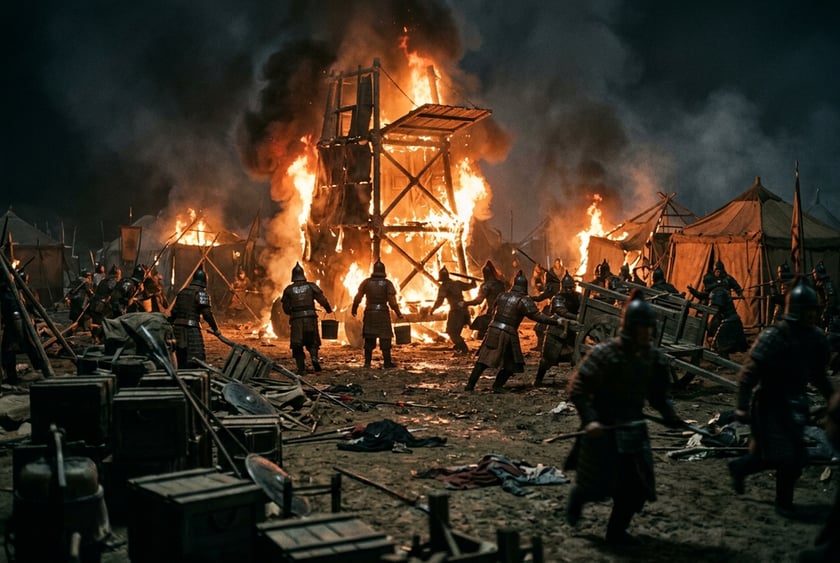
Zhou Yu had originally intended to engage Cao Ren directly with the Wu army's fresh momentum from victory and take the city at a stroke; but this approach put everything on a single point. Gan Ning's proposal was to take Yiling first with three thousand elite troops — knocking out one "horn" of Cao Ren's flanking position — thereby allowing Wu's main force to concentrate on Jiangling. This type of split-axis strike was the mobile water-land operational mode at which the Wu army excelled: ship-transported elite troops make a sudden appearance at some upstream point, disembark, and seize the city before the adversary can respond. Cao Ren's deployment was a classic emergency response: upon learning of the assault on Yiling he immediately dispatched Cao Chun and Niu Jin to secretly reinforce Cao Hong, and had Cao Hong first come out of the city to lure the enemy, converting "losing the city" into "lure and annihilate."
Critical Decision Points
Victory and defeat in this battle came in two phases. In the first phase, decision authority lay with Gan Ning — he successfully persuaded Zhou Yu to abandon the simple plan of attacking Jiangling frontally and adopt the progressive plan of detaching a force to seize Yiling. The core judgment of this decision was: Cao Ren's flanking position depended on Yiling's existence to be effective; once Yiling was taken, Jiangling would be degraded from "two-point defense" to "isolated city defense." In the second phase, decision authority lay with Cao Ren — rather than holding Jiangling without moving, he proactively dispatched elite troops to reinforce Yiling, dragging the Wu army's originally successful surprise into an encirclement situation. Cao Hong lured the battle for over twenty exchanges before fleeing; Gan Ning seized the city in the follow-through. But by dusk Cao Chun and Niu Jin's relief forces had arrived, and the two converging columns encircled Yiling. This meant that Gan Ning found himself in the dangerous position of being encircled almost immediately after taking the city in a single fight, with the dividends of the surprise lasting less than a day.
Outcome and Reverberations
At the tactical level Gan Ning accomplished his mission objective of "taking Yiling," but at the cost of trapping himself and hundreds of soldiers in an encirclement — this also became the direct prelude to Zhou Yu's subsequent adoption of Lv Meng's plan to personally lead his generals in a relief operation (see the event Ganningyilingrushou). At the strategic level, the capture of the city was the turning point that shifted the Battle of Jiangling from "unable to break through" to "continuously attriting Cao Ren": once Cao Ren was compelled to divert forces to rescue Yiling — and that rescue proved futile — the morale and provisions of the Jiangling garrison would rapidly deteriorate. Looking at the novel's narrative, this section is the first instance in the Battle of Jiangling in which Gan Ning appears as an independent tactical thinker, establishing the partnership relationship between him and Zhou Yu of "main commander and sharp-spear general," and pre-building the image for the subsequent series of sharp-spear narratives such as "the hundred cavalry that raided the Wei camp."
Counterfactual Analysis
Had Zhou Yu not heeded Gan Ning's advice and insisted on pressing the main force directly at Jiangling, the most probable outcome would be: Cao Ren holds, Yiling pins, Wu's logistics are stretched and subject to interception by Cao Chun and Niu Jin, with the Battle of Jiangling potentially dragging into the fifteenth year of Jian'an still unresolved. Conversely, had Cao Ren chosen to abandon Yiling and concentrate on defending Jiangling, the Wu forces could certainly have advanced faster, but Cao's forces would have retained more mobile infantry for counter-attacks. Cao Ren's choice of "two-point hold-to-the-death plus encircling relief forces" was the option capable of holding longest given the circumstances of the time; while Gan Ning's "strike the flank first" was the counter-move most capable of breaking the deadlock soonest. The outcome of the collision between these two was: the Wu army paid the price of Gan Ning being encircled and having to mount yet another relief operation, in exchange for the strategic effect of isolating Jiangling. This battle amply demonstrates that the true rhythm of Three Kingdoms siege warfare was not "breaking the city in a single day" but rather a repeated series of negotiations around "flanking positions and relief forces," in which the side that moved first was often not the winner but the critical variable that introduced the situation toward its final resolution.