Background
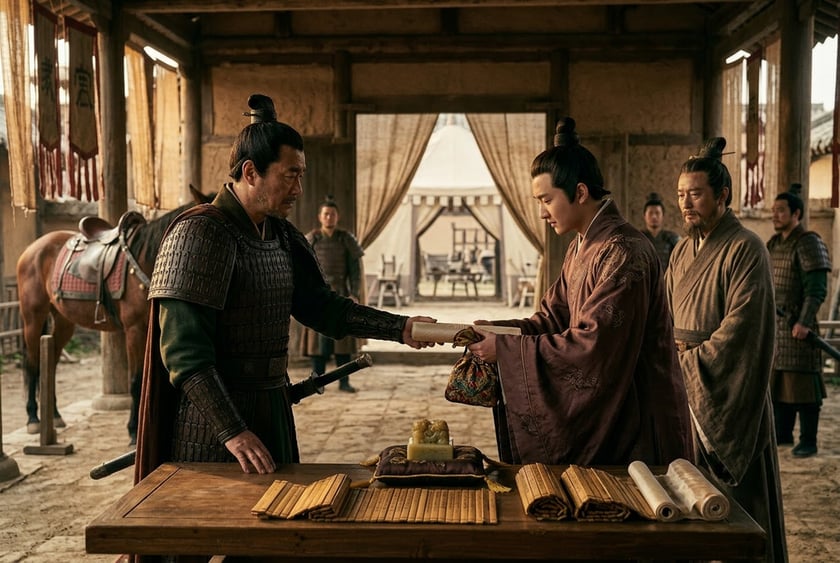
Jiejingzhou is one of the most repeatedly debated complex cases in Chinese traditional diplomatic history. To understand it, one must first break a common misconception: the "loan" was not Sun Quan handing the whole of Jingzhou — territory he already firmly controlled — to Liu Bei. Rather, what took shape after the Battle of Chibi was a "divided occupation and subsequent readjustment" arrangement between Sun and Liu over the fruits of their contest for the middle Yangtze. The actual territorial configuration after Chibi was as follows: Cao Cao withdrew to the Xiang–Fan line north of Jiangling; Sunwu controlled key points along the Yangtze including Jiangling (Nanjun), Xiakou, and Wuchang; Liu Bei swept swiftly southward to secure the four southern Jing commanderies — Wuling, Changsha, Guiyang, and Lingling — through independent military action. In other words, both Sun and Liu had already occupied their respective portions of the territory through their own efforts. When Zhou Yu died in Jian'an year fifteen (210), Lu Su took over the eastern command and proposed a strategic reorientation: transfer Jiangling — "Wu's most exposed forward position against Cao" — to Liu Bei to garrison, having Liu Bei shoulder the burden of facing Cao head-on, while Wu pulled its main forces back toward the Huai River front for offensives against Hefei. That is the true substance of the "loan" — a political deal in which a forward strongpoint was yielded in exchange for a division of strategic labor.
Principal Figures
On Sun Quan's side the core decision-maker was Lu Su. From his celebrated bedside strategic counsel onward, he had consistently advocated for "establishing a foothold in Jiangdong, aligning with Liu Bei to resist Cao Cao" — a long-range plan that diverged sharply from Zhou Yu's strategic vision of "straddling Jing and Yi and contending for supremacy independently." On his deathbed Zhou Yu had reportedly proposed a scheme of "luring the tiger through the pass to kill it" — using an ostensible right of passage into Shu as a pretext to swallow Shu and in the process absorb Liu Bei's forces as well. This plan is elaborated dramatically in the novel, but its historical credibility has been questioned in the Pei Commentary. After Zhou Yu's death Lu Su succeeded him, and Sun Quan's choice to support Lu Su's cooperative strategy was itself a major reorientation of Wu's strategic direction. On Liu Bei's side the core decision-maker was Zhuge Liang. The central principle of the Longzhong plan was to "straddle Jing and Yi"; Jiejingzhou provided the most critical springboard for that strategy — without Jiangling as a base, Liu Bei could never have set out from Gong'an in 212 to campaign westward into Yizhou. Lu Su made multiple subsequent journeys north as envoy to "demand the return of Jingzhou" — Wu's repeated probing of the internal boundary of the alliance. The original kernel of the "single-blade banquet" episode in the novel derives from these missions. Lv Fan's role in all of this was as one of the architects of the proposal to marry Sun Quan's sister to Liu Bei — reflecting Wu's attempt to penetrate Liu Bei's circle not only through land but also through matrimonial channels.
Core Issue
The core issue of this event is how the internal boundary of an alliance is to be drawn. The Sun–Liu alliance reached its peak of trust at the Battle of Chibi but immediately afterward confronted a fundamental question: how are the fruits of victory to be divided? Alliances in the San Guo period were never based on shared values; they were based on common threats. The moment the common threat receded — as Cao Cao withdrew north — resource allocation within the alliance at once became the new source of conflict. Lu Su's "loan" was a highly creative piece of political engineering: by yielding a forward position in exchange for a division of labor, he extended by at least five years an alliance that might otherwise have shattered immediately. The design had three layers of sophistication. First, it maintained externally the united front of joint resistance to Cao Cao. Second, it internally preserved Wu's voice through a "land-as-debt" relational structure — "your territory is borrowed; I can ask for it back at any time." Third, it assigned the greatest military burden to Liu Bei, buying Wu time to open up the eastern front. But the design also had a structural fragility: the moment Liu Bei grew powerful enough in the west to lose the will to recognize the "loan," the entire arrangement would collapse instantly. This is precisely the underlying logic behind the Xiangshui partition of 215 and the catastrophe of Guan Yu's defeat and death in 219.
Political Consequences
The most immediate consequence was that the Sun–Liu alliance maintained a "honeymoon of cooperation" from 210 to 215: Sun Quan was free to concentrate on driving north against Hefei (the Battle of Hefei, 215) and subduing the mountain peoples of Shanyue (intermittently from 210 to 215), while Liu Bei moved west from Gong'an to take Yizhou (211–214) and then north to seize Hanzhong (217–219). The second-order consequence was a significant erosion of Wu's strategic position: lending Jiangling meant that Wu surrendered direct military control over the middle Yangtze — a strategic disadvantage only partially corrected in 215 by the Xiangshui partition, which established "Sun and Liu each taking half of Jingzhou," yet the fundamental situation remained unchanged. The third-order consequence was structural pathology within the "debt-backed alliance": Wu consistently treated Jiangling as a debt claim; Liu Bei's side increasingly regarded it as territory already possessed by right. This cognitive misalignment erupted in concentrated form in 219 — Sun Quan resolved to take back Jiangling; Lv Meng crossed the river in white robes with Lvmengbaiyidujiang and killed Guan Yu, tearing the alliance to shreds. The fourth-order geopolitical consequence in the long term: the division of Jingzhou between Sun and Liu was definitively broken, and Sunwu re-monopolized the middle and lower Yangtze — but it lost Liu Bei as a northern buffer and was thenceforth consigned to a posture of strategic defense along the Jiangnan, unable to push north — which is precisely why Sunwu could never achieve northward expansion.
Counterfactual Analysis
Suppose Lu Su had never proposed the "loan" and Sun Quan had insisted on holding Jiangling himself — what would have followed? The most likely short-term projection is that the Sun–Liu alliance would have collapsed rapidly between 210 and 212, leaving Liu Bei unable to advance westward into Shu (lacking the support of a Jiangling base), probably forced to remain cramped in Gong'an and the four southern Jing commanderies, and ultimately squeezed into irrelevance by pressure from Cao Cao and Sun Quan on both flanks. Under this scenario the San Guo configuration might never have taken shape at all — Shuhan would never have been founded, and history might have reverted to a bipolar standoff between Wei and Wu. A deeper line of counterfactual runs as follows: had Sun Quan, while lending Jiangling, insisted that Liu Bei acknowledge in writing that "Jiangling remains sovereign Wu territory and Liu Bei is merely its trustee-administrator," then the Xiangshui partition of 215 would not have been a "partition" but a "transfer" — Wu might have recovered Jiangling much earlier without resort to arms, and the tragedies of Guanyubeifa and Lvmengbaiyidujiang might have been avoidable. The lesson is that the greatest political hazard of Jiejingzhou was not the loan itself but Wu's failure to formalize the "debt-claim relationship" in institutionalized terms — a classic case, still of scholarly relevance today, of the boundary between "oral pact" and "written covenant" in Chinese traditional diplomacy.