Background
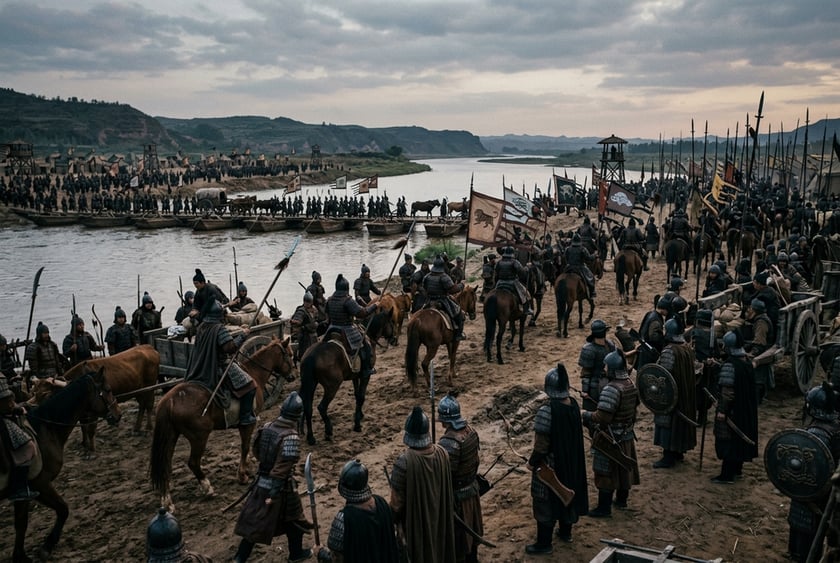
Viewed through the lens of modern political history, "Liubeiruzhuidongwu" — Liu Bei's marriage into the house of Wu — was the first head-on clash within the Sun-Liu alliance over the distribution of the "victory dividend" following the Battle of Chibi. The fire attack at Chibi burned Cao Cao's naval forces, but the fruits of that victory — above all, the seven commanderies of Jingzhou — immediately became a focal point of contention inside the alliance. Sun Quan's side argued that Zhou Yu had fought and suffered for the win, so Jingzhou should belong to Wu; Liu Bei's side had preemptively taken the four southern Jingzhou commanderies by invoking his title of "Imperial Uncle," and held Gongan under the pretext of "borrowing" Nanjun. Zhou Yu was deeply dissatisfied and presented Sun Quan with the "Beauty Trap" — using Sun Quan's sister to lure Liu Bei into marrying into Wu, confining him as a hostage in exchange for Jingzhou [c:16321]. This design rested on two assumptions: first, that Liu Bei was widowed and in need of a new political marriage; and second, that Liu Bei would be seduced by the wealth and comfort of Jiangdong and drift away from Zhuge Liang, Guan Yu, and Zhang Fei [c:16330]. From a game-theory standpoint this was Zhou Yu's "reconnaissance probe" of Liu Bei's character — he did not expect the scheme to necessarily succeed, but hoped to gauge from Liu Bei's reaction whether the man had the will to break free.
Key Figures
The structure of key figures in this event is fascinating: on the surface it is a "Sun-Liu marriage alliance," but in substance it is a "four-way game." The first party is the "seize-Jingzhou faction" led by Zhou Yu, Lv Fan, and Zhang Zhao [c:16322][c:16330]; the second is the "counter-scheme faction" led by Zhuge Liang, who equipped Zhao Yun with three sealed packets of instructions so that Liu Bei would act proactively rather than passively [c:16323]; the third is the "family faction" led by Wu Guotai and Qiao Guolao, who used family honor to defeat Sun Quan's political calculation [c:16324][c:16326]; the fourth is "Sun Furen herself" — a woman of fully independent character who ultimately became neither a political sacrifice nor a subordinate, but forged a brief yet genuine alliance with Liu Bei. Zhuge Liang's brilliance lay in identifying every variable and converting Liu Bei's "personal entry into Nanxu" into a centrifugal force within the opposing camp — the moment Liu Bei set foot in Nanxu, Wu Guotai and Qiao Guolao would be activated to exercise matriarchal checks on Sun Quan, neutralizing Zhou Yu's scheme-within-a-scheme before it could operate.
Core Issues
On the surface the issue was "the marriage alliance"; at a deeper level it was "the boundary conditions for Jingzhou sovereignty and the continuation of the Sun-Liu alliance." Had Zhou Yu's scheme succeeded, the Sun-Liu alliance would have been downgraded from a structure of equals to a "quasi-tributary structure" under Wu supremacy — Liu Bei as hostage, Jingzhou surrendered as "ransom," Shuhan's foundation cut off at the very moment after Chibi [c:16321]. Zhuge Liang's counter-scheme achieved a three-birds-one-stone effect: first, it made Sun Furen's marriage to Liu Bei a fait accompli, leaving Sun Quan no room to use her as a political bargaining chip; second, it secured tacit endorsement from Wu Guotai's personal meeting with Liu Bei at the level of the Jiangdong family [c:16325]; third, it converted Sun Furen herself into a political bridge between Jingzhou and Eastern Wu, transforming latent hostility into routine diplomacy. The sophistication with which this issue was handled meant that the first direct collision between Sun and Liu after Chibi did not fracture the alliance — it was in fact reinforced by the "in-laws" relationship.
Political Consequences
The most immediate consequence was Liu Bei's safe return with Sun Furen from Wu to Jingzhou [c:16331] — Sun Quan was transformed from "chief architect of the plot to seize Jingzhou" into "an elder brother outwitted," and from this point Zhou Yu's assessment of Liubeijituan shifted from "a manageable ally" to "an enemy that must be eliminated," laying the groundwork for his proposal the following year to "campaign west and take Shu" — during which expedition Zhou Yu died of illness at Baqiu, and Eastern Wu lost its most offensively capable commander. The medium-term consequence was that Sun Furen became an invisible diplomatic channel between Sun and Liu during the years she spent in Jingzhou; but because Sun Quan sent ships to take her back (the Romance is silent about this event in its details), that channel ultimately severed, indirectly marking a renewed tightening of Sun-Liu relations. The long-term consequence is that this contest of stratagems shaped the "diplomacy-kinship hybrid" template of Three Kingdoms political drama: political marriage was no longer viewed as a unilateral bargaining chip but as a channel through which both parties interpenetrated; Wei and Wu, Wu and Shuhan, would repeatedly use this model in exchanges that followed. In terms of institutional evolution, this also marked San Guo formally transitioning from the "multi-warlord melee phase" to the "tripartite stalemate phase" — the very capacity to manage disputes through diplomacy rather than pure military force was itself the sign that the three-legged structure had matured.
Counterfactual Analysis
Had Zhou Yu's Beauty Trap succeeded completely — Liu Bei confined, Sun Furen not truly wedded — Jingzhou might have been handed over to Sunwu in stages, Liu Bei would have lost his springboard for entering Sichuan, and the Longzhong strategy of "straddling Jingzhou and Yizhou" would have had no path forward. Had Wu Guotai not been alert and Sun Quan been free to orchestrate the whole marriage himself, Sun Furen would have been a pure political chess piece, recalled to Wu immediately after Liubeituowu, and the Sun-Liu alliance would have fractured far earlier [c:16324]. Had Zhuge Liang not prepared the sealed packets of instructions and left Liu Bei to handle matters on his own initiative, then given Liu Bei's personal character — "utterly bewitched by beauty, with no thought at all of returning to Jingzhou" [c:16330] — he very probably would have lingered in Nanxu and missed the opportunity to enter Sichuan the following year. The true significance of this event lies in the fact that it was the first time Zhuge Liang intervened in alliance-level strategic competition through "remote management," demonstrating that the value of a strategist lies not only in battlefield calculation but in simultaneously grasping the parallel layers of human psychology, family structure, and institutional dynamics.