Background
At the strategic level, the "Jiejingzhou" arrangement of the fifteenth year of Jian'an (210) was the last convulsion of the collapsing framework of Sunwu's "loan" of Jingzhou. After Chibi, Sunwu had lent Nanjun to Liu Bei, intending for Liu Bei to draw Cao Cao's military pressure on the north bank of the Yangtze; but once Liu Bei established a firm foothold, cultivated good relations with Liu Zhang's side, and began to display independent strategic intentions, Sunwu quickly realized it had lent away not a single city but an entire strategic depth. Zhou Yu's real anxiety was not whether Jingzhou would return to Wu, but whether the Liubeijituan would use Jingzhou as a springboard to seize Yizhou for itself — which would utterly transform the balance of the realm and reduce Sunwu to the weakest of the three poles. This anxiety was reasonable, but the solution he chose — disguising a plan to assassinate Liu Bei under the pretext of "taking the western region on his behalf" — was strategically overcomplicated and revealed too openly the suspicion toward an ally.
Key Figures
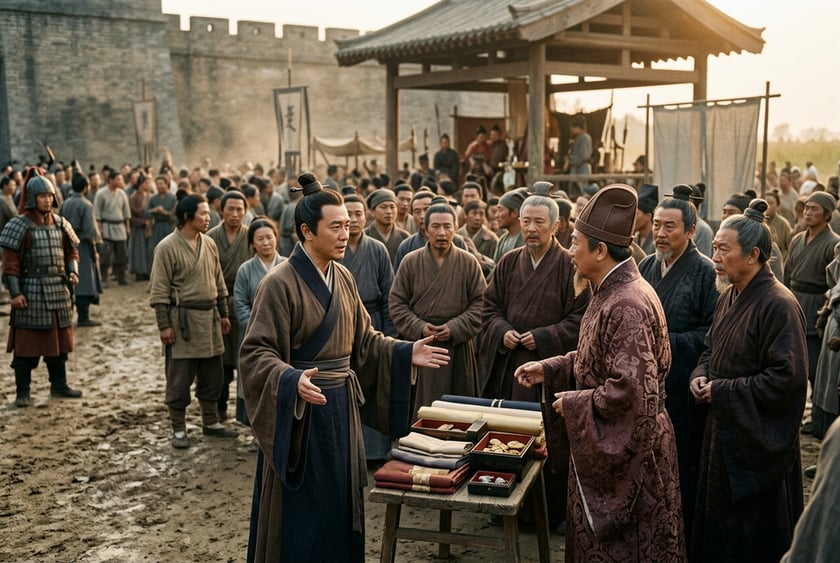
In this episode Zhou Yu played the combined role of planner and executor. He was strikingly candid with Lu Su in laying out his intentions: "I use this only as a pretext; in reality I intend to go and take Jingzhou" — a habit of revealing strategic intent in full to a third party that reflects both his great confidence in his own schemes and a certain unease about Lu Su's execution capabilities. Zhuge Liang's role is that of the passive party responding proactively: through Lu Su's two round trips he saw through the scheme immediately, and through "outwardly agreeing while covertly deploying" he countered it without a ripple. Lu Su in this incident functions as a go-between exploited by both sides — sincerely hoping the Sun-Liu alliance would endure, he was used by Zhou Yu to carry a message and then smoothly disarmed by Kongming's apparent compliance, ending up as a mere conduit for the back-and-forth between the two powers. The climax of this counter-move came when Zhao Yun, from the city tower, declared directly: "Kongming the military counselor already knows the Commander's stratagem of 'Jiejingzhou'" — puncturing Zhou Yu's cover to his face.
Central Issue
This event touches on a core question of the late Han and San Guo period: in a three-way strategic contest, how can suspicion between allies coexist with strategic cooperation? Zhou Yu's logic was "strike first" — while Liu Bei had not yet truly grown strong and while the alliance ties had not yet been undone, eliminate the latent threat through a carefully packaged surprise attack. Zhuge Liang's logic was "maintain the surface, quietly reinforce the core" — neither rupturing the alliance nor being constrained by it, demonstrating through the deployment of four columns of troops that Liu Bei's side was prepared for any attack. Both logics had their merits, but the outcome was a complete defeat for Zhou Yu's side: he not only failed to retake Jingzhou but exposed Sunwu's true hostility toward Liu Bei, driving the Sun-Liu alliance into a fragile phase of mutual wariness from that point on.
Political Consequences
The most immediate consequence was Zhou Yu's arrow wound reopening and his fall from his horse causing a severe relapse, directly leading to his death from illness while en route to Baqiu. This physical consequence was almost simultaneous with the strategic one: Sunwu lost its most aggressively forward-looking commander; the successor Lu Su's line turned clearly toward "cooperating with Liu Bei to resist Cao Cao together"; Sunwu's obsession with Jingzhou was suppressed for nearly nine years, until Lvmengbaiyidujiang unleashed it in an explosive torrent. For Liu Bei's side, this episode not only secured Jingzhou but also bought the critical time window for entry into Shu — barely one year later (211), Liu Bei entered Shu at Liu Zhang's invitation, beginning his strategic advance to take Yizhou. Viewed over a longer arc, although Zhou Yu's "Jiejingzhou" scheme failed, it exposed Sunwu's underlying hostility toward Jingzhou too early, and it planted a deep-rooted vigilance in Shuhan toward Sunwu from that point forward.
Counterfactual
If Zhou Yu's scheme had not been seen through by Zhuge Liang, what would have happened? The most likely scenario: Wu forces, once inside the territory, would have attempted but failed to assassinate Liu Bei at Jingzhou's walls, yet the two sides would already have broken openly; Sun and Liu would immediately have entered a state of war, and Cao Cao could have profited from the north. From this perspective, Zhuge Liang's counter-move not only saved Liu Bei but indirectly preserved the stability of the San Guo balance of power. Conversely, if Zhou Yu had never proposed this scheme and instead accepted Lu Su's line of continuing to lend Jingzhou to Liu Bei — would Sunwu have lost Jingzhou even sooner? History's answer is no: under Lu Su's line, Sunwu in fact maintained a relatively stable internal and external equilibrium between 209 and 219. This case illustrates that in strategy, "rushing to resolve a problem" is sometimes costlier than "temporarily tolerating the problem" — Zhou Yu's brilliance and urgency became, in this operation, his fatal flaw.