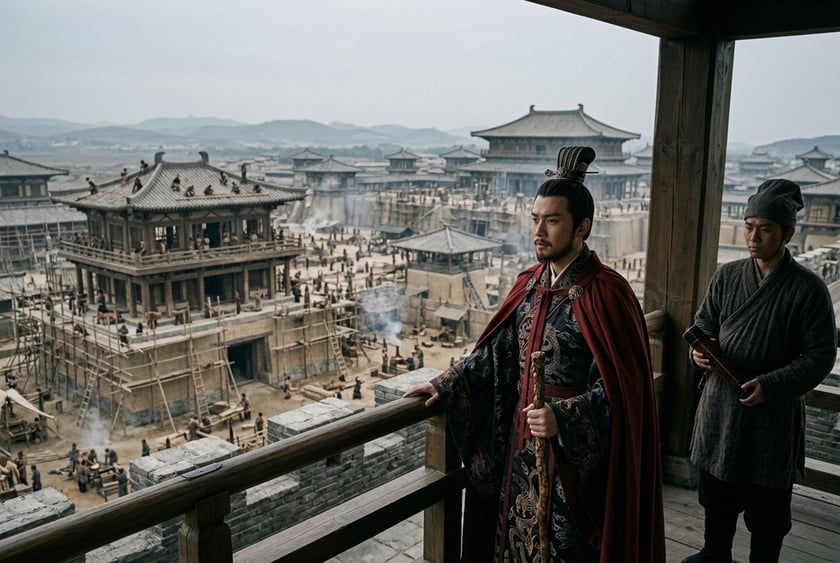
Background
The elevation to King in the twenty-first year of Jian'an was the second-to-last step in Cao Cao's "five-step process of replacing Han" — enfeoffment as Duke, conferral of the nine regalia, and establishment of the Wei kingdom had already been completed; the next step was acceptance of the abdication. In terms of strategic timing, this was the year Cao Cao had just finished contesting Hanzhong (though full-scale confrontation with Liu Bei over Hanzhong did not come until the following year), the north had been highly integrated, and the greatest external threat was the Sun-Liu alliance. The most serious internal voices of opposition — Xun Yu, Xun You, and the faction of aristocratic clans loyal to the Han dynasty — had been gradually absorbed in the preceding two years. In the Romance's narrative, two rounds of discussion preceded the elevation to King: in the first, Wang Can, Du Xi, and two others proposed honoring Cao Cao as King of Wei, but were blocked by Palace Secretary Xun You and the matter was shelved; Xun You fell ill from depression and frustration, dying within ten-some days, and the "abandonment of the King of Wei proposal" was thus only superficial — in reality, the last obstacle to restarting the agenda had been cleared. This pattern of "the agenda passing smoothly after the opponent's death" — from Xun Yu's death to Xun You's death and then Cui Yan's death — constitutes the typical path of Cao Cao's political purges in his later years.
Principal Figures
Cao Cao was both the designer and the beneficiary of this elevation to King. He was required on the surface to "feign three refusals by memorial" — three refusals before acceptance was the standard Han ritual of extreme self-restraint by a subject, designed to inscribe "passive reception" into the ceremonial procedure, avoiding the accusation of active usurpation. Zhong Yao, as the core executor of the edict drafting, was the key operational figure in the documentary dimension of this ceremony; having long followed Cao Cao and being versed in Han precedents, he was able to package the act of "elevation to King" — which broke the Han ancestral injunction that "no one not of the Liu surname shall be a King" — as a reasonable arrangement conforming to the precedents set by the Duke of Yi and the Duke of Zhou. Cui Yan is the most tragically colored figure in the political purges surrounding the elevation to King — he had originally served as Eastern Aide, and during discussions of the heir consistently upheld "the Spring and Autumn principle of establishing the eldest legitimate son," supporting Cao Pi; but he was subsequently accused of "harboring hidden resentment" and put to death. The Romance lists Cui Yan's death as a sub-event of this episode, highlighting the bloody price behind the elevation ceremony. The designation of Cao Pi as heir was an internal power arrangement conducted simultaneously with the elevation to King, pushed forward by Jia Xu, Huan Jie, and others, and ultimately established Cao Pi's status as successor.
Core Issues
The substantive content of the elevation to King went one step further than the enfeoffment as Duke. First was the complete breakthrough at the level of title — Emperor Gaozu of Han's White Horse Oath, "whoever is not of the Liu surname and becomes a king, let all under Heaven strike him down," was the two-hundred-year political injunction of the Han dynasty; for Cao Cao, of a different surname, to be elevated to King was in effect a public declaration that this injunction had lapsed and that the ritual bottom line of the Han dynasty had been completely broken. Second was the comprehensive usurpation at the ritual level — "twelve-tassel crown, riding in the golden-root carriage, drawn by six horses, using the Son of Heaven's carriage, garments, and processional insignia, with clearances issued at departure and arrival" — this entire panoply was identical to that of the Han Son of Heaven, placing Cao Cao alongside Emperor Xian at the visual and ceremonial level. Third was the further independence of regime operation: the establishment of the Wei royal palace elevated Yecheng from an ordinary vassal capital to the de facto political center, while the Han court at Xu Chang retreated to the status of a merely formal institution. Fourth — and the greatest difference from the enfeoffment as Duke phase — was the designation of an heir: simultaneously with the elevation to King came deliberation on the heir designate, meaning that the power succession mechanism of the Caowei faction had begun to formally operate — a core issue that any regime aspiring to replace Han had to resolve.
Political Consequences
After the elevation to King, the Caowei faction entered "the final waiting period before replacing Han." Every institutional pathway had been laid: the Wei kingdom had an independent bureaucratic system, an independent royal palace, an independent heir designate, and independent ritual specifications; Emperor Xian was completely sidelined, with even the right to observe mourning subject to the Caowei faction's wishes. In the four years from Jian'an twenty-one to twenty-five, Cao Cao made no further move to declare himself emperor; outside observers speculated on two levels of reason: first, Sun Quan's "suggestion that Cao Cao declare himself emperor" was rejected by Cao Cao with the taunt that "this boy wants to push me into the furnace," since Cao Cao well understood the extremely high political cost of declaring emperorship; second, in these four years the external military situation remained tense — Guan Yu's flooding of the seven armies and the siege of Xiangfan even led Cao Cao at one point to consider moving the capital to avoid the threat. So the final step of replacing Han was deferred for Cao Pi to complete. As for the contest over the heir, Cao Pi was formally confirmed in his position after the elevation to King, while the Cao Zhi faction (Yang Xiu, Ding Yi, Ding Yi the younger) progressively fell from favor — this integration of power avoided a succession crisis after Cao Cao's death and provided the organizational guarantee for Cao Pi's swift completion of the Han replacement in 220.
Counterfactual Analysis
If Cao Cao had immediately declared himself emperor after the elevation to King, the political backlash he might have faced would have far exceeded what he could have absorbed during his lifetime — Sun Quan and Liu Bei would have immediately united in a northern campaign in the name of "suppressing the Cao clan's usurpation of Han," and the internal forces of opposition (though suppressed, never fully eliminated) would also have seized the opportunity to reorganize. Cao Cao's choice to "become King but not declare himself emperor" was a precise calculation of his remaining store of political capital. If the outcome of the heir contest had been Cao Zhi rather than Cao Pi, the entire process of the Caowei replacement of Han would have been quite different: Cao Zhi's temperament was closer to that of a man of letters, lacking Cao Pi's cold and hard-nosed political skill; the abdication ritual might have been more elegant but execution might have been insufficient, and the early stability of the Caowei regime would also have been affected. In other words, the two decisions of the twenty-first year of Jian'an — elevation to King and designation of the heir — in effect simultaneously locked in both the political form and the executor of the Caowei replacement of Han, making this the most important composite decision of Cao Cao's later years.