Background
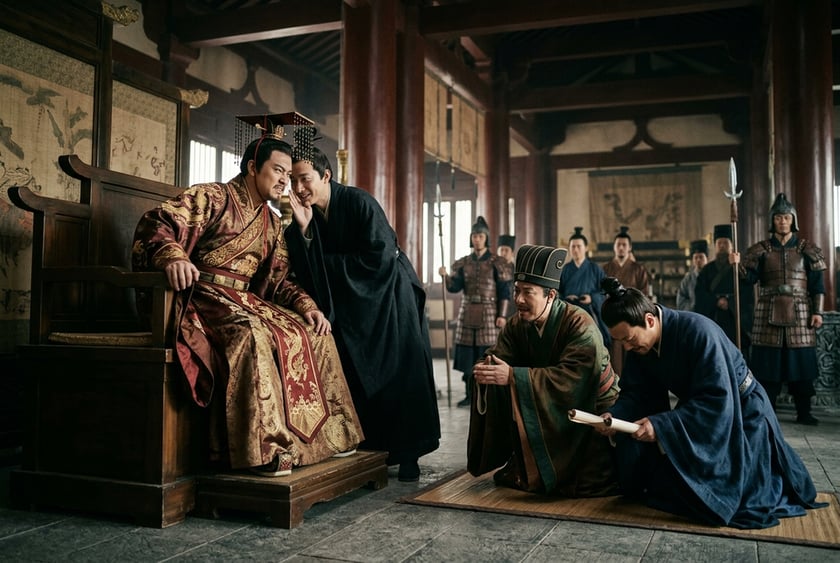
This episode comes from Chapter 68 of the Romance of the Three Kingdoms and is set in the twenty-first year of Jian'an. By this time Cao Cao had long since risen from Marquis of Wei to Chancellor, received the nine gifts of honor, and established the state of Wei — the next step was the higher title of "King of Wei," a move that would represent the critical legitimacy upgrade by which the Cao clan would transition from "the court of the Han" to "an independent kingdom." After Cao Cao returned to the capital at Ye from campaigning, civil and military officials jointly proposed advancing Cao Cao to King of Wei; Cui Yan, as a Secretary of State, publicly opposed this on the court floor, which provoked those at odds with him to file reports against him to Cao Cao, and he was ultimately imprisoned and beaten to death. Though this narrative occupies only a small section in the novel, it is a concentrated sample for observing the political atmosphere of Caowei on the eve of the replacement of Han.
Key Figures
Cui Yan, courtesy name Jigui, was from Dongwucheng in Qinghe Commandery — a distinguished student of the late Han renowned Confucian Zheng Xuan, he had served under Yuan Shao as a Senior Aide, and after Yuan Shao's defeat joined Cao Cao, being entrusted with offices such as East Cao Aide and Secretary of State, long responsible for talent selection. He was known for his manner of "stern rectitude with imposing dignity"; Cao Cao treated him with exceptional courtesy, and even the young Cao Pi would compose himself in Cui Yan's presence out of respect for his bearing. Cao Cao is the initiator of this purge, and in this section of the novel he is presented as a ruler who "can no longer tolerate dissent within his advisory corps." The intermediary who triggered the event was "someone at odds with Cui Yan" — the novel does not name him, but historical records indicate it was actually Ding Yi, the core figure of the Cao Zhi faction, who used Cui Yan's public opposition to file a frame-up report, transforming Cui Yan from "a man of integrity treated with exceptional courtesy" into "a criminal slandering the King of Wei."
Central Issues
The central issue of this affair is "the cost of a counselor's dissent at the critical moment of a power upgrade." What Cao Cao wanted was not for everyone to agree to his becoming king, but for no one to dare publicly voice doubts in court — this is the standard move on every eve of supplanting a dynasty. What Cui Yan opposed was not Cao Cao's accomplishments, but this specific step of the royal enfeoffment — as a Confucian scholar he maintained his own boundary as to what "minister of the Han house" meant. But at this kind of critical node, any attitude of "not wholehearted support" would be read by opponents as "opposition," and reports would flood to the ruler like snowflakes. Cui Yan's words "change will surely come" were intended as a rebuke of those who curried favor by riding the winds of change, but the informants deliberately extracted them from context and reframed them as "cursing the King of Wei," instantly converting contextual irony into substantive treasonous speech. This mechanism of "context — accusation" conversion was the most common tool in the political purges of the late Han.
Political Consequences
The direct consequences of Cui Yan's death operated on three levels. First, the "pure-stream rhetoric" within the Caowei advisory corps was suppressed in one stroke — Xun Yu had died some years earlier; now Cui Yan died; beside Cao Cao there remained no Confucian scholar who dared publicly raise the ethics of the Han house; this cleared the rhetorical obstacles for his elevation to King of Wei and for Cao Pi's later replacement of Han. Second, Ding Yi and other members of the Cao Zhi faction scored merit through the denunciation and strengthened their standing in Cao Cao's eyes, adding fuel to the Cao Zhi succession movement and indirectly catalyzing the later struggle over who would be heir. Third, the event itself became a recognized miscarriage of justice within Caowei — Chen Shou in the San Guozhi explicitly wrote that "at the time Cao Cao was suspicious of and dealt harshly with a great many people; of all of them only Cui Yan is most mourned and regarded as wronged to this day" — showing that Caowei internally never truly completed the political digestion of this execution.
Counterfactual Analysis
The counterfactual can be examined on two levels. First, if Cui Yan had maintained silence during the court deliberation, would he have lived out his years? Given the psychology of the Ding Yi faction — "we must score merit at the moment of the royal-elevation milestone" — Cui Yan would very likely have been entrapped on some other charge even if he had stayed silent. So long as he existed as the symbolic representative of the pure-stream faction, his very silence was a political signal. Second, if Cao Cao had not executed Cui Yan, what would have happened? The most likely result is that the process of enfeoffment as King of Wei would have been delayed or carried a higher rhetorical cost, but this would not have changed the great tide of Caowei replacing Han — what Cao Cao needed was not the support of any specific minister, but for the entire court's mode of "assent without dissent" to be locked in place. Cui Yan's personal tragedy lay in his unwillingness to betray the inner standard of a Han Confucian official, while being situated within a political structure that admitted no ambiguity — this kind of "unable to satisfy both extremes" tragic figure was in fact not unique to Cui Yan in the process of the Han-Wei dynastic transition, but he was written with the greatest tragic form because his death was the earliest to signal "in what manner Caowei's Confucian ministers would be sacrificed."