Background
This event is both an extension of the parent event "Caocaohongzanggaoling" and the final step in the political process of Caopidaihan. In the first month of the twenty-fifth year of Jian'an (220), Cao Cao died in Luoyang. Cao Pi succeeded him in Ye as King of Wei, Chancellor, and Governor of Jizhou, taking command of the entire military-political apparatus his father had built. Throughout that spring and summer, Cao Pi completed all the groundwork for "a powerful-minister clan completing a generational transition within itself" in under a year — rapidly consolidating control of the imperial clan (granting death to Cao Zhang's rivals and suppressing Cao Zhi), absorbing his father's legacy (veteran ministers such as Jia Xu and Hua Xin continued at court), and reinforcing the political legitimacy of his status as eldest legitimate heir. By the tenth month of the first year of Yankang, the abdication ceremony was complete. Cao Pi formally ascended the imperial throne at the Shouchantai outside Xu Chang.
Key Figures
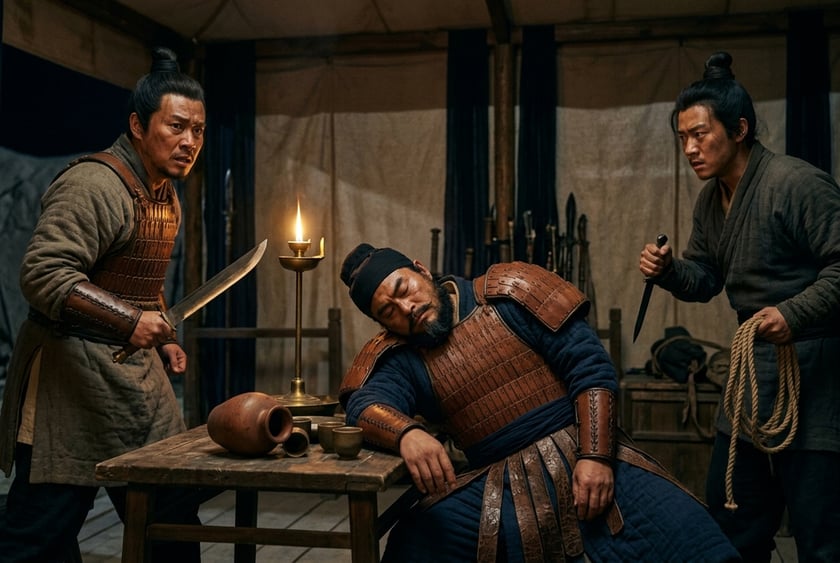
Cao Pi himself is the center of the event. On the day of his enthronement, "a sudden strange wind arose on the platform and all the torches were extinguished," causing him to collapse on the platform and not recover for some time, leaving him unable to hold court for several days. [c:16975] This account — however much the romance embellished it — reflects the sense of tension in public opinion around the abdication ceremony. Hua Xin and Wang Lang, as the chief architects of the abdication procedure, were enfeoffed as Minister of Works and Minister over the Masses respectively, completing the personnel arrangement of the new dynasty's Three Excellencies. Jia Xu, as the man whose pivotal advice — "think of Yuan Bendi and Liu Jingsheng's sons" — had been decisive in establishing Cao Pi's succession, received the highest-grade political reward of Grand Commandant. Liu Xie, now enfeoffed as Duke of Shanyang and maintaining Han dynastic observances at Shanyang, was transformed in image from "the one who was overthrown" to "the one who retired voluntarily." This stable identity for him was equally important to the new dynasty's legitimacy.
Core Issues
The first issue was the relocation of the new dynasty's political center. After declaring himself emperor, Cao Pi immediately grew suspicious that the palaces of Xu Chang were "full of inauspicious occurrences" and moved from Xu Chang to Luoyang, undertaking extensive palace construction there. [c:16975] This was a symbolic severance from his father's era of "holding the emperor to command the lords," in which Xu Chang had been the center of power. The return to Luoyang was both a political gesture of restoring the Eastern Han capital and a decisive act of "pulling the new dynasty out of the Cao Cao system" to rewrite its spatial narrative. The second issue was the configuration of the new dynasty's core personnel. The Three Excellencies, centered on Hua Xin, Wang Lang, and Jia Xu, with Chen Qun, Sima Yi, and other secondary officials forming the Chancellery system, produced the archetypal early Caowei structure of "veteran ministers stabilizing court order, imperial clan controlling military power." The third issue was the strange omen and legitimacy. The strange wind and extinguished torches on the day of the ceremony were amplified by the romance into a metaphor of "heaven withholding its blessing," and Cao Pi spent the Huangchu years addressing this rhetorical wound through increasingly elaborate sacrifices and auspicious-omen events.
Political Consequences
First: Wei entered the "Cao Pi mode" — legitimacy sourced from the abdication procedure, political center at Luoyang the old Eastern Han capital, the Three Excellencies and Nine Ministers as the ritual shell, and the Chancellery/Secretariat as the actual nerve center. This institutional design was essentially inherited by Jin, Song, Qi, Liang, Chen, and the Northern dynasties. Second: Cao Pi's move to Luoyang and his ambitious palace-building program opened a political trajectory that persisted throughout Caowei — both Cao Pi and Cao Rui devoted enormous national resources to Luoyang's palaces, reinforcing the symbols of imperial power while overtaxing the treasury. Third: this event, as the political continuation of "Caocaohongzanggaoling," completed the Cao clan's identity shift from "Han ministers" to "founders of a dynasty." The compressed tempo — succeeding to power in the year of a father's mourning, then replacing Han in the very same year — gave Cao Pi a more tightly packed opening than any other abdication successor in history, which is also the objective condition that allowed him to drive a series of institutional reforms within a reign of only seven years.
Counterfactual Analysis
Had Cao Pi, after the strange-wind omen on the day of his enthronement, still insisted on remaining in Xu Chang rather than moving to Luoyang, the new dynasty would have retained far more traces of "powerful-minister succession" — keeping Xu Chang as the capital would mean the political space remained embedded in the old narrative of "holding the emperor," and the visual and ritual autonomy of imperial power would have been diminished. History has him choosing a rapid return to Luoyang and ambitious palace construction; the cost was the premature exhaustion of popular labor and finances. A second counterfactual: had Cao Pi after his enthronement deliberately postponed the abdication ceremony by several years, using more patient auspicious-omen propaganda and border pacification as preparation — this path might have reduced public skepticism, but it conflicts with Cao Pi's political temperament of urgency to establish himself as a founding emperor, and history did not take this road.