Strategic Background
In the spring of 184 (the first year of Zhongping), Zhang Jue organized hundreds of thousands of Taiping Dao followers to rise up simultaneously. Jizhou, Yingchuan, and Nanyang became the three main theaters of war. Jizhou was Zhang Jue’s base, the area around Julu was the birthplace of the Taiping Dao, and the Yellow Turban forces in Hebei were most concentrated there. The Eastern Han court responded by sending forces along separate routes: Lu Zhi was responsible for the northern front against Zhang Jue’s main force, while Huangfu Song and Zhu Jun were responsible for the Yingchuan front. The first chapter of Romance of the Three Kingdoms clearly sets out this arrangement: Lu Zhi surrounded Zhang Jue at Guangzong, while Zhang Liang and Zhang Bao faced off against Huangfu Song and Zhu Jun in Yingchuan. However, according to the Book of the Later Han, “Biography of Huangfu Song,” Zhang Liang actually remained in Hebei with Zhang Jue and was later killed by Huangfu Song at Guangzong. The novel placed him in Yingchuan to give the fighting on that front a sufficiently formidable opponent.
Guangzong lay in the area of present-day Wei County, Hebei, on the plains in the heart of Jizhou, with little defensible terrain. The Yellow Turban Army relied on its numbers and religious cohesion to hold the city, while the government forces had the advantage in organization and siege equipment. This determined the basic character of the campaign: victory would not come through decisive field combat, but through siege and counter-siege.
Deployment of the Two Sides
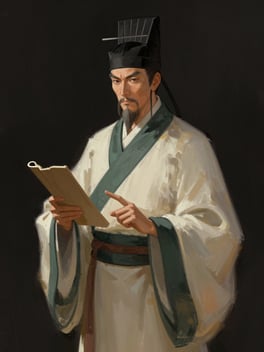
The novel gives Zhang Jue a force of 150,000 and Lu Zhi a force of 50,000, with the two sides locked in a stalemate at Guangzong; the Book of the Later Han gives no figures for either side’s forces. The “Biography of Lu Zhi” in the Book of the Later Han records that Lu Zhi first defeated Zhang Jue repeatedly in field battles, forcing him to retreat behind the defenses of Guangzong. Lu Zhi then built siege walls, dug trenches, and constructed scaling ladders in preparation for a full assault. The city was already close to falling.
Liu Bei’s role in the novel is something of an episodic interlude. He first fought under the command of the governor of You Province. After hearing that his teacher, Lu Zhi, was at Guangzong, he went to join him with five hundred men. Lu Zhi kept him at his tent, then gave him a thousand government troops and sent him to Yingchuan to make contact with Huangfu Song and Zhu Jun. The Records of the Three Kingdoms does not mention Liu Bei’s joining Lu Zhi. This was the novel’s way of weaving Liu Bei, Guan Yu, and Zhang Fei into the various theaters of war, while also using the teacher-student relationship to give Liu Bei an additional layer of orthodox legitimacy.
Key Decision Point
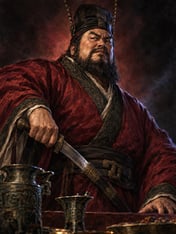
The most consequential decision in this campaign was made not on the battlefield, but at court. According to the “Biography of Lu Zhi” in the Book of the Later Han, the court sent a eunuch to the front to inspect military affairs. Someone advised Lu Zhi to offer him gifts, but Lu Zhi refused. After returning to the capital, the eunuch slandered Lu Zhi, claiming that he was holding his position without fighting and waiting for Heaven to punish the rebels. Emperor Ling flew into a rage, had Lu Zhi transported back under guard in a caged cart to face punishment, and appointed Dong Zhuo in his place. A siege that was nearing its conclusion thus saw a change of command midway through—a typical case of eunuchs meddling in military affairs in the late Eastern Han.
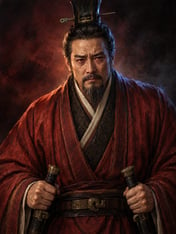
Dong Zhuo made no progress after taking over. The “Biography of Huangfu Song” in the Book of the Later Han says that Lu Zhi and Dong Zhuo both returned without success from their campaigns against Zhang Jue. The court therefore ordered Huangfu Song, who had already pacified Yingchuan and Dongjun, to move north. Huangfu Song’s choice of tactics was highly representative: Zhang Liang’s troops were tough, and a frontal assault could not defeat them, so Huangfu Song closed his camp and rested while observing the enemy. Once he noticed that the Yellow Turban Army had let down its guard, he reorganized his troops during the night and launched an attack at cockcrow, fighting until dusk. It was a strategy of waiting for the enemy to tire before striking decisively, taking up where Lu Zhi’s siege strategy had left off.
Outcome and Aftermath
According to the “Biography of Huangfu Song” in the Book of the Later Han, Huangfu Song routed the Yellow Turban forces at Guangzong and killed Zhang Liang. He took 30,000 heads, while about 50,000 people drowned themselves in the river, and more than 30,000 supply carts were burned. Zhang Jue had already died of illness. Huangfu Song had his coffin opened, mutilated the corpse, and sent the head to the capital. He later killed Zhang Bao at Xiaquyang, and the main Yellow Turban forces in Hebei were thereby broken. The court appointed Huangfu Song General of the Left Chariots and Cavalry and Governor of Jizhou. Lu Zhi was reinstated after Huangfu Song spoke in his defense.
This campaign also reflects two sides of Eastern Han rule. On the one hand, professional military men such as Huangfu Song, Zhu Jun, and Lu Zhi were still capable of suppressing an unprecedentedly large rebellion within a year. On the other, interference from eunuchs at the front and the court’s suspicions of its generals had already severely weakened the central government’s military capacity. Dong Zhuo’s defeat at Guangzong did not end his career. He continued to command troops in the fighting in Liang Province and, several years later, led his army into Luoyang, becoming a direct force in the collapse of the Eastern Han.
The novel’s treatment of this episode makes clear choices about what to include. In the latter half of the first chapter, Liu Bei encounters the caged cart carrying Lu Zhi while returning with his troops, and Dong Zhuo takes over. In the second chapter, a scout reports that Huangfu Song won seven battles in a row and killed Zhang Liang at Quyang, which differs from the historical account that places Zhang Liang’s death at Guangzong. The novel is concerned with how the three brothers witnessed the successes and failures of famous commanders across the land, not with the campaign at Guangzong itself.
Counterfactual
If Lu Zhi had not been replaced, Guangzong would probably have fallen by the summer or autumn of the first year of Zhongping. Zhang Jue might have been captured before he died of illness, and the northern campaign would have ended several months earlier. For the Han court, this would have meant fewer losses. But the more interesting question concerns personnel: if Lu Zhi had remained at court after earning the chief credit for defeating Zhang Jue, his reputation and forthright character might have given him a greater voice in the later events surrounding Dong Zhuo’s entry into the capital.
Conversely, if Huangfu Song had been in too much of a hurry at Guangzong and his assault had failed, the Yellow Turban forces in Hebei might have spread once more, forcing the court to devolve still more military authority to local officials. In fact, this trend did emerge several years later: in 188, the court adopted Liu Yan’s proposal to appoint provincial governors in some provinces. Local military and administrative power gradually concentrated in the hands of a small number of people, laying the groundwork for the warlords’ division of the realm. Victory at Guangzong merely delayed this process; it did not change its course.