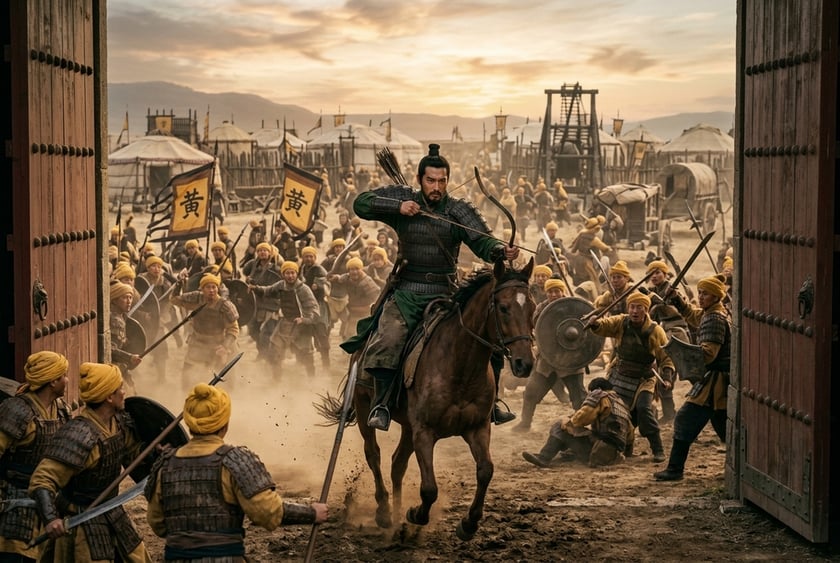
Strategic Background
In the first year of Chupíng the Guandong coalition rose against Dong Zhuo. Yuan Shao, the alliance's nominal leader, anchored himself at Henei while the various lords assembled along the Henan–Yingchuan line under the banner of "restoring the throne." In practice, however, few lords actually engaged Dong Zhuo's main forces in large-scale battle — Cao Cao had already been routed by Xu Rong at Xingyang, and most other lords stood idle on the outskirts of Luoyang. Sun Jian at this point held the title "General Who Crushes Bandits, acting Inspector of Yuzhou," appointed by Yuan Shu. Advancing north from Nanyang along the Luyang–Liangxian–Yangren axis, he was one of the few lords who actually pressed close to Luoyang and took the offensive. To counter Sun Jian's rapid advance, Dong Zhuo first sent Xu Rong to strike and scatter Sun Jian at Liangdong, then appointed Hu Zhen as Supreme Protector and Lv Bu as Cavalry Commander, leading tens of thousands of troops to close in on Yangren with the aim of annihilating Sun Jian's force in a single blow.
Dispositions of Both Sides
Sun Jian's forces were vastly outnumbered by Dong Zhuo's army, but they were his own elite core troops — veterans who had campaigned with him for years, including Cheng Pu, Huang Gai, Han Dang, and Zu Mao — well-organized and fighting with high morale. On Dong Zhuo's side, Hu Zhen was a military pedigree figure from Liangzhou; Lv Bu was a ferocious cavalryman from Bingzhou who had only recently switched sides. The two men had no mutual trust, no coordination, and yet near-equal status. Before the campaign even set out Hu Zhen was already boasting that he would "behead the holders of green sashes and impose military discipline" — remarks interpreted as aimed at Lv Bu. Lv Bu in turn was passive and deliberately undermining morale. Dong Zhuo handed an army several times the size of the enemy's to two commanders who actively disliked each other: this was the fatal flaw embedded in the entire battle from the moment of its strategic planning.
Key Decision Points
The pivotal node of the battle was Sun Jian's assessment and exploitation of the contradictions within the enemy command. When Hu Zhen's and Lv Bu's great host pressed close to Yangren, Sun Jian did not choose open battle. Instead he feigned weakness and held his position, ordering his troops to light many torches through the night and spread wide-ranging cavalry patrols, creating the illusion of overwhelming numbers on his own side. Hu Zhen's army was already exhausted from a long march; a night of false beacon fires left it even more spent. By midnight panic-driven trampling had broken out inside the camp. Lv Bu's contingent not only refused to help but actively beat drums to amplify the chaos. At dawn Sun Jian seized the moment when Dong Zhuo's force was at its most fragile and personally led his elite troops in a counterattack. Hua Xiong, serving as a subordinate du-du under Hu Zhen, was killed by Sun Jian's troops during the retreat; Dong Zhuo's main force collapsed. Sun Jian's two key decisions were: first, not to immediately engage a superior enemy in open battle but to use deception and harassment to amplify the adversary's coordination failures; second, to identify the exact moment of the enemy's collapse and strike at once, converting a tactical success into a decisive rout.
Outcomes and Resonance
The Battle of Yangren was the most substantively meaningful victory of the Guandonglianjuntaodong campaign. In the short term, Dong Zhuo was forced to send envoys to seek peace with Sun Jian and attempted to buy him off with a marriage proposal, which Sun Jian flatly refused — a posture that elevated his political standing within the coalition to its highest point. In the medium term, Dong Zhuo concluded from this battle that "Luoyang can no longer be held for long" and accelerated his decision to burn Luoyang and move the capital to Changan. Although the Guandong coalition failed to press its advance, Sun Jian's single victory changed the entire strategic calculus of the Dongzhuojituan. In the long term, this battle was the founding engagement of the Jiangdong Sun clan's identity as an independent military brand — it transformed "Sun Jian" in the minds of the realm's literati from "a guest-general under Yuan Shu" into "a fierce warrior bold enough to take on Dong Zhuo's main force alone." That reputational capital was fully inherited and amplified by Sun Ce and Sun Quan.
Counterfactual Analysis
Had Dong Zhuo made even a modest adjustment in his personnel choices — for instance letting Lv Bu command independently, or reassigning Hu Zhen and handing command to Xu Rong or Niu Fu — the outcome of the Battle of Yangren might have been entirely reversed. No matter how elite Sun Jian's troops, they could not have beaten a Wei force several times their size with coordinated command. In other words, this battle is better described not as "Sun Jian's miracle against the odds" but as "a collapse caused by enemy commander discord, precisely caught by Sun Jian." That pattern recurs throughout San Guo military history: many celebrated victories of "the weak over the strong" had, behind them, structural fissures of internal dissension in the opposing camp. The Battle of Yangren thus became a standard case study for later strategists on "what generals must never do" — when a supreme commander and a subordinate commander are at odds, it is better not to march at all, because any numerical advantage can be turned against you by the enemy overnight. From the perspective of the novel's adaptation, Luo Guanzhong later transferred the credit for "beheading Hua Xiong" to Guan Yu, using a victory that originally belonged to Sun Jian to elevate the early image of Liubeijituan; but in the authentic military record, the title "Fierce Tiger of Jiangdong" has always pointed to Sun Jian himself, and Yangrenju is the most solid footnote to that title.