Strategic Context
The Battle of Sishuiguan is the "narrative overture" of the Romance of the San Guo's treatment of the Guandong coalition's great anti-Dong Zhuo campaign. From a historical standpoint, the coalition's actual battlefields were scattered across multiple directions — Sishuiguan, Huwao Pass, Suanzao, Henei, Luyang, and more — and no single pass called "Sishuiguan" served as the coalition's primary objective. The novel compresses multiple engagements onto the space before a single pass in order to create a concentrated stage. Against this political backdrop, in the first month of Chuping year 1 (190), Qiao Mao forged a proclamation in the name of the Three Excellencies calling on the lords to campaign against Dong Zhuo; heroes from Guandong rose in response, allied at Suanzao, and elevated Yuan Shao as alliance leader and Sun Jian as forward vanguard commander — forming in Chinese political history the first "Guandong military alliance." Although this alliance numbered more than ten contingents, its internal interests were sharply divided: Yuan Shao and Yuan Shu maintained a facade of harmony while privately at odds, Cao Cao's strength was still modest, and there was a vast geographic gulf between the northern lords such as Gongsun Zan and Liu Bei and the southern contingent under Sun Jian. The true strategic context of the Battle of Sishuiguan is precisely this political structure of "formal alliance, underlying private agendas".
Deployment of Forces
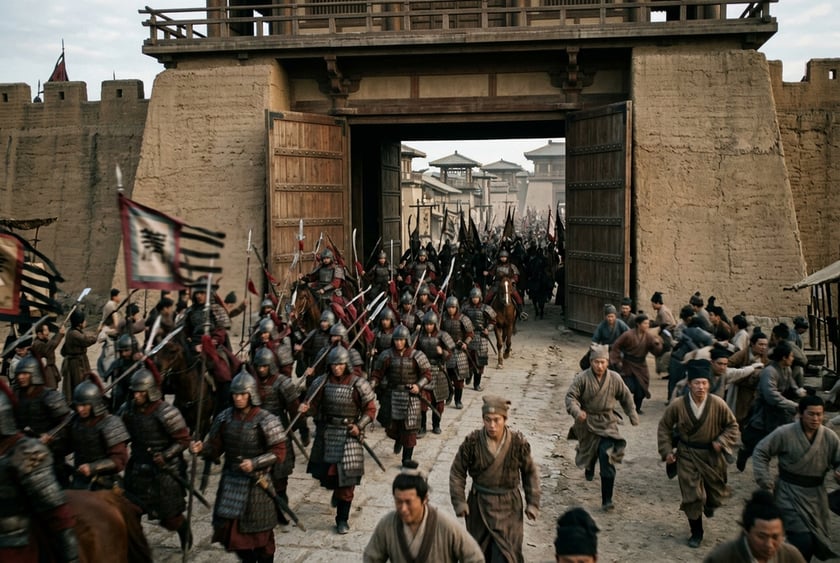
On Dong Zhuo's side: Hua Xiong commanded as the front-line marshal, with Li Su, Hu Zhen, and Zhao Cen as deputies, dispatching fifty thousand infantry and cavalry to march on the pass overnight to engage the enemy; in the novel, Hua Xiong is cast as a "nine-foot-tall tiger-bodied general with the waist of a wolf and the head of a leopard, arms like an ape's" — the most individually formidable warrior in Dong Zhuo's camp apart from Lv Bu. On the coalition side: Sun Jian led the vanguard, with Cheng Pu, Huang Gai, Han Dang, and Zu Mao as deputies, making the main assault on Sishuiguan; Yuan Shu supervised provisions; Yuan Shao sat at the central command; and the remaining lords — Bao Xin, Han Fu, Gongsun Zan, Cao Cao, Liu Bei, and others — held advantageous ground in support. This deployment of "Sun Jian pressing forward, Yuan Shao presiding at the rear" appeared to be a clear division of labor but concealed a fatal flaw: Sun Jian's supplies depended entirely on Yuan Shu, and Yuan Shu harbored a fear that Sun Jian would become the wolf driven out only to yield a tiger — this "front fighting while the rear obstructs" dynamic was the structural root cause of the coalition's eventual disintegration.
Key Decision Points
The first decision point is Bao Xin secretly sending his brother Bao Zhong on a shortcut to seize the first meritorious deed. Fearing that Sun Jian would claim the leading credit, Bao Xin secretly sent his younger brother Bao Zhong with three thousand soldiers down a side path; this was the first clear signal of "competition for glory" within the coalition — and Bao Zhong accordingly became the first casualty of this battle. The second decision point is Yuan Shu's withholding of grain. Yuan Shu, persuaded by a slanderer that "Sun Jian is the fierce tiger of Jiangdong — if he breaks Luoyang and slays Dong Zhuo, it is merely driving out the wolf to gain the tiger," deliberately held back the grain supplies, throwing Sun Jian's army into chaos and creating the opening for Hua Xiong's night raid. This decision is the true turning point of the entire engagement — it demonstrates that the coalition was not defeated by Dong Zhuo but by itself. The third decision point is Hua Xiong and Li Su's night-raid plan. Hua Xiong adopted Li Su's two-pronged scheme — one force to circle around by a small path from behind, one to strike head-on — and launched a night attack on Sun Jian's camp; this is the sole element of the battle that has genuine tactical military value. The fourth decision point is Zu Mao exchanging head-cloth with Sun Jian. Sun Jian's red head-cloth made him too conspicuous; Hua Xiong's men used it as their pursuit target. Zu Mao voluntarily proposed "let me wear your head-cloth" so the two could split and run by different routes; ultimately Sun Jian escaped by the smaller path while Zu Mao was pursued and cut down by Hua Xiong — this scene is an early canonical instance of the novel's "loyal sacrifice for one's lord" motif. The fifth and narratively most significant decision point is Guan Yu's request to fight and his beheading of Hua Xiong. Under the twin pressure of Yuan Shu's doubts and Yuan Shao's hesitation, Cao Cao overrode all objections and declared "let him try his horse"; Guan Yu appeared under the pledge "if I fail, cut off my head," Cao Cao poured a warm cup of wine for him to take into battle, and before the wine had cooled, Hua Xiong's head had already been delivered — this is the first stage the novel designed for Guan Yu's debut as the "martial saint."
Outcome and Resonance
Within the novel's own narrative, the Battle of Sishuiguan produced three immediate results: first, Hua Xiong was slain, compelling Dong Zhuo to send Lv Bu himself (which introduces the next and even grander drama — the Sanyingzhanlvbu at Huwao Pass); second, Sun Jian suffered a temporary setback but was not annihilated, preserving his main force for the next phase's march into Luoyang; third, Guan Yu, though merely a mounted archer, completed his first head-on appearance and established the narrative keynote of the three brothers Liu Bei, Guan Yu, and Zhang Fei as men of humble origin who win their standing through battle deeds. Looking at the deeper narrative architecture, this battle introduces several core motifs that recur throughout the entire novel: "allies sabotaging one another" (Yuan Shu withholding grain); "loyal sacrifice" (Zu Mao dying in place of Sun Jian); "the small overcoming the great" (an archer slaying a fearsome general); and "Cao Cao's eye for talent" (insisting that Guan Yu be given his chance). These motifs resonate repeatedly in pivotal events thereafter — Chibi, Yiling, the debut of the Five Tiger Generals, and more. From a historical standpoint, it was Sun Jian's forces who slew Hua Xiong — specifically at the Battle of Yangren — and the deed was attributed to Guan Yu in the novel, a typical novelistic transposition of "letting character drive plot." Yet this transposition gave Guan Yu's image as the "martial saint" its earliest concrete battlefield support and significantly caused Sun Jian's actual military achievements to be underestimated.
Counterfactual Analysis
The most imaginative counterfactual is: if Yuan Shu had dispatched the grain on time, Sun Jian's army would not have fallen into the chaos that made Hua Xiong's night-raid plan viable; with Jiangdong's elite troops, Sun Jian could quite conceivably have broken Sishuiguan within a few days and pressed on toward Luoyang. The terminus of this divergent path is Sun Jian rather than Cao Cao winning the initiative in "protecting Emperor Xian," and the San Guo configuration would have been reorganized around the "Jiangdong Sun clan." Second, if the Guandong coalition had truly achieved unified command, Dong Zhuo could not have held more than ten contingents with one Sishuiguan — he was ultimately killed by Lv Bu precisely because the coalition's pressure never fully abated and he was compelled to reach an internal reckoning with Wang Yun. A third scenario: if Guan Yu had not made his name in a single battle at Sishuiguan, his identity as a mounted archer under Liu Bei would have left his next narrative stretch — the solo ride of a thousand li, passing five passes and slaying six generals — without any buildup; the reason the novel moved the credit for slaying Hua Xiong to Guan Yu was fundamentally to lay the foundation for a character whose story was to be elevated to divine status. To grasp the true weight of the Battle of Sishuiguan, one must read backward from the fact that "this battle was the first rung the novel built for the character of Guan Yu" — it records not history, but the origin of the martial saint.