Strategic Background
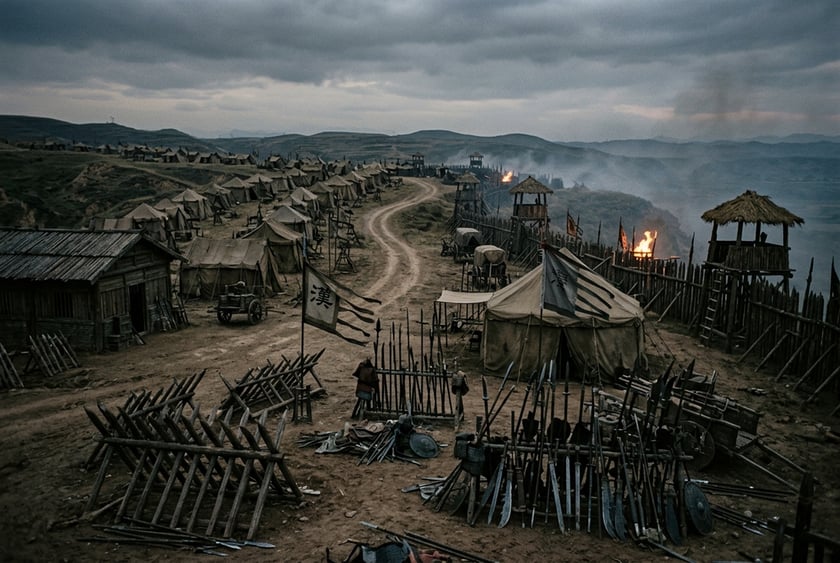
As a sub-event of the Campaign against Dong Zhuo by the eastern lords, this encounter took place before Hulao Pass. Dong Zhuo garrisoned troops there and cut off the lords' central route, so the coalition split into eight columns to come to the rescue, with Cao Cao leading his army back and forth in support. From the coalition's perspective, Hulao Pass was the throat for advancing west to Luoyang and striking straight at Dong Zhuo; but the presence of Lü Bu turned this pass into a problem of "individual prowess vetoing the coalition's advantage in numbers"—Dong Zhuo had only to make Lü Bu his spearpoint to repeatedly repel the lords, who, though many in troops and generals, were disunited in command.
Dispositions of the Two Sides
The Wei side (Dong Zhuo's army) relied heavily on a single point: Lü Bu rode out with three thousand armored cavalry to issue challenges, himself the core of the assault. The coalition side, though it had eight columns of lords arrayed on the high ground, was a loose confederation lacking unified command and coordination. Once battle was joined, this structural weakness was at once exposed: Lü Bu ran Mu Shun, a subordinate of Zhang Yang, through with a single thrust of his halberd, then severed the wrist of Wu Anguo, a subordinate of Kong Rong, and the lords could only respond passively in a "rush out together to save him" fashion. Cao Cao saw the crux and proposed that the eighteen lords confer together—capture Lü Bu first, and Dong Zhuo would be easy to slay—which in essence acknowledged that "combined strength must be used to suppress the single point."
Key Decision Point
The turning point came the instant Gongsun Zan was beaten and fled and Lü Bu gave chase on his Red Hare steed. Zhang Fei brandished his spear to bar the way and, with the taunt "slave of three surnames," steadied the battle—the first decision: using one man's valor to first withstand the tempo of Lü Bu's pursuit. Then Guan Yu and Liu Bei threw themselves in one after another, escalating from a duel to three men attacking in alternating waves, finally forcing Lü Bu back to the foot of the pass. This approach of "wearing down a top-tier lone general through a multi-man wheel attack" was precisely a correction of the earlier lesson that "single combat is sure to lose"—here the Romance uses one battle to resolve the coalition's predicament.
Outcome and Resonance
Though the three heroes' combined effort forced Lü Bu back, they failed to capture or kill him, and Dong Zhuo subsequently abandoned the pass to hold a defensive line. In terms of campaign effect, this battle did not change the outcome that the anti-Dong coalition eventually disintegrated through internal strife; but in terms of narrative, it established in one stroke the brotherly image and martial coordinates of Liu, Guan, and Zhang, and at the same time fixed both Lü Bu's persona as "the foremost warrior in the realm" and his stigma as "fickle and faithless," shaping the portrayal of all four men throughout the rest of the book.
Counterfactual Speculation
It must be pointed out that this is a fictional episode the Romance created to shape its characters; there was no historical "three heroes fight Lü Bu." Even reasoning within the novel's logic: had Zhang Fei not intercepted in time, Gongsun Zan would likely have died beneath Lü Bu's halberd, and the coalition's morale would have collapsed further; had the coalition truly been able, as Cao Cao said, to unify command and annihilate Lü Bu with combined strength, the campaign against Dong Zhuo might not have dispersed without result. The true "counterfactual" value of this battle lies in its demonstration of how organizational coordination checks individual heroism—and the eastern coalition of history lost precisely for lack of such coordination.