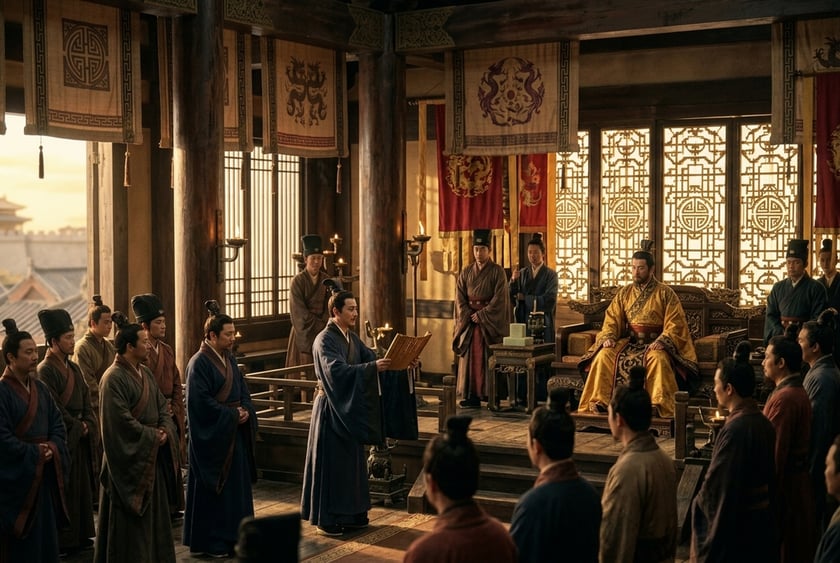
The Final Moment
From a biographical perspective, Wei Yan's last moment unfolded beneath the walls of Nanzheng — a "two-layer ambush" of deliberate design. The outer layer was military; the inner layer was psychological. By the time Wei Yan arrived at Nanzheng with his remaining troops, Jiang Wei had already occupied the city and raised the drawbridge in defiance, while Yang Yi, holding Zhuge Liang's sealed final letter, waited atop the walls for the right moment. That letter is rendered dramatically in the Romance: its inscription specified explicitly that it was to be opened only "once you are face to face with Wei Yan on the field," and inside lay a scheme of psychological entrapment — Wei Yan was to be goaded into calling out three times in front of the formation, "Who dares kill me?". The ingenuity of this design lies in its deep knowledge of Wei Yan's character: he was proud of his valor, unwilling to concede defeat, and, having just suffered a brief battlefield reverse, was desperate to recover his prestige — making him maximally susceptible to being drawn into a public act of swagger. The sealed letter contained no military strategy whatsoever, only an observation about human nature — Zhuge Liang's final legacy to Yang Yi, and his coldest political judgment on a general he had personally elevated while never ceasing to guard against.
The Last Words
Wei Yan's "last words" were precisely the trigger for his execution: laughing in front of the formation, he called out three times, "Who dares kill me?" Before the third repetition was finished, Ma Dai appeared behind him, blade rising and falling. The scene in the Romance carries intense dramatic irony — a fierce general whose entire identity rested on "charging fearlessly into battle" met his end because of a phrase he used to boast about himself. Ma Dai's role here deserves attention: he was the executor of Zhuge Liang's secret deathbed orders, placed beside Wei Yan in advance as a "false defector turned inside agent." From Ma Dai's point of view, he was a man driven simultaneously by two layers of instruction — he had to play Wei Yan's ally to ensure the blade could fall, and yet in that one instant execute a total switch of loyalty back to Shuhan's center. The Romance gives Ma Dai no lines; his entire action is a single soundless "blade rising." That silence is itself the greatest irony against Wei Yan's boastful clamor.
Aftermath
After Wei Yan's death his troops scattered completely. The three hundred cavalry Ma Dai had commanded were absorbed into Shuhan's central army establishment, and Wei Yan's family was executed to the third degree. The position of vanguard commander of the Northern Expedition fell to Wang Ping; Jiang Wei led the campaigns, Wang Ping held Hanzhong, and Fei Yi and Jiang Wan governed Chengdu. The entire power structure was reshuffled within three months. But the cost of the reshuffle was plain to see: after Wei Yan, Shuhan never again had a senior general of the "aggressive-war" persuasion; the offensive genetic code of the Northern Expedition army was permanently excised. Yang Yi himself found no good end from executing Wei Yan either — he had believed that after Zhuge Liang's death he would inherit the great authority; instead he was appointed as Central Army Director with nothing substantive to do, publicly complained that "had I known it would come to this, I would rather have surrendered to Wei," was denounced by Fei Yi, reduced to commoner status, and killed himself in exile. Viewed through the lens of "aftermath," both Wei Yan and Yang Yi ultimately became sacrificial victims of Zhuge Liang's deathbed personnel arrangements — it was Jiang Wan, Fei Yi, and Jiang Wei, the triad Zhuge Liang had quietly positioned, who were the true beneficiaries.
Historical Assessment
Historical assessments of Wei Yan have been split from the beginning. The Romance, in order to build Zhuge Liang's image as a godlike strategist, labels Wei Yan a natural aberration with "a bone of rebellion at the back of his skull" — from his very first appearance (killing Han Xuan to surrender to Liu Bei) to his last (executed at Nanzheng), the narrative is pervaded by a fatalistic "bound to rebel eventually". But strip away that narrative filter and Wei Yan's true image is far more complex: he was the officer Liu Bei personally elevated from the ranks to govern Hanzhong, who designed the "layered gate" deep-defense system that successfully protected Hanzhong for nearly a decade; who served as Zhuge Liang's vanguard commander across every Northern Expedition; and whose Ziwu Valley stratagem, though never adopted, identified real tactical opportunities during periods when the Guanzhong defense was thin. To freeze the endpoint of such a general's life into the punchline of "Who dares kill me?" is a simplification that history does not deserve. The question truly worth asking is: why could an organization — Shuhan — provide no institutionalized path of succession for a supremely capable but temperamentally unyielding number-two figure after the death of its supreme leader? That question recurs throughout Chinese history; Wei Yan's death is merely one of its earliest specimens.