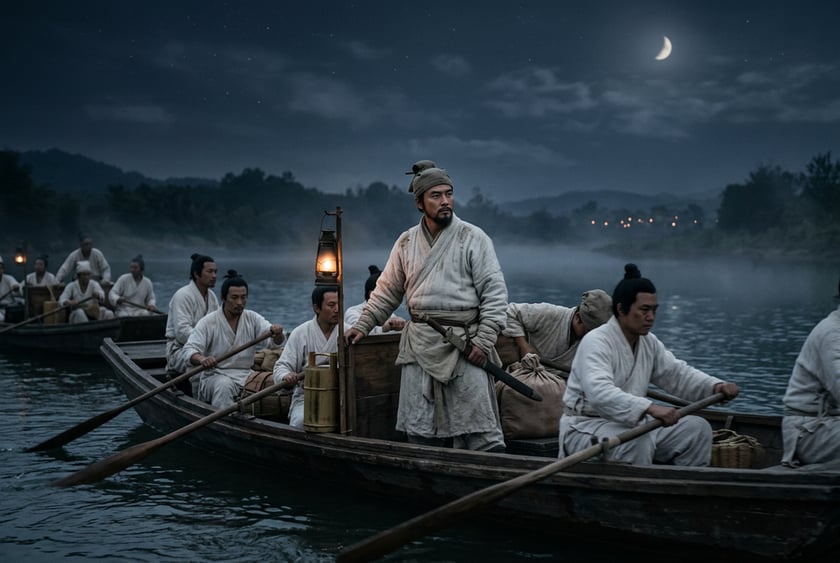
Strategic Background
The Jiangweibeifa should be understood as a strategic cycle spanning more than twenty years, not as a single campaign. After Zhuge Liang died at Wuzhangyuan in 234, Shuhan's successive administrators were Jiang Wan and then Fei Yi. Both leaned toward holding firm and husbanding resources, and neither supported large-scale northern offensives — Fei Yi in particular explicitly capped Jiang Wei's troop deployments "within ten thousand men" so that a single defeat could not drag down the state's strength. After the twelfth year of Yanxi (249), Wei experienced the Gaopinglingzhibian: Sima Yi killed Cao Shuang and seized control of the government. Xiahou Ba, suspected by the Simashi clan, defected from Longxi to Shuhan and became Jiang Wei's adviser. Shuhan judged that Wei's internal instability was an opportunity to strike, and with Fei Yi's assassination removing the internal brake on his activity, Jiang Wei was finally free to prosecute the northern campaigns in earnest.
Deployments on Both Sides
Jiang Wei's overall strategic direction was to break through from the Longxi–Yongzhou axis, treating "advancing into Longright" as the central axis of carrying on Zhuge Liang's legacy. In the early phase he built two east-west forts below Qushan, attempting to establish a forward base; he also cultivated ties with the Qiang peoples — dispatching Xi Zheng carrying gold, pearls, and Shu brocades into Qiang territory — so that the Qiang commander E Heshaoge would lead fifty thousand men as his vanguard. In the middle phase he lured the Wei general Xu Zhi to his death with a feint-and-ambush, and at Tielushan, when caught between the combined assault of Guo Huai and Deng Ai, he turned and shot back an arrow that killed Guo Huai — one of the rare occasions in the Shuhan northern campaigns where the tactical exchange was on genuinely equal terms. In the later phase he and Deng Ai repeatedly faced each other at the nine camps of Qishan, at Changcheng, at Taoyang, and at Houhe; Deng Ai "first read the topographic veins of the earth," digging tunnels beneath the Qishan positions in advance to neutralize Jiang Wei's deployments at the tactical level.
Critical Decision Points
The Jiangweibeifa had critical decision points at three levels. The first was "when to go out" — he was unable to mobilize large forces while Fei Yi was alive; 254–262 was the period of his most intensive northern campaigns, yet this was also precisely the period of Shuhan's most depleted national strength. The second was "which route to take" — he consistently committed to the Longright route, reasoning that he knew the Qiang situation well and could use the Qiang as allies; but this route had an overextended front and difficult logistics, and each time he was forced to withdraw due to supply problems. The third was "how to allocate forces" — he and Right General of Chariots Hu Ji had agreed to rendezvous at Shanggui, but Hu Ji failed to arrive on time, resulting in the catastrophic defeat at Duangu and the loss of more than ten thousand troops — the single heaviest internal operational failure of Jiang Wei's northern campaigns. In the later phase he finally changed strategy and stationed his main forces at Dazhong to keep out of trouble (escaping the political pressure generated by Huang Hao at court), but this simultaneously meant the Hanzhong defensive line was thinned — the structural reason why Shuhan was ultimately pierced when Deng Ai crossed through Yinping.
Outcome and Echoes
Measured in tactical achievements, the Jiangweibeifa was a net draw — a decisive victory over several tens of thousands of Wang Jing's troops at Taoxi, shooting Guo Huai to death, and killing Xu Zhi were all impressive results; but the Duanguzhibai, the inconclusive standoff at Houhe, and the retreats to Yinpingqiao were equally conspicuous failures. Measured in strategic effectiveness, he never genuinely recovered a single commandery of territory. Measured in national attrition, years of continuous campaigning steadily hollowed out Shuhan's population and fiscal base — on the eve of Shuhan's destruction, the ratio of 280,000 households, 90,000 soldiers, and 40,000 officials had reached the point of near-unsustainability. The most consequential impact was that sustained northern campaigning left Hanzhong's defenses thin, with Jiang Wei's main force pinned down at Dazhong and Jiange; when Zhong Hui and Deng Ai drove south on two axes, Shuhan had no mobile reserves to commit. After Jiang Wei fell back to Jiange, Deng Ai crossed through Yinping and drove directly on Chengdu; Liu Chan surrendered — Shuhan's destruction was directly linked to Jiang Wei's strategic choices.
Counterfactual Analysis
Suppose Jiang Wei abandoned the northern campaign strategy and instead adopted a defensive posture of "rebuilding internal governance and consolidating Hanzhong." Shuhan's national strength might have persisted somewhat longer — but the cost would have been a further erosion of political legitimacy: abandoning the banner of "Han and traitors cannot coexist" would have ideologically undermined Shuhan's very reason for existing. Suppose the northern campaigns continued but under Fei Yi-style restraint — never more than ten thousand men at a time, never driving deep into Longright — there would have been no catastrophic losses like Duangu, but also no strategic pressure on Wei worth speaking of; which is precisely the actual state of Shuhan during Fei Yi's lifetime. The most interesting counterfactual is this: had Hu Ji not missed the rendezvous at Duangu, and had Jiang Wei been able to consolidate real control of even one Longright commandery after his victory at Taoxi, the Shuhan northern campaigns might have upgraded from "harassment strategy" to "territorial conquest strategy" — which is what Zhuge Liang's design had originally envisioned. But Hu Ji's failure to appear, compounded by Huang Hao's interference at court, foreclosed that possibility entirely. In other words, the fundamental cause of Jiang Wei's northern campaigns failing was not on the battlefield but in the inability of Shuhan's mid-to-late political and military system to sustain the high-intensity external strategy Zhuge Liang had designed.