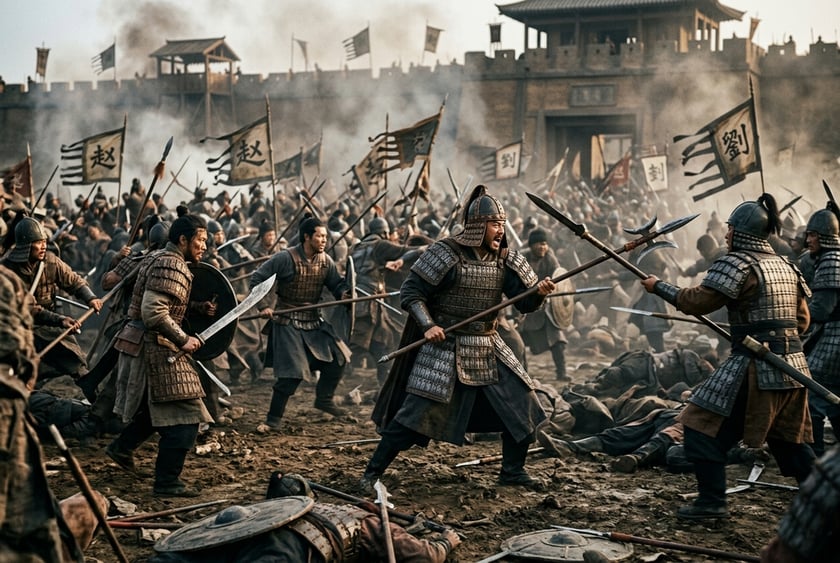
Background
By the final years of Jingao, Shuhan's national power was far diminished from the era of Chancellor Zhuge Liang. Jiang Wei had long been garrisoning Dazhong and avoiding Chengdu because the eunuch Huang Hao was wielding power at court, the Right Grand General Yan Yu was colluding with him, and Jiang Wei harbored such suspicion of his own position that he no longer returned to the capital [c:17894]. This situation — in which the supreme commander was unwilling to come home — was itself the classic symptom of a regime in terminal decline. When Jiang Wei detected signs of Zhong Hui mobilizing troops in Guanzhong and submitted a memorial requesting reinforcements for Yanganguan and the Yinping bridgehead, the memorial was shelved; by that point Shuhan's central decision-making apparatus had nearly ground to a halt [c:17894].
Key Figures
Jiang Wei, as Grand General, was the actual bearer of Shuhan's military will in this phase. His reading of the danger on the northern line was sharper than that of the Chengdu center, and he was more willing to stake everything on a decisive field engagement. Liao Hua, Zhang Yi, and Dong Jue represented the senior generation of Shuhan's middling officials; they cooperated with Jiang Wei while also harboring disagreements — all three had on multiple occasions expressed dissatisfaction with Jiang Wei's repeated northern campaigns. Zhong Hui, as the adversary, was the young and ambitious commander in whom Sima Zhao had placed his highest hopes; the conquest of Shu was simultaneously a national mission and a personal career vehicle. Lurking behind all of this was an invisible actor: the Chengdu eunuch faction, which had marginalized Jiang Wei while continuously curtailing his authority at the front — their hobbling of the frontline indirectly enabled the Wei army's surprise thrust.
The Central Problem
The decision to fall back and hold Jiange was Jiang Wei's choice of the least-bad option among two bad ones. Dazhong was too far west and too distant from Chengdu; once the Wei army broke into the Hanzhong basin, his line of retreat would be cut. Yanganguan had already fallen, and to fight Zhong Hui and his more than one hundred thousand Wei regulars in a pitched battle within the Hanzhong basin with Shuhan's remnant forces meant near-certain defeat. The logic of withdrawing to hold Jiange was straightforward: Jiange Pass was the "one man holds the pass, ten thousand cannot break through" kind of defensive fulcrum, the most economical anchor point for Sichuan's northern defense. With roughly forty to fifty thousand troops, Jiang Wei could sit tight for months, strangling Zhong Hui's supply lines and waiting for seasonal shifts or internal fractures in the Wei army. This approach was tactically correct — events proved that Zhong Hui's main force did in fact stall before Jiange, with supply pressure so acute that withdrawal was under consideration. The problem was not Jiang Wei's judgment but his inability to foresee that Deng Ai would wrap himself in felt, roll down cliffs, and slip past Jiange by a route that amounted to virtual suicide.
Political Consequences
At the campaign level, the withdrawal to Jiange directly blocked Zhong Hui's main force and was the final showcase of Jiang Wei's personal tactical ability. At the strategic level, however, it bet Shuhan's entire survival on the single fulcrum of "Jiange must not fall" — once Deng Ai bypassed Jiange and drove straight into the Jiangyou-Mianzhu-Chengdu heartland, Shuhan had no second-line mobile force to call upon, because every available mobile unit had been concentrated at Jiange. This "all chips on one point" deployment was a forced choice under the extreme resource scarcity of a failing regime, not a proactive strategy. Jiange's successful resistance and Deng Ai's successful infiltration form a dramatically mirrored pair within the 263 campaign to destroy Shu: the former won locally, lost globally; the latter gambled everything and won a state.
Counterfactual Analysis
Had Shuhan's center in the fifth year of Jingao accepted Jiang Wei's recommendation to reinforce Yanganguan and the Yinping bridgehead [c:17894], Zhong Hui's main force would in all likelihood have been unable to enter the Hanzhong basin at all, and the Yinping trail would have been rendered completely impassable by a garrison — Shuhan could without great difficulty have held on another decade. Conversely, had Jiang Wei chosen not to withdraw to Jiange and instead fought Zhong Hui and Deng Ai separately in the open field at Hanzhong or Mianzhu, the collapse would only have come faster. The true tragedy of the withdrawal to Jiange lay not in tactical error but in the predicament of a capable commander forced to make choices within the framework of a regime that had already abandoned the will to repair itself — no matter which choice he made, he was only delaying, not preventing, the collapse.