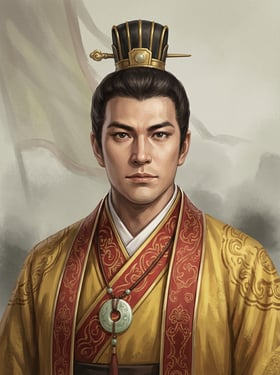
Historical Record
Sun Ba, styled Zixiao, was the Prince of Lu of Eastern Wu during the Three Kingdoms period, the fourth son of Sun Quan. In the histories he is portrayed as a figure who coveted the position of heir apparent. After his elder brother Sun He was made crown prince, Sun Ba began to contend with him for the succession—this is the famous Struggle of the Two Palaces. This contention not only entangled many officials of the Sun-Wu court but also had a profound effect on Eastern Wu's political landscape. For example, Wu Can—an official who had served as Administrator of Kuaiji, General of the Household Who Manifests Righteousness, Colonel of Garrison Cavalry, Privy Treasurer, and Grand Tutor to the Crown Prince—firmly supported the crown prince Sun He during the Struggle of the Two Palaces, asserting the distinction between legitimate heir and cadet. He strongly urged that the Prince of Lu, Sun Ba, be removed from the capital to garrison Xiakou, so as to prevent him from continuing to vie for power with the crown prince in the capital. Wu Can also corresponded repeatedly with Lu Xun, who was garrisoned at Wuchang, and together they remonstrated with Sun Quan on this matter c:1449. Yet it was precisely because of these actions that Wu Can was slandered and ousted by Sun Ba and his clique, and in the end was imprisoned and executed. Although Sun Ba receives little space in the histories, the political upheaval triggered by the succession struggle is enough to reveal his importance on the political stage of late Eastern Wu c:1450.
In the Novel
Romance of the Three Kingdoms gives Sun Ba no independent literary characterization. In the novel, Sun Ba's role scarcely appears, and his Struggle of the Two Palaces with the crown prince Sun He is not depicted in detail. This stands in sharp contrast to the histories' record of Sun Ba and the political events he set off. The novel focuses chiefly on the military struggles and political maneuvering of major figures such as Liu Bei, Cao Cao, and Sun Quan; as for the internal succession struggle within Eastern Wu, and the portrayal of Sun Ba in particular, it is almost a blank. Therefore, regarding Sun Ba's character, words and deeds, and his specific role in historical events, there is no clear record in Romance of the Three Kingdoms, and readers can derive no literary image of Sun Ba from it. This makes Sun Ba's presence in the novel far less prominent than his actual influence in the official histories.
Key Relationships
Sun Ba's key relationships revolve mainly around his coveting of the heir's position and the political struggle it touched off:
* Sun He (sibling_of): Sun Ba's elder brother, the crown prince of Eastern Wu. The relationship between Sun Ba and Sun He is a textbook case of brothers turning against each other; in vying for the position of heir, the two formed a fierce opposition. This Struggle of the Two Palaces was at the heart of the political turmoil of late Sun-Wu c:1449.
* Wu Can (betrayed_by): Wu Can was a staunch supporter of the crown prince Sun He, who clearly asserted the distinction between legitimate heir and cadet and strongly urged Sun Quan to remove Sun Ba from the capital. Yet it was precisely Wu Can's integrity and loyalty that made him a thorn in the side of Sun Ba and his clique, and in the end he was slandered to death by Sun Ba and the others. Wu Can's fate directly reflects Sun Ba's ruthless methods in the succession struggle c:1449.
* Shi Ji (rival_of): The histories do not directly mention any direct rivalry between Shi Ji and Sun Ba, but as an important general of late Eastern Wu, Shi Ji's stance in the Struggle of the Two Palaces was undoubtedly significant. Although there is no explicit record of a direct conflict between him and Sun Ba, in the complex political struggle, latent competition between different factions was widespread.
* Eastern Wu (member_of): As a son of Sun Quan, Sun Ba was naturally a member of the Sun-Wu imperial house. His conduct and political struggle directly affected the stability and development of the Sun-Wu regime, and form an important part of the history of late Sun-Wu c:1450.
Signature Scenes
Sun Ba's most signature scene is undoubtedly the succession struggle that unfolded around the Struggle of the Two Palaces. In it, he displayed a fierce hunger for power and political cunning:
* The succession struggle with the crown prince Sun He: After Sun He was made crown prince, Sun Ba, unwilling to remain in the position of a vassal prince, actively cultivated a clique and sought to displace Sun He from the heir's position. This contention lasted for years, splitting the Eastern Wu court into two great factions, one supporting the crown prince and one supporting the Prince of Lu. The character of "coveting the heir's position" that Sun Ba displayed in this process is his most central trait c:1450.
* Wu Can framed to death: This is a scene in which Sun Ba displayed his political cunning and cruelty during the Struggle of the Two Palaces. Wu Can, as a staunch champion of the crown prince Sun He, repeatedly remonstrated with Sun Quan, demanding that Sun Ba be removed from the capital to uphold the distinction between legitimate heir and cadet. It was precisely these actions of Wu Can that angered Sun Ba and his clique, ultimately leading to Wu Can being slandered, imprisoned, and put to death. This event not only highlights Sun Ba's unscrupulous methods in the power struggle but also reflects the perilous political environment of Eastern Wu at the time c:1449.
* The suspicion of improper dealings reported by Wei and Shu envoys: Although the histories give no detailed account of any specific dealings between Sun Ba and the Wei and Shu envoys, the description of "a suspicion of an offense of impropriety reported by Wei and Shu envoys" implies that, in the course of vying for the succession, Sun Ba may, for his own interests, have committed acts that deviated from convention or harmed the state's interests. This further deepens his negative image in the histories and shows the unconventional means he might adopt to achieve his ends.
These scenes together construct Sun Ba's historical image—a Prince of Lu, ambitious and willing to pay any price to seize power.
Portrait file
Character profile
- Character
- Sun Ba coveted the position of Crown Prince and was on ill terms with his brother, Crown Prince Sun He, standing against him as an equal. He was once suspected of the fault of insubordination, as reported by envoys of Wei and Shu.
- Life
- Sun Ba was appointed Prince of Lu, and the favor and special esteem shown him were no different from those given the Crown Prince Sun He. Later he and Crown Prince Sun He were both cut off from receiving guests; his partisans Quan Ji, Wu An, Sun Qi, Yang Zhu, and others secretly attached themselves to Sun Ba and plotted to endanger the Crown Prince. In the end Sun Ba was ordered to take his own life, and his partisans Quan Ji, Wu An, and Sun Qi were all executed. After Sun Hao ascended the throne, he pursued the old grudge, stripped Sun Ba's two sons of their ranks and lands, and banished them to Wushang County in Kuaiji.
- Anecdotes
- A son of Sun Quan and Prince of Lu of Wu, he was established as Prince of Lu in the fifth year of Chiwu and ordered to take his own life in the thirteenth year; he was one of the central figures of the Struggle of the Two Palaces. He was on a par with the Crown Prince Sun He, once sought to ally with Zhu Ji but was rebuffed, and was also at odds with Gu Tan.
Relationships
8 relationships
Family2
Lord & vassal1
Friends1
Enemies3
Other1
Chapters6 回 ▸
- 史ch.47ch.52ch.57ch.58ch.59ch.61
Relationship timeline1 条 ▸
史 ch.59
- Sun He§23
sibling_of
和之弟;为鲁王,宠爱崇特与和无殊
Inner monologues · AI-generated1 段 ▸
- My name was Sun Ba; my courtesy name is unknown. Born into the Sun clan, I lived in the court of Wu. To judge my honor a
Life events4 ▸
- 0245-01-01 · JianyeGu Tan's Memorial on Legitimate and Illegitimate Succession· Instigator
- 0250-01-01 · JianyeStruggle of the Two Palaces· Victim
- 0250-01-01 · JianyeSun Ba Ordered to Die and His Faction Purged· Victim
- 0250-01-01 · JianyeDeposition of the Crown Prince and Execution of Prince of Lu Sun Ba· Victim