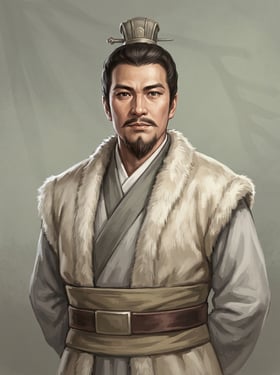
Historical Record
Yang Hu, courtesy name Shuzi—though his deeds are recorded in the official histories, the historical source material provided here does not give specific content directly. Therefore, the detailed records of Yang Hu in the official histories—such as his origins, his official career, his specific achievements, his character, and his dealings with others—cannot be set out here. The official histories typically record, in an objective manner, a figure's changes of office, military actions, political positions, and ultimate fate, striving to restore the true face of history. However, lacking the support of specific historical source material, we cannot here expound in detail on the historical facts of Yang Hu.
In the Novel
In Romance of the Three Kingdoms, the image of Yang Hu (courtesy name Shuzi) is given rich literary color, concentrated mainly on the period of his standoff with the famous Wu general Lu Kang. When he first arrived at Xiangyang, his army was short of grain, but by reducing the troops on patrol and reclaiming more than eight hundred qing of wasteland, he brought the army from "less than a hundred days' grain" to "a ten years' store in the camp", displaying his outstanding ability to govern an army and his foresight. Yang Hu governed his army strictly yet with generosity and benevolence; he "would wear light furs and a loose sash, not donning armor, with no more than a dozen attendants before his tent", quite unlike the traditional image of a military commander, all the more showing the bearing of a scholar-general.
Yang Hu well understood Lu Kang's cunning. Faced with subordinates' proposal to take advantage of the Wu troops' slackness and raid them, he plainly pointed out that Lu Kang was "abundant in wisdom and stratagems" and not to be acted against rashly, holding that "to advance lightly without weighing the situation is the way to bring about defeat". This prudent attitude reflects his precise judgment of the enemy's situation and his deep understanding of war. His mutual admiration with Lu Kang is also a famous tale. On one hunt, Yang Hu strictly ordered, "Our army shall not cross the border", not violating Wu territory, and returned game that had been wounded by Wu men—an act that won the admiration of the people of Wu. Lu Kang thereupon sent wine, and Yang Hu, suspecting no treachery, "drained the flask and drank it", displaying his open and aboveboard breadth of spirit. The two thereafter often corresponded; and even when Lu Kang fell ill, Yang Hu sent medicine, which Lu Kang took without the slightest hesitation—a thing exceedingly rare between hostile parties, profoundly depicting the deep friendship between the two that transcended enmity.
On the great plan to conquer Wu, Yang Hu once urged the Jin lord Sima Yan strongly that "Sun Hao's tyranny is now extreme; at present Wu may be conquered without a battle", emphasizing the right timing for the conquest of Wu. However, Sima Yan did not at first adopt it. Only when Yang Hu was gravely ill, and Sima Yan personally came to inquire after him, did he, still mindful of it, recommend Du Yu to succeed to his ambition of conquering Wu; and with the noble integrity of "to receive office in open court yet give thanks at a private gate is something I will not do", he burned the draft of his memorial of recommendation, seeking no personal fame or gain. After Yang Hu died, the people of the southern provinces and the soldiers of the lands south of the river all wept for him, and the people of Xiangyang built him a temple and raised a stele—the famous "Stele of Falling Tears"—showing how deeply his benevolent governance had entered the people's hearts, and how far-reaching his influence.
Key Relationships
* The Sima clan (serves): As an important minister of the Jin court, Yang Hu served the Sima clan loyally. He put forward to the Jin lord Sima Yan the strategy of conquering Wu, and actively reorganized military preparations, contributing to Jin's unification of the realm. On his deathbed, still mindful of the state, he recommended worthy men to Sima Yan, reflecting his loyalty and sense of responsibility toward the Sima regime.
* Lu Kang (friend_of): Yang Hu and Lu Kang were a pair of mutually admiring rivals in the late Three Kingdoms. Standing off against each other at the border, they could yet associate through virtue and exchange goods. Yang Hu deeply admired Lu Kang's cunning, regarding him as "abundant in wisdom and stratagems", not to be taken lightly. They exchanged game, fine wine, and even medicine, displaying a deep friendship that transcended their hostile relationship (novel only). Lu Kang too once sighed, "Since he bestows virtue upon me, how can I have nothing with which to repay him?", and finally recognized that "he relies solely on virtue, I solely on harshness; thus he will subdue me without a battle"—a mutual respect and understanding that is a rare bright spot in Romance of the Three Kingdoms.
* Sima Yan (advises_in): Yang Hu was an important counselor of Sima Yan. He not only garrisoned Xiangyang and stabilized the border militarily, but also strategically planned the great campaign to conquer Wu for Sima Yan. Although Sima Yan failed to adopt his advice at first, on Yang Hu's deathbed Sima Yan personally came to inquire after him and finally accepted Yang Hu's counsel on conquering Wu and recommending Du Yu, showing Sima Yan's trust and high regard for Yang Hu.
Iconic Scenes
* Farming at Xiangyang, Abundant Army Provisions: When Yang Hu first arrived at Xiangyang, the army was short of grain, but by reducing the garrison troops and reclaiming wasteland, he brought the army's grain stores from "a hundred days' grain" to "a ten years' store". This scene displays Yang Hu's outstanding ability in internal administration and military management, laying a solid foundation for the later conquest of Wu.
* Light Furs and Loose Sash, the Bearing of a Scholar-General: In the army Yang Hu "would wear light furs and a loose sash, not donning armor, with no more than a dozen attendants before his tent". This image stands in sharp contrast to the mighty image of the traditional military commander, highlighting his temperament as a scholar-general who won others through virtue and pacified Wu's borders by gentleness, and also reflecting his high confidence in his own safety and his generosity toward the people of Wu's lands.
* Exchanging Fine Wine and Medicine with Lu Kang: On one hunt, Yang Hu strictly observed the border and returned game wounded by Wu men. Lu Kang thereupon sent fine wine, and Yang Hu, suspecting no treachery, gladly drank it. Later, when Lu Kang fell ill, Yang Hu sent medicine, which Lu Kang likewise took without hesitation. These scenes vividly depict the deep friendship between Yang Hu and Lu Kang that transcended enmity, becoming the model of the "friendship of Yang and Lu," and embodying Yang Hu's strategy of winning others through virtue (novel only).
* Recommending a Worthy on His Deathbed and the "Stele of Falling Tears": When Yang Hu was gravely ill, Sima Yan personally came to inquire after him. On his sickbed, still mindful of state affairs, Yang Hu recommended Du Yu as fit for the great task of conquering Wu, and burned the draft of his memorial, seeking no fame. After his death, the people of the southern provinces and the soldiers of the lands south of the river all wept for him, and the people of Xiangyang built him a temple and raised a stele; because the inscription was so deeply moving that passersby could not see it without shedding tears, it was named the "Stele of Falling Tears". This scene displays not only Yang Hu's noble character and loyalty to the state but also confirms the immense influence of one who had truly won the people's hearts.
Portrait file
Character profile
- Character
- Yang Hu was generous and magnanimous in his dealings, winning men over by virtue; he pacified the Wu frontier with a conciliatory hand and governed his army through virtue.
- Anecdotes
- He served as the Jin's General of Chariots and Cavalry and area commander, garrisoning Xiangyang; ordered to relieve Bu Chan, he later withdrew. When his territory bordered Lu Kang's, he prized good faith, exchanging wine and medicine with him, and on his deathbed he recommended Du Yu.
Relationships
3 relationships
Friends1
Other1
Quotes
11 recorded lines · 3 featured
「天下不如意者,十常八九。今天與不取,豈不大可惜哉!」
This line speaks to the ordinary course of human life; widely circulated, it has high cultural recognition.
「孫皓暴虐已甚,於今可不戰而克。若皓不幸而歿,更立賢君,則吳非陛下所能得也。」
This line embodies Yang Hu's far-reaching vision and his profound insight into the great cause of unification.
「我軍不許過界。」
This line shows Yang Hu's strict military discipline and mutual respect with Lu Kang, shaping his image as a gentleman.
Chapters2 回 ▸
- 史ch.58
- 演ch.120
Inner monologues · AI-generated1 段 ▸
- When I was stationed at Xiangyang, I often thought of the soldiers guarding the frontier. What was at stake was not mere
Life events4 ▸
- 0272-01-01 · XilingBu Chan's Defection from Wu to Jin· Commander
- 0272-01-01 · XilingBattle of Xiling· Commander
- 0278-01-01 · XiangyangYang Hu's Garrison at Xiangyang· Commander
- 0280-01-01 · JianyeSun Hao's Accession and the Decline of Wu· Commander