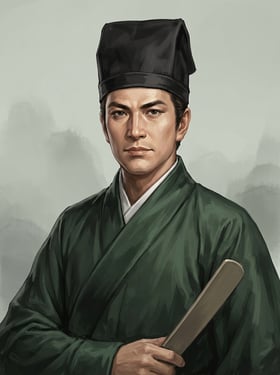
Historical Record
Kuai Yue, courtesy name Yidu, was an important strategist of Liu Biao, Governor of Jing Province at the end of the Eastern Han. With his deep wisdom and outstanding insight, he played a key role in the process of Liu Biao first stabilizing Jing Province. When Liu Biao first arrived in Jing Province, he faced a complex situation: powerful clan-bandits, Yuan Shu occupying Nanyang, and the Wu men Su Dai and Ju Yu creating disorder. Liu Biao summoned Kuai Liang, Kuai Yue, Cai Mao, and others to discuss countermeasures. Kuai Yue proposed the strategy that "in governing disorder, stratagem comes first," holding that troops lay not in numbers but in winning men. He advised Liu Biao to exploit the greed and brutality of the clan-bandits, luring them with profit, then killing their leaders and absorbing their followers. Liu Biao adopted Kuai Yue's plan, dispatching Kuai Yue to lure and kill fifty-five clan-bandits and absorb their armies. Kuai Yue then, together with Pang Ji, rode out alone to persuade the Jiangxia bandits Zhang Hu and Chen Sheng to surrender, successfully pacifying the Jiangnan region, so that the eight commanderies of Jing Province were settled by the mere passing of a proclamation c:6194.
During the Jian'an era, Liu Biao fell gravely ill, and his wife Lady Cai, together with Cai Mao, Zhang Yun, and others, wished to install his younger son Liu Cong as heir, pushing aside his elder son Liu Qi. After Liu Biao died, Cao Cao's great army marched south. Persuaded by Kuai Yue, Fu Xun, and others, Liu Cong decided to surrender to Cao Cao. At the time Liu Cong had hesitated, believing he could rely on the whole land of Chu and guard his late father's enterprise. However, Fu Xun persuaded Liu Cong with the principle that "rebellion and obedience have their grand norms, and strength and weakness have their fixed momentum," pointing out that for a subject to resist his lord was rebellion, that the newly founded Chu could not withstand the state, and that Liu Bei too was insufficient to oppose Cao Cao. Kuai Yue and others also supported surrender c:3221. In the end, Liu Cong surrendered the whole province to Cao Cao. Cao Cao greatly valued Kuai Yue's talent, and once wrote to Xun Yu saying, "I rejoice not at gaining Jing Province, but at gaining Kuai Yidu" c:6195. After Jing Province was pacified, Kuai Yue was appointed Superintendent of the Imperial Household and enfeoffed as a marquis. He died in the nineteenth year of Jian'an; before his death he wrote to Cao Cao entrusting his family affairs, and Cao Cao replied expressing condolence and affirmation c:6195.
In the Novel
In Romance of the Three Kingdoms, Kuai Yue's image is further developed on the basis of historical fact, with some dramatic episodes added. He first appears when Liu Biao first stabilizes Jing Province: together with Cai Mao, on Liu Biao's orders, he led troops to intercept Sun Jian. In this clash, Kuai Yue directly demanded of Sun Jian the whereabouts of the Imperial Hereditary Seal, sparking the battle between Huang Gai and Cai Mao c:6196. This episode has no clear basis in the histories and is a literary invention of the novel meant to highlight character and drive the plot.
The novel also gives Kuai Yue the skill of judging horses. After Liu Bei presented the Dilu horse to Liu Biao, Kuai Yue recognized at a glance that this horse was named "Dilu," pointing out that it "has tear-channels below the eyes and a white mark on the brow," making it a horse that "harms its master," and advised Liu Biao not to ride it c:3222. This detail is not mentioned in the histories, but it enriches Kuai Yue's image, making him not merely a strategist but also possessing some traits of a master of occult arts.
Moreover, the novel's account of Kuai Yue in the matter of Liu Cong's surrender to Cao Cao is largely consistent with historical fact: he was likewise an important figure in persuading Liu Cong to surrender. He again stressed the view that "rebellion and obedience have their grand norms, and strength and weakness have their fixed momentum," pointing out that Cao Cao acted in the name of the court, so that for Liu Cong to resist would be without just cause c:3224. However, in the novel, when Cai Mao once conspired with Kuai Yue to do away with Liu Bei, Kuai Yue expressed concern, believing it would "risk losing the goodwill of the gentry and common people" c:3223. This to some degree displays Kuai Yue's more cautious side, and accords with his image in the histories as an active participant in Liu Cong's surrender.
Key Relationships
* Liu Biao's faction (advisor): Kuai Yue was one of the core strategists of Liu Biao's faction, jointly assisting Liu Biao along with Kuai Liang, Cai Mao, and others. He rendered great service in pacifying the clan-bandits of Jing Province and stabilizing the situation for Liu Biao c:6194.
* Liu Cong (advises_in): After Liu Biao's death, Kuai Yue, together with Fu Xun and others, jointly persuaded Liu Cong to surrender to Cao Cao, exerting a decisive influence on Liu Cong's decision c:3221.
* Cao Wei (defected_to): After Liu Cong surrendered, Kuai Yue likewise submitted to Cao Cao, and was highly praised and given important responsibilities by Cao Cao, rising to the post of Superintendent of the Imperial Household c:6195.
* Liu Bei (potential adversary, novel only): In the novel, Cai Mao once conspired with Kuai Yue to do away with Liu Bei, but Kuai Yue had reservations, fearing they would "lose the goodwill of the gentry and common people" c:3223.
* Sun Jian (adversary, novel only): In the novel, Kuai Yue, on Liu Biao's orders, led troops to intercept Sun Jian and directly demanded of Sun Jian the matter of the Imperial Hereditary Seal c:6196.
Iconic Scenes
* First stabilizing Jing Province, offering a plan to lure and kill the clan-bandits: When Liu Biao first arrived in Jing Province, facing the predicament of clan-bandits holding sway, Kuai Yue offered Liu Biao the strategy that "in governing disorder, stratagem comes first," advising him to lure and kill the clan-bandit leaders and absorb their followers. Liu Biao adopted his plan, and Kuai Yue successfully lured and killed fifty-five clan-bandits and, with Pang Ji, persuaded Zhang Hu and Chen Sheng to surrender, allowing the situation in Jing Province to be swiftly pacified c:6194. This scene fully displays Kuai Yue's wisdom and decisiveness.
* Persuading Liu Cong to surrender to Cao Cao: As Cao Cao's great army bore down, Liu Cong hesitated. Kuai Yue, together with Fu Xun and others, strongly urged Liu Cong to surrender, analyzing the pros and cons with the principle that "rebellion and obedience have their grand norms, and strength and weakness have their fixed momentum," ultimately prompting Liu Cong to abandon resistance and surrender the whole province to Cao Cao c:3221. This act spared Jing Province from devastation and also won Kuai Yue Cao Cao's esteem.
* Cao Cao's praise: "I rejoice not at gaining Jing Province, but at gaining Yidu": After Jing Province was pacified, Cao Cao gave the highest praise to Kuai Yue's talent, even writing to Xun Yu, "I rejoice not at gaining Jing Province, but at gaining Kuai Yidu" c:6195. This praise became the best testament to Kuai Yue's personal ability and worth, reflecting his important standing in Cao Cao's eyes.
* Judging the Dilu horse (novel only): After Liu Bei presented the Dilu horse to Liu Biao, Kuai Yue recognized at a glance that this horse was one that "harms its master," and described its features in detail, advising Liu Biao not to ride it c:3222. Though a fiction of the novel, this scene adds an air of mystery to Kuai Yue and makes his image fuller.
Portrait file
Character profile
- Character
- Kuai Yue was a strategist and supporting minister to Liu Biao. He once urged Liu Biao to execute the clan-brigands, and later urged Liu Cong to surrender Jing Province to Cao Cao. Skilled in scheming, he took part in the defensive dispositions at Xiangyang and strongly advocated surrendering Jing Province to Cao Cao.
- Manner of speech
- His manner of speech combined physiognomy with strategic counsel: he could remonstrate with his lord using the traits of a horse, and could also use intrigue to turn men to his side.
- Life
- Kuai Yue, styled Yidu, was a man of Zhonglu. He once urged Liu Biao to execute fifty-five of the clan-brigands to bring stability to Jing Province, and talked the Jiangxia brigands into surrendering. He urged Liu Biao to submit to Cao Cao, and urged Liu Cong to surrender the whole province. He was later enfeoffed as a marquis and served as Chamberlain for the Palace Attendants (guangluxun), dying in the nineteenth year of Jian'an.
- Anecdotes
- He once dissuaded Cai Mao from killing Wang Wei, and was enfeoffed by Cao Cao as Grand Administrator of Jiangling and Marquis of Fancheng. Cao Cao once said, "I do not rejoice at gaining Jing Province; I rejoice at gaining Yidu."
Relationships
5 relationships
Family1
Friends1
Enemies1
Other2
Quotes
6 recorded lines · 2 featured
「昔先兄蒯良,最善相馬,越亦頗曉。此馬眼下有淚槽,額邊生白點,名為的盧,騎則妨主。張武為此馬而亡。主公不可乘之。」
This line points to the allusion of the horse 'Dilu,' a famous episode in the Romance of the Three Kingdoms.
「傅公悌之言是也。夫逆順有大體,強弱有定勢。今曹操南征北討,以朝廷為名,主公拒之,其名不順。且主公新立,外患未寧,內憂將作。荊襄之民,聞曹兵至,未戰而膽先寒,安能與之敵哉?」
This line reflects Kuai Yue's keen insight into the situation; his urging of Liu Cong to surrender to Cao Cao shaped the fate of Jing Province.
Chapters5 回 ▸
- 史ch.6
- 演ch.6ch.34ch.40ch.41
Relationship timeline5 条 ▸
Inner monologues · AI-generated3 段 ▸
- After Jing Province was pacified, Cao Gong comforted the people there, saying, “I am not pleased to have gained Jing Pro
- I am Kuai Yue, courtesy name Yidu. I stood at a moment of crisis in Jing Province. What troubled me was not the loss or
- I was born into the Kuai family of Nanyang. In my youth, I saw that the Han court’s moral teachings still lived in peopl
Life events3 ▸
- 0191-01-01 · XiangyangSun Jian's Campaign Against Liu Biao· Advisor
- 0208-01-01 · XiangyangLiu Cong's Surrender to Cao Cao· Advisor
- 0208-01-01 · XiangyangThe Succession Dispute of Liu Biao· Advisor