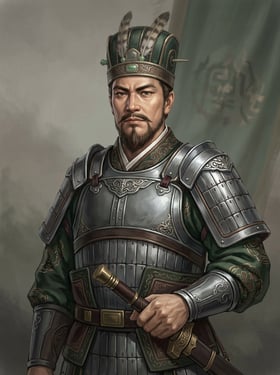
Historical Record
Bu Chan, courtesy name Zhongsi, was a general of the state of Wu. His elder brother Bu Xie had commanded the troops of their father Bu Zhi, with the additional title of General Who Calms the Army. After Bu Xie died, Bu Chan inherited his position, serving as Commander of Xiling, with the additional title of General Who Manifests Valor and the rank of Marquis of Xiting. In the eighth month of the first year of the Fenghuang era (269 CE), Sun Hao summoned Bu Chan to court to serve as Commander of the Surrounding Tents. The Bu family had guarded Xiling for generations, and on being summoned this time, Bu Chan felt he had lost his original authority and feared he might fall victim to slander and intrigue, and so held the city and rebelled against Wu, surrendering to Jin.
After surrendering to Jin, Bu Chan sent his son Bu Ji and his younger brother Bu Xuan to Luoyang as hostages. The Jin court gave this great importance, appointing Bu Chan Commander of all military affairs at Xiling, General of the Guards, with ceremonial rank equal to the Three Excellencies, the additional title of Palace Attendant, the staff of authority, and the office of Governor of Jiaozhou, and enfeoffing him as Duke of Yidu. His son Bu Ji was appointed Inspector of all military affairs at Jiangling, General of the Left, with the additional title of Cavalier Attendant-in-Ordinary, and the office of Administrator of Luling, his fief changed to Marquis of Jiangling; his younger brother Bu Xuan was appointed Palace Steward, General Who Spreads Awe, and enfeoffed as Marquis of a Capital Township. Jin promptly dispatched the General of Chariots and Cavalry Yang Hu and the Inspector of Jing Province Yang Zhao to lead troops to rescue Bu Chan.
However, the state of Wu responded swiftly, sending the Commander of Lexiang, Lu Kang, to lead troops to besiege Bu Chan. On learning of Bu Chan's revolt, Lu Kang immediately deployed his troops, ordering the generals Zuo Yi, Wu Yan, Cai Gong, and others to march straight to Xiling. He commanded the army to build a tight encircling fortification, from Chixi to Gushi, hemming in Bu Chan within and guarding against the Jin relief army without, pressing the construction day and night without pause as if a great enemy were at hand, so that the officers and men suffered greatly. The generals all remonstrated, holding that they should seize the moment before the Jin relief army arrived to concentrate their elite force and swiftly take Bu Chan, rather than spend their energy building walls. But Lu Kang reckoned that Xiling's walls were solid and its provisions ample, and that since the defensive works had all been planned by himself, it would be hard to take quickly. He foresaw that the Jin relief army would certainly arrive, and that without full preparation he would face being caught between enemies inside and out. Though the generals insisted on attacking the city, Lu Kang would not permit it. The Administrator of Yidu, Lei Tan, spoke earnestly, and Lu Kang, to satisfy the multitude, permitted a single assault on the city, which indeed proved fruitless, after which the encircling works were at last closed.
When the Jin general Yang Hu led troops to press toward Jiangling, the generals held that Lu Kang should not go to Jiangling. Lu Kang, however, insisted that Jiangling's walls were solid and its troops ample, and there was no cause for worry. He pointed out that even if Jiangling were lost, the Jin army could not hold it for long, and the loss would be slight. But if the Xiling rebellion were allowed to persist, all the non-Han peoples of the southern hills would be stirred to unrest, which would be the greater calamity. He therefore would rather give up Jiangling to preserve Xiling. Lu Kang had earlier ordered the Commander of Jiangling, Zhang Xian, to build a great dam to block the waterways and prevent the enemy from invading. Yang Hu tried to use this waterway to transport grain, and gave out that he would break the dam to let his infantry pass. On hearing this, Lu Kang immediately ordered Zhang Xian to demolish the great dam. The generals were puzzled at this and remonstrated repeatedly, but Lu Kang would not listen. When Yang Hu reached Dangyang and learned that the dam had been destroyed, he had to switch to transport by cart, expending great manpower and resources.
In the end, Lu Kang captured the city of Xiling, killed Bu Chan and several tens of his fellow conspirators, and exterminated their families to the third degree. The Bu clan was thereby wiped out, only Bu Xuan, being in Jin, surviving to continue the sacrifices of the Bu family.
In the Novel
Romance of the Three Kingdoms gives no detailed literary portrayal of Bu Chan's life and deeds. He is mentioned in the novel only in chapter 120, as a general of late Wu; his defection to Jin largely accords with the histories, but with no added detail or dramatic depiction. The novel devotes very little ink to Bu Chan, far less detailed than the historical record, and gives no in-depth portrayal of his character, motives, or interactions with others. Therefore Bu Chan's image in the novel is rather blurry, existing mainly as a side episode of the decline of late Wu, given no distinctive literary color. The novel also does not mention the background of the Bu family having guarded Xiling for generations, nor Bu Chan's inner anxiety over losing his post and falling victim to slander upon being summoned—these historical details are all absent from the novel.
Key Relationships
* Sima clan (defected_to): Out of anxiety over losing his post and falling victim to slander, Bu Chan held the city and rebelled against Wu, surrendering to Jin and going over to the Sima clan's regime. The Jin court gave Bu Chan's surrender high honors, appointing him Commander of all military affairs at Xiling, General of the Guards, with ceremonial rank equal to the Three Excellencies, and enfeoffing him as Duke of Yidu.
* Bu Xie (sibling_of): Bu Chan was Bu Xie's younger brother. After Bu Xie died, Bu Chan inherited his elder brother's position, becoming Commander of Xiling and commanding the troops of their father Bu Zhi. This relationship of family inheritance was the basis of Bu Chan's holding an important post in Wu.
* Cao Wei (defected_to): Although the sources clearly state that Bu Chan surrendered to Jin, Jin was the regime that succeeded Cao Wei, so in a broad sense Bu Chan's surrender may be regarded as going over to the successor of Cao Wei. The more precise description, however, should be "surrendered to Jin".
Signature Scenes
* The Xiling Revolt and Surrender to Jin: In the eighth month of the first year of the Fenghuang era (269 CE), because he was recalled to the capital to serve as Commander of the Surrounding Tents and felt he had lost his post and feared slander, Bu Chan held the city of Xiling, betrayed Wu, and surrendered to Jin. He sent his son Bu Ji and his younger brother Bu Xuan to Luoyang as hostages, an act that directly touched off the military conflict between Wu and Jin in the Xiling region.
* Lu Kang Besieges Xiling: After Bu Chan's revolt, the Wu general Lu Kang immediately led troops to besiege Xiling. During the siege Lu Kang displayed outstanding military talent and strategic vision; disregarding the generals' objections, he insisted on building solid encircling works to cope with the Jin relief army. He was even willing to give up Jiangling to ensure the pacification of Xiling, ultimately succeeding in capturing Xiling, killing Bu Chan and his associates, and quelling the rebellion.
* Family Annihilation and Surviving Line: After Bu Chan's revolt failed, he and several tens of his fellow conspirators were exterminated to the third degree, and the power of the Bu family in Wu was utterly wiped out. However, because Bu Chan's younger brother Bu Xuan was already in Luoyang as a hostage, he escaped the disaster and continued the sacrifices of the Bu family, becoming the sole surviving line of the Bu clan in Jin.
Portrait file
Character profile
- Character
- Bu Chan was the Commander of Xiling; he held the city and surrendered to Jin, and was finally attacked, destroyed, and beheaded by Lu Kang.
- Life
- In the first year of Fenghuang, Bu Chan held Xiling and surrendered to Jin; he was then besieged, destroyed, and beheaded by Lu Kang.
- Anecdotes
- He was the younger brother of Bu Xie, and inherited the post of Commander of Xiling.
Relationships
3 relationships
Chapters3 回 ▸
- 史ch.48ch.52ch.58
Relationship timeline1 条 ▸
史 ch.52
- Bu Xie§76
sibling_of
步阐为协弟,继业为西陵督
Inner monologues · AI-generated1 段 ▸
- I am Bu Chan, courtesy name Zhongsi. I have now been summoned away from Xiling and appointed Commandant of the Encirclin
Life events3 ▸
- 272 CE · XilingBu Chan's Defection from Wu to Jin· Instigator
- 272 CE · XilingBattle of Xiling· Instigator
- 272 CE · XilingLu Kang Defeats Yang Zhao and Recovers Xiling· Victim