Background
Viewed through the lens of modern political history, Ma Chao's surrender to Liu Bei was the pivotal turning point in the Yizhou campaign and a compelling illustration of how the novel presents the relationship between the movement of talent and the shifting of the geo-political landscape. Ma Chao's political identity was exceptionally distinctive: he was simultaneously the sole legitimate heir of the Liangzhou military bloc and a sworn blood enemy of Cao Cao — making him in the late-Han talent market a strategic asset so rare that it could not be purchased with ordinary chips. When Cao Cao executed Ma Teng, his intent was to eliminate the western-front threat, but the unintended consequence was to generate a revenge-driven armed force centered on Ma Chao. After Ma Chao's defeat in the Guanzhong campaign and his retreat to shelter under Zhang Lu, his political value did not diminish — rather, it was compressed into a transferable asset awaiting the right buyer [c:18019]. Zhuge Liang and Liu Bei were at that moment locked in a grinding contest with Liu Zhang for Yizhou; the front was stalemated, and they urgently needed a force capable of instantly tilting the strategic balance — and Ma Chao's arrival provided precisely that kind of external shock.
Key Figures
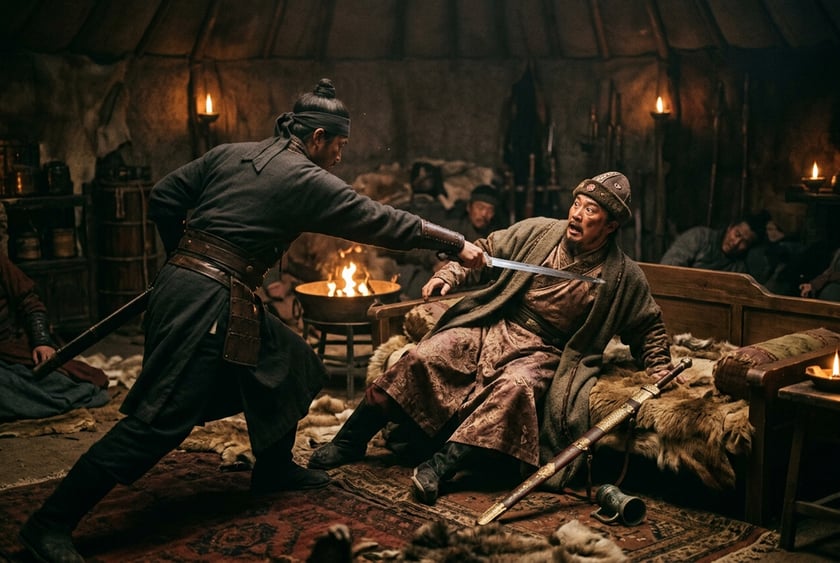
The central actors can be grouped into three clusters: Ma Chao as the acquisition target; Liu Bei, Zhuge Liang, and Zhang Fei as the acquiring party; and Zhang Lu, Yang Song, and Li Hui as the intermediaries available to be manipulated. Ma Chao was already in a "no-way-forward, no-way-back" position when attacking Jiamengguan — retreating to Hanzhong would expose him to Zhang Lu's growing suspicion, while attacking Chengdu was beyond his means: he was a classic "suspended military force" [c:18024]. On Liu Bei's side, Zhang Fei appeared to be the one fighting ferociously at the front, but Zhuge Liang was executing the truly decisive moves in the rear: he let Zhang Fei and Ma Chao grind each other through over a hundred bouts, reducing Ma Chao's fighting spirit to the point of diminishing marginal returns [c:18022]; while simultaneously arranging for Li Hui to approach Ma Chao in the role of an old acquaintance and advocate surrender, and bribing Yang Song to sow distrust between Zhang Lu and Ma Chao [c:18023]. Before his intervention, Li Hui stated his own case: "a fine bird chooses its tree, a worthy official chooses his lord" — one of the rare self-articulated value statements by a persuader in the novel, which imbued his advocacy not merely with tactical shrewdness but with a claim to moral legitimacy [c:18024].
The Core Issue
The substantive question is "how to absorb a crack force held within a third-party camp at the lowest possible cost." Zhuge Liang's solution is textbook: use a "military commander of equivalent rank" (Zhang Fei) to exhaust the opponent's fighting will; then open a psychological channel through "an envoy who shares the target's roots"; and finally cut off the target's line of retreat by exploiting "external suspicion" [c:18022] [c:18023] [c:18024]. The three moves in combination form a complete surrender-persuasion process. It is worth noting that Liu Bei did not personally step forward to negotiate the surrender, but delegated the entire operation to Zhuge Liang — partly because Liu Bei needed to maintain "the dignity appropriate to a lord," and partly because a personally led recruitment, if it failed, would have carried too great a political cost. From an institutional perspective, this is a mature "standard operating procedure for receiving surrendered generals" — the same division of labor can be seen in Liu Bei's subsequent incorporation of Wei Yan, Huang Zhong, and Yan Yan.
Political Consequences
The most immediate consequence of Ma Chao's surrender to Liu Bei was that the Yizhou campaign ended in an instant: Ma Chao personally went to the walls of Chengdu to request Liu Zhang's surrender, ending the siege and sparing tens of thousands from the casualties that storming Chengdu would have caused [c:18025]. There were three deeper consequences. First, Liu Bei's power acquired political influence over the Liangzhou-Qiang-Hu corridors, preserving for later northern campaigns a western-route strategic option. Second, the Shuhan military command structure gained a top-tier node at the "Five Tiger Generals" level, and the configuration of Guan Yu — Zhang Fei — Ma Chao — Huang Zhong — Zhao Yun was essentially finalized at this point. Third, Pang De, who remained in Hanzhong and was ultimately absorbed by Cao Cao before dying at Fancheng, constitutes the most dramatically loaded mirror image of "Ma Chao entering Shu" — from the same blood lineage, one branch followed Shu, the other Wei, each playing a central role on different battlefields more than twenty years later [c:18020].
Counterfactual Analysis
There are two layers to the counterfactual analysis. If Zhuge Liang had not arrived at Jiamengguan in time, Zhang Fei and Ma Chao's fighting — even if it had produced a winner — would have cost Liu Bei's forces dearly: either Zhang Fei's defeat and a catastrophic blow to morale, or Ma Chao's death and the dissolution of the revenge faction, but with Shuhan permanently losing this top-tier warrior. Either outcome would have been a loss for Liu Bei's Yizhou strategy. The other counterfactual: if Ma Chao had not been defeated in Guanzhong and had maintained a Xiliang domain intact, he would have been a third-party variable wedged between Cao Cao and Liu Bei, and Shuhan's western-front strategy might have evolved toward "allying with Ma against Cao" rather than "drawing Ma into Shu" — but this required Ma Chao to possess stronger political organizational ability than he demonstrated. Both the novel and historical accounts hint at his weakness in political integration, so this path's probability was actually low. In sum, the apparently hasty surrender beneath Jiamengguan was precisely Zhuge Liang's high-difficulty operation of locking a variable that would otherwise have run out of control into the Shuhan system with precision — and its significance for Shuhan runs far deeper than a single battlefield victory.