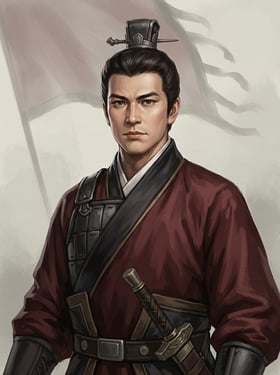
Historical Record
Cao Chun, styled Zihe, was the younger brother of Cao Ren. When he was fourteen, his father died, and he set up a separate household from his elder brother Cao Ren. Cao Chun inherited the family estate; his household was wealthy, with servants and retainers numbering in the hundreds. He managed the household affairs well, maintaining discipline and order so that everything was in good order, and the people of his hometown all praised his ability. Cao Chun loved learning and revered scholars, and many scholars attached themselves to him, so he earned praise both near and far. At eighteen he was appointed Gentleman of the Yellow Gate. At twenty he followed Cao Cao to Xiangyi to recruit troops, and thereafter accompanied Cao Cao on campaign for years on end.
Cao Chun first took part in the military affairs of the Minister of Works as a Court Gentleman for Consultation, and commanded the Tiger and Leopard Cavalry. During the siege of Nanpi, Yuan Tan came out of the city to give battle, and Cao Cao's troops suffered heavy casualties. Cao Cao for a time wished to ease the assault, but Cao Chun advised: "Now that we have come a thousand li deep into enemy territory, if we cannot take it, withdrawing will lose us our military prestige; moreover, an army deep in enemy land cannot hold out long. The enemy is proud because of victory, and we are fearful because of defeat; if we pit a fearful army against a proud enemy, we will surely win." Cao Cao adopted his advice and pressed the assault, and Yuan Tan was finally defeated. The cavalry under Cao Chun's command beheaded Yuan Tan.
Cao Chun then followed Cao Cao north on the campaign against the three commanderies, and his troops captured the Chanyu Tadun at the Battle of Liucheng. For these accumulated achievements he was enfeoffed as Marquis of Gaoling Village with a fief of three hundred households. During the campaign against Jing Province, Cao Chun pursued Liu Bei to Changban, capturing Liu Bei's two daughters and his baggage train, and gathering up Liu Bei's scattered soldiers. Afterward he joined the army in occupying Jiangling and finally followed Cao Cao back to Qiao County. In the fifteenth year of Jian'an (210 CE), Cao Chun died.
After Emperor Wen Cao Pi ascended the throne, he posthumously honored Cao Chun as Marquis Wei. According to the Book of Wei, the Tiger and Leopard Cavalry that Cao Chun commanded were all the bravest and most skilled fighters in the realm, some of them even selected from among commanders of a hundred men. Cao Cao felt it was difficult to find a general capable of commanding this force. After Cao Chun was chosen as their commander, he cared for the soldiers and won their hearts. After Cao Chun died, the responsible officials proposed selecting a new general to replace him, but Cao Cao said: "Where could I find another man like Cao Chun! Can I not command this force myself?" And so he no longer selected a new general. Cao Chun's son Cao Yan inherited his rank and rose to General Who Commands the Army, and in the Zhengyuan era was promoted to Marquis of Pingle Township. After Cao Yan died, his son Cao Liang inherited the rank.
In the Novel
In Romance of the Three Kingdoms, Cao Chun's portrayal is relatively flat, appearing mainly as a relief force for Cao Ren, and his life is far less richly drawn than in the historical record. He first appears in Chapter 51, taking part in the battle between Cao Ren and Zhou Yu at Nan Commandery.
In this battle, Cao Ren sent Niu Jin to lead five hundred troops out to fight, and Ding Feng feigned defeat to lure Niu Jin deep into the Wu formation. When Niu Jin was surrounded, Cao Ren, seeing from atop the city that Niu Jin was trapped, put on his armor, mounted his horse, and led several hundred stalwarts out of the city, fighting his way fiercely into the Wu camp and rescuing Niu Jin. After rescuing Niu Jin, Cao Ren found that several dozen cavalry were still trapped, so he charged into the encirclement again and rescued them. At that moment Jiang Qin blocked the way, and Cao Ren and Niu Jin fought hard to scatter the enemy formation. Just then Cao Chun also led troops up to support them, and a melee with the Wu army ensued. In the end the Wu army was routed, and Cao Ren returned victorious.
The novel's depiction of Cao Chun focuses mainly on his role as Cao Ren's kinsman and military aide, providing support on the battlefield. Compared with the historical record of his commanding the Tiger and Leopard Cavalry, beheading Yuan Tan, and capturing Tadun, the Cao Chun of the novel is more of a supporting character, whose military talent and strategic vision are not fully displayed. Cao Chun's appearances in the novel serve more to set off Cao Ren's valor and their brotherly bond than to shape his own individual image. The records in the histories about his losing his father young, managing the family estate, and loving learning and revering scholars are not mentioned in the novel, reflecting how the novel's emphasis in characterization differs from that of the histories.
Key Relationships
* Cao Ren (kin_of): Cao Chun was the younger brother of Cao Ren. In both history and the novel, the two served together as trusted generals of Cao Cao. In the novel, Cao Chun led troops to support the besieged Cao Ren, displaying their brotherly bond and their coordination on the battlefield.
* Cao Wei (serves): From the age of twenty Cao Chun followed Cao Cao on campaign and was an important general of the Cao Wei regime. He long commanded the elite Tiger and Leopard Cavalry and won great achievements in Cao Cao's unification of the north, forming an important part of Cao Wei's military strength.
Signature Scenes
* Commanding the Tiger and Leopard Cavalry and beheading Yuan Tan: As a Court Gentleman for Consultation taking part in the Minister of Works' military affairs, Cao Chun commanded the elite Tiger and Leopard Cavalry. During the siege of Nanpi, he forcefully advocated a swift, decisive battle and led his troops to behead Yuan Tan, displaying his outstanding military talent and decisive judgment. Cao Cao rated his ability to command troops very highly, even declaring after his death that no one could replace him in commanding the Tiger and Leopard Cavalry.
* Pursuing Liu Bei at Changban: During Cao Cao's campaign against Jing Province, Cao Chun led his troops in pursuit of Liu Bei to Changban Slope, capturing Liu Bei's two daughters and baggage train and gathering up the scattered soldiers of Liu Bei's army. This event is clearly recorded in the histories and was an important victory for Cao Chun in his military operations.
* Supporting Cao Ren at the Battle of Nanjun (novel only): In Chapter 51 of Romance of the Three Kingdoms, Cao Chun led troops to support his elder brother Cao Ren, who was trapped in a Wu encirclement. He and Cao Ren together scattered the enemy formation, helping Cao Ren escape successfully and repel the Wu army. Although this scene is a literary creation of the novel, it highlights Cao Chun's image as an important aide to Cao Ren.
Portrait file
Character profile
- Character
- Cao Chun was the younger brother of Cao Ren and commanded the Tiger-Leopard Cavalry. He pursued Liu Bei at Changban together with Wen Ping, and in the Romance received Cao Ren and besieged Yiling.
- Life
- Cao Chun lost his father at fourteen and inherited the family fortune, becoming immensely wealthy with a great host of servants and retainers. He first took part in the military affairs of the Minister of Works as a Court Gentleman for Consultation, then commanded the Tiger-Leopard Cavalry. He beheaded Yuan Tan at Nanpi, and on the northern campaign against the three commanderies captured the Chanyu Tadun; at Changban he pursued Liu Bei and seized his baggage train. He was enfeoffed as Marquis of Gaoling Village with a fief of three hundred households, and died in the fifteenth year of Jian'an; after Emperor Wen ascended the throne, he was given the posthumous name Marquis Wei.
- Anecdotes
- The Tiger-Leopard Cavalry that Cao Chun commanded was an elite force, and Cao Cao held that no one could replace Cao Chun in leading these horsemen.
Relationships
2 relationships
Family1
Other1
Chapters3 回 ▸
- 史ch.9ch.18
- 演ch.51
Inner monologues · AI-generated1 段 ▸
- I am Cao Chun, courtesy name Zihe. The highest point I reached in life was not the day I was enfeoffed as a marquis, nor
Life events3 ▸
- 0205-01-01 · NanpiBattle of Nanpi· Warrior
- 0208-01-01 · JianglingBattle of Jiangling· Warrior
- 0209-01-01 · YilingGan Ning's Capture of Yiling· Warrior