Origins
The first year of Zhengyuan saw the palace coup in which Emperor Cao Fang was deposed and replaced by the Prince of Gaogui Township, Cao Mao; Sima Shi's rapid consolidation of power in Luoyang had already aroused unease among commanders in the Huainan region. General-in-Chief of the East Guanqiu Jian and Inspector of Yangzhou Wen Qin had both benefited from the grace of the Caowei founder-line and deeply resented Simashi's monopoly on power. In the first month of the following year, the two men raised troops in Huainan under the pretext of "avenging the deposed emperor" to attack Sima Shi [c:17144]. The choice of Shouchun as the staging ground for the uprising was deliberate: it was both the political and military center of Huainan and adjacent to Wu, making it convenient to draw on Eastern Wu as an external ally should the campaign go badly. In the novel's structural scheme this rebellion is a critical node in the overarching plotline of "Simashiduoquan," representing the last collective act of resistance by Wei's loyal old ministers against the transfer of central military authority.
Participants
The three core figures on the rebel side were: Guanqiu Jian, skilled at managing troops and having twice campaigned against Goguryeo — at the time one of Wei's most battle-seasoned frontier commanders; Wen Qin, brave but lacking strategic vision, the main provider of local military manpower; and Wen Yang, representing the most charismatic young warrior type in the Huainan forces, whose episode of single-handedly charging in and out of enemy lines is rendered with lavish detail in the novel [c:17144]. The core on the suppression side was Sima Shi himself, along with first-line commanders Zhuge Dan, Deng Ai, Wang Ji, and Fu Gu. Sima Shi personally led the campaign despite suffering excruciating pain from an eye tumor, demonstrating that he understood this battle to be a matter of life or death for Simashi's central authority.
Decisive Turn
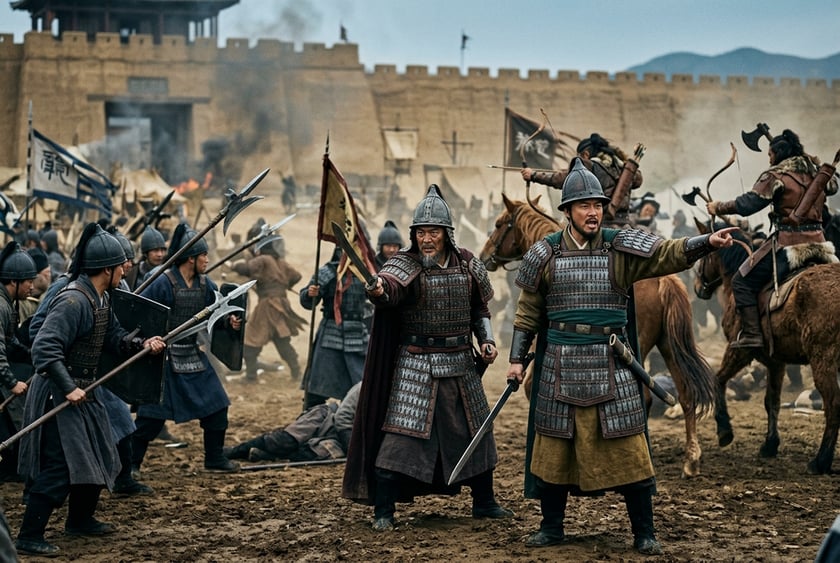
The critical turning point was the night assault by Wen Qin and his son — they attempted at Lejia to strike with five thousand elite troops while Sima Shi's encampment was not yet fully established, hoping that a lightning assault could reverse the disparity in numbers [c:17144]. Wen Yang's entrance is immediately emphasized: "eighteen years of age, eight chi tall, fully armored, with a steel mace at his waist" — the novel here provides full buildup for the solo-charge episode to come. However, Wen Qin's other column became lost in the mountain roads and failed to arrive simultaneously with his son; the night assault was left with only Wen Yang's column to engage alone. Sima Shi held firm despite his agony, relief forces closed in from all sides, and Wen Yang was eventually forced to withdraw — the novel's celebrated "Wen Yang charging in and out seven times" grew from this moment. This failure determined the fate of the entire rebellion.
Suppression and Outcome
After the night assault failed, Wen Qin retreated; Guanqiu Jian withdrew to Xiangcheng, whereupon Sima Shi ordered multiple columns to close the encirclement. The novel arranges for Zhuge Dan to attack Shouchun, Hu Zun and Wang Ji to block the retreat routes, and Deng Ai to mop up at Lejia. Wen Qin ultimately fled to Wu and the court of Sun Jun. Guanqiu Jian was killed by a local inhabitant while fleeing, and his head was sent to the capital. Although Sima Shi died of illness in Xu Chang not long after the campaign ended, he had already completely consolidated central control over Huainan. After the war, Sima Zhao took over as Grand General and Recorder of Affairs, in practice completing the hereditary transfer of power within the Simashi clan — a pivotal step. The chain of political consequences makes clear that this battle was not merely a military victory; it was the turning point at which Simashi's hereditary monopoly on central military authority became institutionalized.
Historical Legacy
This rebellion had several long-term structural consequences. First, it thoroughly suppressed the willingness of the southeastern frontier commanders to resist the center; Zhuge Dan's subsequent rebellion, though larger in scale, was already a final desperate gamble. Second, it left in the literary tradition the legendary figure of Wen Yang; the "single-handedly charging in and out seven times" in chapter 110 of the novel became a progenitor-motif for later narratives of martial valor. Third, from the perspective of the Weijinchandai, this battle accomplished the clearing of the ground for Simashi to complete the generational handoff "from Shi to Zhao" — without this clearing, the path for Sima Zhao to replace Wei could not have been completed within a decade or so. From a wider vantage point, the Wuqiujianwenqinzhiluan reflects a common pattern: once the tension between centralized authority and frontier autonomy tips out of balance, the "legitimizing packaging" of "rising under a secret imperial edict" that frontier commanders adopt is nearly guaranteed to fail when the new center has already completed its control of the palace script — the true outcome of a rebellion is decided before the first battle, in the phase of political preparation.