Background
The seeds of the case of Empress Fu's deposition and execution had been sown as early as the Dong Cheng Girdle Edict affair in the fifth year of Jian'an. After that plot to assassinate Cao Cao was exposed, the anti-Cao forces around Emperor Xian were purged, and Empress Fu Shou, out of fear and resentment, wrote to her father Fu Wan, asking him to find a way to deal with Cao Cao. Fu Wan, a mere consort-kin, knew well the vast disparity in strength and never dared to act, and so the letter became a time bomb lying dormant for years. By the nineteenth year of Jian'an, five years after Fu Wan's death, the old letter at last leaked into Cao Cao's hands. By this time Cao Cao had already been enfeoffed as Duke of Wei and granted the Nine Bestowments, his power dominating the court; eliminating the last consort-kin force around Emperor Xian was a logical step in his process of hollowing out the Han court.
Principal Figures
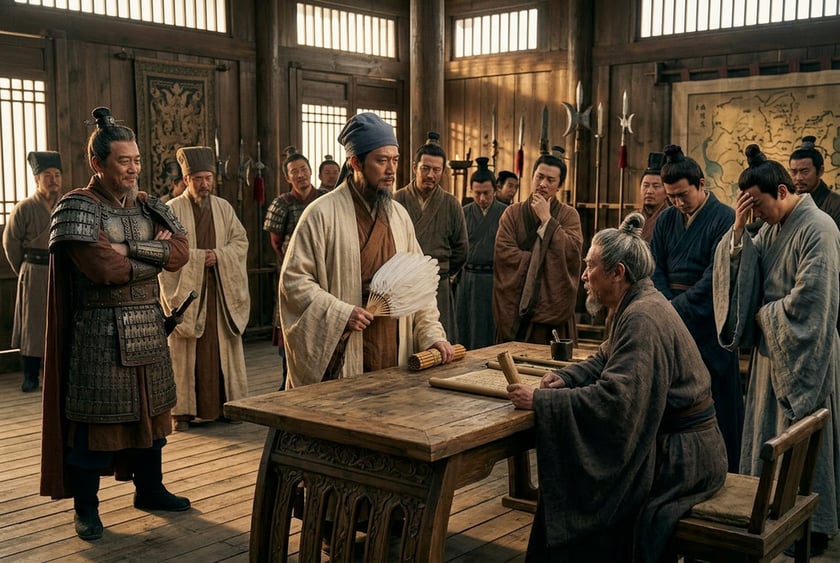
The roles of the various parties in the affair were sharply distinct. Cao Cao was the mastermind behind the scenes; he needed not appear in person—he had only to force Emperor Xian to issue an edict deposing the empress, packaging a political purge as "a family matter of the emperor." The executors were the Imperial Counselor Xi Lü and the Prefect of the Masters of Writing Hua Xin—especially Hua Xin, who led troops into the palace and with his own hands dragged Fu Shou out from the double wall where she had hidden, in the most vivid and most reviled scene of this atrocity. Emperor Xian of Han (Liu Xie) was a helpless bystander; faced with the empress, hair disheveled, weeping, "Can you not keep me alive?", he could only reply, "I myself do not know when my own life will end," words that capture all the desolation of a puppet Son of Heaven. Fu Shou herself was the victim of this reckoning of power, and though her father Fu Wan had long since died, the old letter still dragged down the entire clan.
Core Issues
The core of this case was the final showdown between Cao Cao and the residual power of the Han court. The ostensible charge was that the empress "harbored malice and plotted against a senior minister," but the true issue was this: on the eve of Cao Cao's next advance, he could by no means tolerate the existence within the palace of any node capable of coalescing opposition. The Fu clan, as Emperor Xian's consort-kin by marriage, was precisely such a node. It is worth noting that Cao Cao chose to handle it through the legal form of "deposing the empress" rather than a naked coup, both preserving the ritual-legal shell of the Han and utterly clearing away the substantive threat—this was exactly Cao Cao's habitual "holding the Son of Heaven" technique: making the emperor sign with his own hand the very edict most damaging to himself.
Political Consequences
Empress Fu was confined and died in the Lateral Courts, her two sons were poisoned, more than a hundred of the clan were executed, and nineteen of her mother's kin were banished to Zhuo Commandery; the house of Fu was all but torn up by the roots. The more far-reaching consequence was a change in the political structure: the following year, three women including Cao Cao's daughter Cao Jie entered the palace as Honored Ladies, and before long Cao Jie was installed as empress. The Han inner palace thus passed from the consort-kin hands of the Fu into the control of the Cao—Emperor Xian was from then on surrounded even in his inner court by Cao Cao's daughters. This step, dovetailing with the enfeoffment as Duke of Wei and elevation to King of Wei, marked the hollowing-out of Han sovereign power to a mere name, and paved the way for Cao Pi to supplant the Han five years later.
Counterfactual Speculation
Suppose Fu Shou's old letter had never leaked—could the Fu clan have come to a good end? Likely this would only have delayed, not averted, the outcome. In the course of advancing his design to supplant the Han, any force around Emperor Xian possessing consort-kin status and potential rallying power would sooner or later have been cleared away—Dong Cheng of the Girdle Edict was already a cautionary precedent. The true historical significance of the Empress Fu case lies not in Fu Shou's personal fate but in how it demonstrated Cao Cao's use of the procedure of "legal deposition" to accomplish a political strangulation: both maintaining a formal respect for ritual law and leaving no room for any counterstroke. This deft technique of "using the Han to control the Han" is precisely what set Cao Wei's path to supplanting the Han apart from naked usurpation and made it appear as if it had come about "as naturally as water reaching its channel."