Background
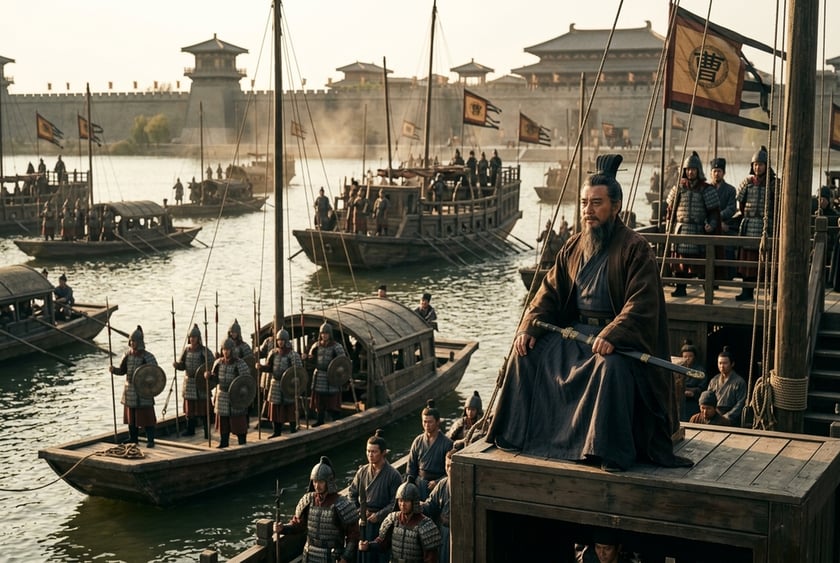
In the first year of Jian'an (196), the Cao Cao faction in Yanzhou stood at a delicate turning point. On one hand, Cao Cao had already consolidated his grip on Yanzhou — he had routed Lv Bu, pacified the Yellow Turbans of Qingzhou, and accumulated a force of three hundred thousand "Qingzhou soldiers," giving him the military foundation to mobilize on a far larger scale. On the other hand, his official standing within the Han court still amounted to nothing more than Inspector of Yanzhou; the title of "foremost among the lords" remained, nominally at least, out of reach. Emperor Xian had made his way eastward from Changan back to Luoyang, yet Luoyang lay in ruins — no palaces, no provisions, ministers picking food among thorns — while the generals escorting the Son of Heaven each acted on their own authority, turning the emperor into a political powder keg that every faction wanted to touch but none dared simply seize. It was precisely at this moment that Mao Jie's proposal — "honor the Son of Heaven to command those who refuse to submit" — furnished a clear path for converting the emperor into political capital, prompting Cao Cao to make the boldest political wager of any lord in the late Han.
Key Figures
The central figures of this event are the strategists and executors of the Yanzhou faction. Mao Jie, serving as the Administrator of Yanzhou, was the first to articulate the dual-track formula of "honoring the Son of Heaven to command those who refuse to submit, and cultivating agriculture to accumulate military resources" — binding political legitimacy to economic sustainability as a unified grand strategy. Dong Zhao was the indispensable executor: originally attached to the camps of Zhang Miao and Zhang Yang, he switched to Cao Cao's side and then leveraged his old ties with Yang Feng by writing Yang Feng a letter in Cao Cao's name. This convinced Yang Feng to accept an arrangement whereby "Cao, Inspector of Yanzhou, would supply grain and fodder while the Han Son of Heaven relocated his capital," thereby dissolving the instinctive wariness the escort generals felt toward an outside lord entering Luoyang. Cao Cao himself was the supreme decision-maker, integrating Mao Jie's strategic agenda with Dong Zhao's personal-network maneuvering into a concrete political action. Emperor Xian, Liu Xie, remained the central figure throughout the event — yet was passive at every step; Yang Feng, Han Xian, and Dong Cheng, as escort generals each commanding their own forces, were divided and neutralized one by one through Dong Zhao's behind-the-scenes manipulation, and ultimately lost effective control over the Son of Heaven.
Core Issues
Receiving and honoring the Son of Heaven required the Cao Cao faction to navigate three interlocking difficulties. The first was the question of "strategy before action": when Mao Jie first put forward his proposal, many of the Yanzhou advisors still regarded the emperor as a "leaking vessel" and were reluctant to get involved; Cao Cao not only adopted Mao Jie's recommendation but established it as the overall direction of the Yanzhou faction — a decision that in itself demonstrated strategic judgment surpassing his peers. The second was "how to divide the escort generals": Yang Feng, Han Xian, and Dong Cheng all might have become opponents; Dong Zhao adopted the approach of "first drawing Yang Feng in, then engineering a rift between Yang Feng and Han Xian," weakening them one by one, so that Cao Cao's forces entered Luoyang without any direct armed confrontation. The third was "how to persuade the emperor to leave Luoyang": though Luoyang lay in ruins, it was still the old dynastic capital with its ancestral temples, and a relocation had to overcome the psychological resistance of both emperor and court. Cao Cao used the practical pretext of "insufficient grain supply in Luoyang — grain depots must be drawn from closer by" to package the move as a temporary arrangement, ultimately persuading Emperor Xian to accept the transfer of the capital to Xudou. This sequence of operations together exemplifies the Cao Cao faction's three-stage political execution style: "set the strategic agenda, align personnel to support it, and persuade through practical rationale."
Political Consequences
The most immediate consequence of the event's success was that in the ninth month of the first year of Jian'an, Emperor Xian relocated the capital to Xudou, and Cao Cao formally issued commands in his capacity as Han Chancellor. From that point forward, his campaigns against other lords could be dispatched under imperial edicts, so that every military action simultaneously carried the moral authority of legitimacy. Medium-term consequences included: the emperor's permanent residence in Xudou enabled Cao Cao to construct, across political, ritual, and personnel dimensions, a proto-court centered on himself; Yang Feng, Han Xian, and Dong Cheng were each before long either marginalized or eliminated, the escort generals' coalition disintegrated entirely, and the personnel networks around Emperor Xian were rebuilt by Cao Cao from scratch. In the long run, the strategy of "honoring the Son of Heaven," pursued in parallel with the same year's launch of military farming colonies, secured for Caowei both a stable grain supply and a moral advantage in the lead-up to and through the Battle of Guandu. It was the most fundamental institutional foundation for defeating Yuan Shao, absorbing Hebei, and ultimately establishing an independent kingdom.
Counterfactual Analysis
Suppose Mao Jie had not proposed "honor the Son of Heaven to command those who refuse to submit" in the first year of Jian'an — Cao Cao might still have considered receiving the emperor at a somewhat later time, but the strategic moment would have been entirely different. Had Yuan Shao heeded the counsel of Ju Shou and Tian Feng and moved first to receive the emperor, Cao Cao would have been permanently shut out of this resource; the whole late Han political balance would have tilted northward, and Yecheng rather than Xudou would have become the political center. Conversely, had Cao Cao received the emperor in the first year of Jian'an but not simultaneously pursued military farming, he would have faced the fiscal reality of "being unable to support an entire court"; the "honor the Son of Heaven" strategy might have become a hollow shell within two years, insufficient to sustain subsequent large-scale operations. Finally, had Dong Zhao failed to open up Yang Feng, Cao Cao might have been compelled to take over the emperor by force, triggering a direct military clash with the escort generals — which in turn would have given other lords the pretext of "Cao Cao abducting the Son of Heaven" to assemble a coalition against him, turning Cao Cao into everyone's target instead. All three scenarios together demonstrate why receiving and honoring the Son of Heaven became the true watershed in Cao Cao's rise: it was precisely because the three layers of "strategic agenda, personnel operations, and economic infrastructure" came together in precise coordination at one and the same moment — not one layer of which could be missing.