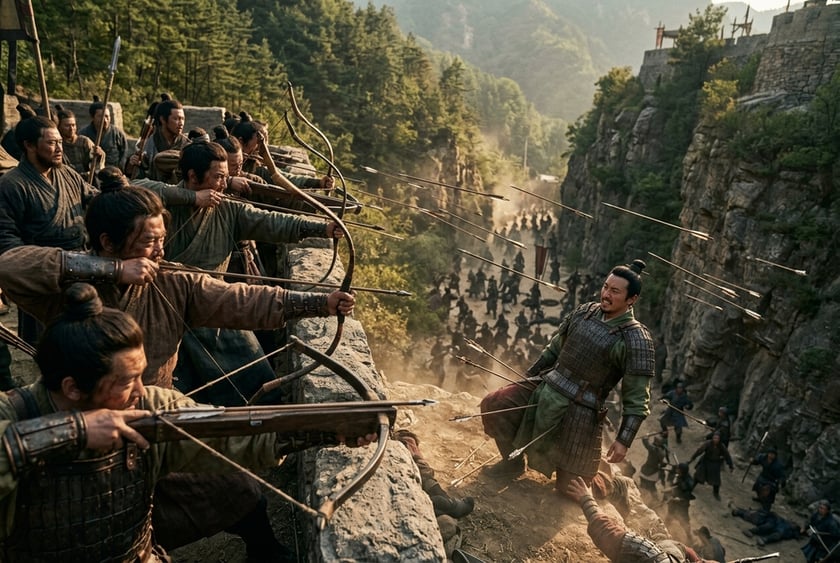
Background
The Chuping years were the most chaotic period in the political order of the late Han. After Dong Zhuo's death, Guanzhong was controlled by Li Jue and Guo Si, and Emperor Xian wandered without a stable home. The lords east of the mountains nominally operated under the banner of the Allied Forces to Punish Dong, but in practice attacked one another without any unified command. Cao Cao had just pacified the Yellow Turbans of Qingzhou and established himself at Juancheng in his capacity as Governor of Yanzhou; the newly reorganized Qingzhou troops provided manpower, but the fiscal base and political legitimacy were still far from secure. Mao Jie, a man of Chenliu, entered Cao Cao's staff and was appointed Administrator of the Interior — one of the most senior civil positions at the prefectural level, whose duties by nature required offering long-range planning at the strategic level.
Key Figures
Mao Jie came from humble origins, unlike many of the aristocratic shidafu of his era; he built his reputation on "integrity and a plain lifestyle," and for a long time was the representative figure in Cao Cao's staff who stood for "impartiality in conduct and frugality in appointments." The fundamental problem Cao Cao urgently needed to solve at this moment was how to convert military power into sustainable political capital. Yuan Shao and Liu Biao occupied far larger territories but had not adopted "championing the imperial house" as their banner — Yuan Shao had even attempted to enthrone Liu Yu as a rival emperor. Against this backdrop, the plan Mao Jie put forward had structurally differentiated value.
Core Arguments
Mao Jie's counsel can be decomposed into three layers. The first was a diagnosis of the situation: "the realm is fractured, the ruler has been displaced, the people have no settled will, and the state has no accumulated stores"; Yuan Shao and Liu Biao, though commanding many troops and people, had "established no foundation and built no base." This diagnosis was more sobering than most strategic papers of the era, and directly pointed out that the powerful are not equivalent to the winners. The second was the path to legitimacy: "uphold the Son of Heaven to command those who are insubordinate." The key to this phrase was not receiving Emperor Xian in itself, but using the name of the Han house to elevate military action from "regional warlord melee" to "the center suppressing rebels" — thereby branding all opponents as "those insubordinate to the throne." The third was the fiscal path: "cultivate agriculture to stockpile military supplies." This concept later materialized directly as the Xu commandery military-colony system, yoking the wasteland and displaced population of wartime into a state food-producing machine. The two paths interlocked — the first answered "why fight," the second answered "with what to fight" — together forming the twin pillars of an enterprise of supremacy.
Political Consequences
Cao Cao respectfully adopted this strategy and transferred Mao Jie to the positions of Administrator of the Interior and East Section Chief — both posts controlling the selection of personnel — through which Mao Jie long guarded the talent intake point of the Cao staff, exerting enormous influence on the clean and temperate character of early Caowei's bureaucracy. In terms of strategic implementation: in the first year of Jian'an, Cao Cao received Emperor Xian into Xudou, translating "uphold the Son of Heaven to command the insubordinate" from policy paper into action; the same year large-scale military colonies were launched, converting "cultivate agriculture to stockpile military supplies" from a slogan into an institution. Once both paths were activated simultaneously, Cao Cao achieved a structural lead over Yuan Shao and Liu Biao in both political legitimacy and fiscal sustainability. When Jia Xu later counseled Zhang Xiu to submit to Cao Cao, he said explicitly that "Cao Cao upholds the Son of Heaven to command the insubordinate" — demonstrating the real influence this banner held in the Central Plains political marketplace.
Counterfactual Analysis
Had Mao Jie's counsel been proposed several years later, the gap between Cao Cao and Yuan Shao could only have been bridged through sheer military risk — given the odds at the Battle of Guandu, Cao Cao without a legitimacy advantage could scarcely have held on for long. Had Cao Cao not adopted this strategy, thinking along the lines common to the eastern lords of the era, he might have leaned toward the shorter-term gambit of "enthroning a royal clansman" or "holding Emperor Xian as a human shield" — a gambit that appeared many times in the late Han but never produced a durable regime. Conversely, had Yuan Shao earlier accepted Ju Shou's counsel to "hold the Son of Heaven hostage to command the lords" (which in fact he rejected), the dividends of this strategy would have accrued to Hebei and the initial conditions of the entire San Guo script would have been completely rewritten. From a longer perspective, Mao Jie's initiative represents the first time that shidafu of humble origins designed a "legitimacy plus fiscal" institutional package for a new type of regime in the great political upheaval of the late Han — a model whose demonstration effect extended to Caowei's military-colony system, the Nine-Rank System, and the early governance structure of Western Jin.