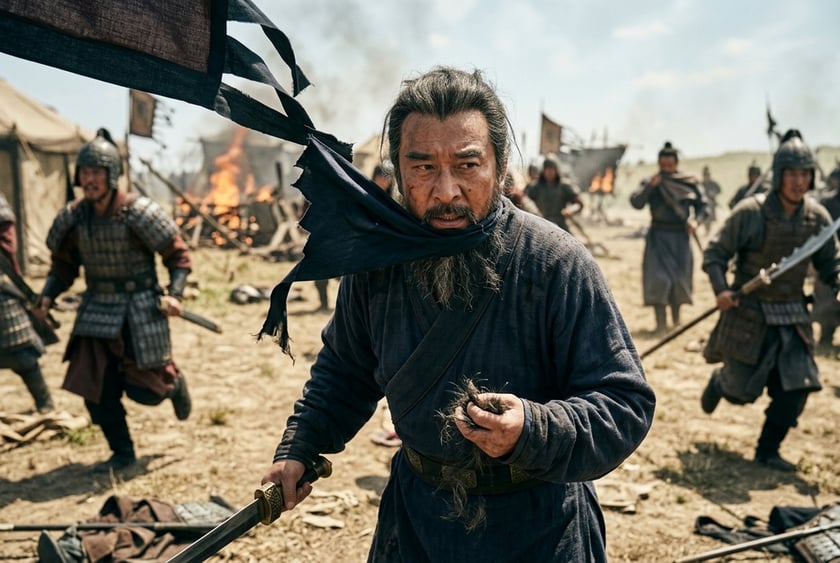
Background
The Emperor Xian of Han in the first year of Jian'an (196) was a Son of Heaven who had been wandering without shelter. Having moved eastward out of Changan, he was first seized by the rebel armies of Li Jue and Guo Si along the way, then fought over by escort generals Yang Feng, Han Xian, Dong Cheng, and others, before eventually arriving in halting steps at the old capital of Luoyang — only to find Luoyang devastated, the palace buildings gone, provisions inadequate, and the ministers unable to sustain themselves. At this moment, the warlords of the Pass-East region were broadly taking a wait-and-see attitude toward "whether to welcome and serve the Son of Heaven": within Yuan Shao's staff, Ju Shou and Tian Feng advocated welcoming the Emperor, but Yuan Shao hesitated and could not decide; Gongsun Zan, Liu Biao, and Yuan Shu each had their own calculations. Cao Cao, acting decisively on the strong recommendation of Xun Yu and Mao Jie, moved first to lock in the political resource of "honoring the Son of Heaven in order to command the lords" during the most critical time window — his moral legitimacy thereby leaped ahead of all other warlords in a single bound.
Key Figures
The most central decision-maker in the event was Cao Cao himself, but the true providers of strategic guidance were two advisors from the Yanzhou bloc: Xun Yu, approaching from the big picture, put forward "honoring the sovereign in order to accord with popular hopes" and "upholding great righteousness to attract brilliant talent"; Mao Jie had even earlier proposed "honoring the Son of Heaven in order to command those who refuse to submit, and cultivating agriculture in order to accumulate military resources" — the two together constructed the two-track rationale for bringing the Emperor to Xu. At the execution level, Dong Zhao was the driving force: serving as the key "inside operative" in this event, he worked through letters back and forth to open the channels between Cao Cao and the escort generals such as Yang Feng, and designed the relocation route that would draw the Son of Heaven from Luoyang toward Xu County. Cao Hong, as military representative, led forces into Luoyang — the executor who turned the plan into action on the ground. Emperor Xian Liu Xie himself was at the center of the event but passively accepted every arrangement throughout; escort generals Yang Feng, Han Xian, Dong Cheng, and others were each marginalized or co-opted in the course of the capital relocation.
Core Issues
In bringing the Emperor to Xu, the Cao Cao faction needed to resolve three layers of difficulty. The first was "choosing the location": Luoyang as the old capital had no capacity to sustain the court; Changan was too distant to reach; Yecheng was within Yuan Shao's sphere; Xu County was selected as the new capital for being centrally located, having grain stores, and being closest to Cao Cao's base. The second was "the contest for the escort authority": escort generals such as Yang Feng, Han Xian, and Dong Cheng each controlled a portion of the escort forces, placing them in a contested relationship with Cao Cao over seniority; Cao Cao chose Dong Zhao as a back channel, first splitting then absorbing, stripping Yang Feng and Han Xian of actual control over the Son of Heaven. The third was "rebuilding the economic base": simply relocating the Son of Heaven to Xu County did not solve the problem — it was necessary to simultaneously rebuild the fiscal capacity to support the Emperor and the court; accordingly, "the initiation of land reclamation" (Shixingtuntian) is a sub-event within this event — Cao Cao promoted military and civilian land reclamation around Xu County, exchanging low rents and labor levies for population and output, transforming "honoring the Son of Heaven" from a political posture into a sustainable system of support. Resolving all three issues at the same time was the core of what made bringing the Emperor to Xu truly successful.
Political Consequences
The political consequences of the event unfold across three layers — short, medium, and long term. In the short term, Cao Cao obtained the highest political identity of "Han Chancellor"; henceforth whenever he campaigned against any party, he could issue orders under an edict of the Han Son of Heaven. Between the first and fifth years of Jian'an he continuously used edicts to maneuver Xuzhou, Huainan, Guanzhong, and other warlords, compelling them either to "respond to the edict and enter Xu" or to "defy the edict and betray the Han" — placing opponents in a morally passive position. In the medium term, Xu County became the political center of the Han-Wei transitional period; the official system, ancestral temples, and ritual music of Caowei were gradually assembled with Xudou as their base; simultaneously the land reclamation system allowed the Cao army to accumulate sufficient grain before the Battle of Guandu, establishing the material basis for the decisive battle against Yuan Shao. In the long term, the political model of "honoring the Son of Heaven in order to command the lords" became the template for the transition from strongman to dynastic founder throughout the Chinese imperial era — from Cao Cao to the Simashi, through the multiple abdications of the Northern and Southern Dynasties — all find their prototype in this event.
Counterfactual Analysis
Suppose Yuan Shao had heeded Ju Shou and Tian Feng's counsel and moved first to welcome the Son of Heaven to Yecheng: Cao Cao would have lost this most critical political resource, and his expansion across the Central Plains would have had to rely entirely on military conquest alone — its speed and moral legitimacy would both have been significantly diminished; the Cao-Yuan showdown script at Guandu might never have materialized, since without imperial edicts to drive peripheral warlords to maintain neutrality or a watching brief, the dynamics would have been entirely different. Conversely, had Cao Cao chosen not to relocate the capital but instead installed the Son of Heaven in the ruins of the old Luoyang palace, he would have been unable to simultaneously establish an independent fiscal base from the Xu County land-reclamation harvest — "honoring the Son of Heaven" would have become an empty shell with ceremony but no substance; escort generals such as Yang Feng, Han Xian, and Dong Cheng might also have seized the opportunity to rise again and retake control. Finally, had Cao Cao not simultaneously promoted land reclamation after welcoming the Son of Heaven, his military grain would have remained long dependent on local land taxes, leaving him unable to sustain the consecutive major campaigns of the Battle of Guandu and the pacification of the Yellow River north — the San Guo configuration would very likely have remained frozen in the old shape of "Yuan strong, Cao weak." The reason bringing the Son of Heaven to Xu became the true watershed of Cao Cao's rise is precisely that it completed the integration of "moral legitimacy, geographical control, and economic base" at the same moment.