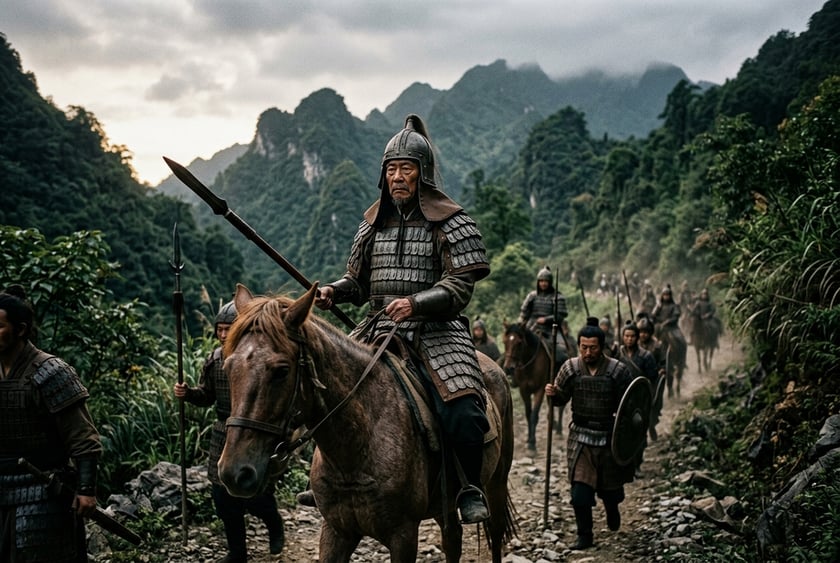
Strategic Background
The Battle of Lejia in the second year of Zhengyuan was the decisive engagement of the second Huainan revolt. Sima Shi personally led the main force north with the objective of defeating Guanqiu Jian and Wen Qin in detail before their forces could fully assemble. Strategically, the rebel army's core vulnerability was the absence of a secure rear area: their base of Shouchun was pinned down by Zhuge Dan, and the field army depended entirely on open-country maneuvering to maintain morale. Wen Qin's response plan was to split father and son into two converging prongs attacking Sima Shi's central army in a pincer: Wen Yang striking from the north, Wen Qin from the south, arranged to simultaneously break into the Wei camp at the third watch of the night. The tactical concept was not without merit — a night raid with a double-pronged pincer was a classic anti-encirclement approach — but it depended critically on the two force elements being precisely synchronized and fully coordinated.
Deployments
On the Wei side, Sima Shi personally led the main army in establishing camp at Lejia, waiting for Deng Ai's forces to link up before launching the decisive engagement. This was a classic "resting troops in wait for a fatigued enemy" deployment — the main force dug in solidly, relying on the fresh reinforcements to double the battlefield advantage. Sima Shi himself was in extremely poor physical condition, having just had an eye tumor surgically removed, and armored soldiers stood guard in a ring around his tent — an exposure window that was fatal when it came to a night raid. On the rebel side, the force led by Wen Qin and his son Wen Yang was relatively limited in size, but possessed two major advantages: surprise plus the personal bravery of the commanders. Wen Yang himself was not yet twenty years old and was the core strike force under Wen Qin's command; Wen Qin coordinated the outer circuit, and was supposed to launch the southern attack simultaneously at dawn.
Key Decision Points
This battle had three key decision nodes. The first was that Wen Yang arrived as promised at the third watch and struck north into the Wei camp on schedule — he delivered his part, charging left and right, invincible in all directions, and repeatedly fighting his way to the central command. The second was that Wen Qin failed to launch his coordinated southern attack on schedule — the novel does not explicitly explain the reason, but from the outcome it appears the southern force either lost its way or made a last-minute change of formation and failed to reach the designated position at the appointed time. This failure was the fundamental cause of the night raid's ultimate undoing. The third was Wen Yang's withdrawal decision when dawn came and he found his father had not arrived and Deng Ai's fresh forces had: he chose not to linger in battle and rapidly withdrew south, and during the withdrawal repeatedly turned back alone on horseback to charge the pursuers, driving them off four or five times in succession. These three decisions together present the standard template of Wen Yang as a young martial prodigy — strong in execution, courageous in the face of the enemy, decisive in the judgment to withdraw.
Outcome and Resonance
The military outcome was that the rebel night raid failed to defeat Sima Shi; but Sima Shi's eye condition worsened severely under the strain of the battle — his eyeball burst from its socket — and he died not long after the Battle of Lejia. From a purely military standpoint, Wen Yang did not defeat Sima Shi; but from the perspective of political consequences, he indirectly caused Sima Shi's death, bringing forward the succession of central power in Caowei — Sima Zhao succeeded his brother in command, and the political background of the third Huainan revolt was thereby altered. Wen Yang personally made his name in this battle; the assessment of him as "braver than Xiang Ji" made him the most prominent symbol of personal martial valor among commanders in the later San Guo period. His subsequent career — surrendering to Eastern Wu, then repeatedly moving between Wei and Wu as a Wu general, ultimately killed by the Simashi in the early Western Jin — ended in tragedy. This battle was also one of Deng Ai's most important battlefield performances before the Shu campaign: at the critical moment when Sima Shi was gravely ill, he stepped forward and fought Wen Yang to a standstill, demonstrating that he possessed the qualifications of a field army commander.
Counterfactual Analysis
Had Wen Qin's southern force arrived on schedule, the rebel army's complete pincer attack on Sima Shi's central command at the third watch would, with Sima Shi in his gravely ill state, have been quite capable of killing him in the field — the rebel forces would have achieved a tactical victory far exceeding expectations. But even so, the structural weakness of the rebel army's lacking a secure rear base would still have led to their defeat within months — a momentary tactical victory cannot reverse an overall strategic disadvantage. Had Wen Yang not launched the night raid but instead met the Wei army in conventional engagement, the rebel forces were already at a numerical disadvantage and defeat in open battle was inevitable. Had Wen Yang not dared to turn back and charge during withdrawal, he might have been surrounded and killed by Wei great commanders in the pursuit, and once Wen Qin lost him as his core fighting commander, collapse would have come even faster. Seen from this angle, Wen Yang's martial performance was simultaneously the greatest highlight of this battle and the only tactical capital the rebel forces could demonstrate from a position of strategic disadvantage. It is worth noting that Wen Yang's bravery at Lejia is attested in the official historical record (the Wei Shi Chunqiu, the Jinji, and others), broadly matching the novel's version; the novel's expansion at this point is primarily in the realm of literary rhetoric and does not depart from the historical framework. Sima Shi's worsening eye condition and death are also clearly recorded in the official histories, and the novel's direct causal link to Wen Yang's night raid is a logically defensible narrative treatment.