Background
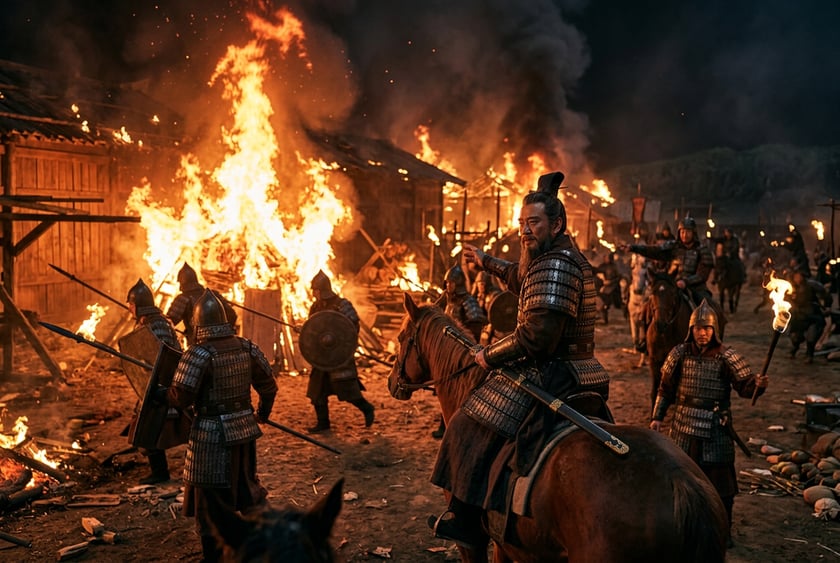
In the first year of Jian'an, Cao Cao welcomed Emperor Xian and established the capital at Xu, having just grasped the political lever of "holding the Son of Heaven to command the lords." At this moment the eastern situation harbored a hidden worry: Liu Bei held Xu Province and governed it on his own authority, while Lü Bu, defeated in battle, had come to take refuge and been settled at Xiaopei. Cao Cao feared that, should the two join hearts and lead troops to invade, they would become a deadly threat at his core, and so he gathered his advisors to discuss how to break up this potential alliance in advance. Xu Chu advocated simply sending fifty thousand troops to take both men's heads, but Xun Yu vetoed a frontal assault—Xu had only just been settled and was no place for rash use of arms; the surer course was to use a scheme to "borrow a knife". This council is a textbook sample of the Cao Cao faction converting a military problem into political estrangement.
Principal Figures
On the scheming side, Xun Yu was the brain and Cao Cao the decision-maker: Xun Yu devised the plan, and Cao Cao adopted it and carried it out concretely in the name of the Son of Heaven. On the receiving side were Liu Bei and Lü Bu, the very "two tigers" the scheme meant to set against each other. The decisive counter came from Liu Bei—faced with Zhang Fei's goading that "Lü Bu is without honor; what harm in killing him?", he refused, saying "to kill a man who has come to take refuge in his distress is unrighteous", and went further by showing Cao Cao's secret letter directly to Lü Bu, exposing the estrangement to his face. Yuan Shu, meanwhile, was cast as the "wolf" set to attack Liu Bei in the subsequent "Driving the Tiger to Devour the Wolf," an external variable to be set in motion.
Core Issues
The ingenuity of the Stratagem of Two Tigers Fighting over Food lay in its "win-win estrangement": petition to invest Liu Bei substantively as Governor of Xu Province, then secretly order him to kill Lü Bu—if it succeeded, Liu Bei would lose the support of a fierce warrior and could be dealt with at leisure; if it failed, Lü Bu would turn and kill Liu Bei—either outcome favoring Cao Cao. Its venom lay in bundling together the delivery of "favor" (granting office) and "command" (killing a man), trapping the recipient in a dilemma whether he accepted or not. But this calculation had one uncounted variable: Liu Bei's political judgment and moral posture. Liu Bei saw through it as a design to "make the two devour each other while he reaps the profit from within," and defused it with unruffled candor—he refused to play the "tiger" in the script Cao Cao had set.
Political Consequences
After the first scheme came to nothing, Xun Yu immediately rolled out the "Stratagem of Driving the Tiger to Devour the Wolf": tipping off Yuan Shu to lure him into attacking Liu Bei, and forging an edict ordering Liu Bei to campaign against Yuan Shu, still hoping to make the two sides devour each other while breeding discord in Lü Bu. This linked stratagem shows that the Cao Cao faction's estrangement was systematic and iterable, with a follow-up ready when one scheme failed. In the short term, Liu Bei's defusal preserved a surface harmony with Lü Bu; but Xu Province was, after all, a powder keg of three-way struggle among Cao Cao, Lü Bu, and Liu Bei, and once the seeds of estrangement were sown, the later episode of Lü Bu seizing Xu Province and Liu Bei losing his ground still moved toward the internecine outcome Cao Cao was glad to see.
Counterfactual Speculation
It must first be noted that this is a fictional scheming episode invented by the Romance; there is no clear historical record of Xun Yu offering these two stratagems, and their purpose is to shape Xun Yu's wisdom and Liu Bei's benevolence. Even reasoning within the novel's own logic: had Liu Bei coveted the "substantive grant" of the governorship of Xu Province and actually moved to kill Lü Bu, then whether he succeeded or failed he would at once have fallen into the dire straits of losing his support or being killed—right into Cao Cao's hands; by choosing to hold to righteousness and break the scheme with sincerity, he both preserved his moral image and avoided being the "borrowed knife." The deeper meaning of this passage is that even the most meticulous estrangement cannot defeat the clear-headedness of a target who refuses to act according to the script; in matters of intrigue, victory or defeat often depends on whether the opponent is willing to play that "tiger fighting over food."