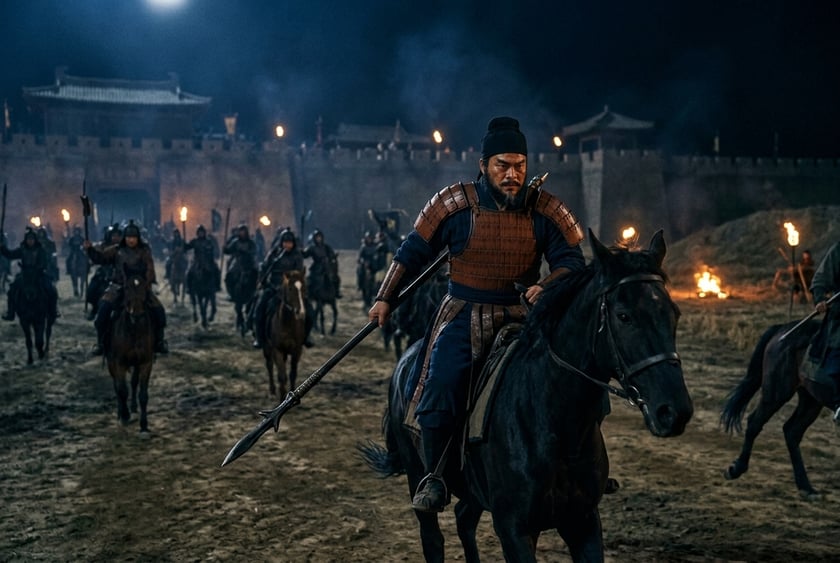
Strategic Background
During the Yanxi reign (238–257), the first two supreme commanders of Shuhan — Zhuge Liang, then Jiang Wan and Fei Yi — had died one after another. Under Fei Yi's administration, policy was "protect the borders and let the people rest," holding Jiang Wei's appetite for northern campaigns to the smallest possible scale — no more than ten thousand men per sortie. The first year of Jiaping (249) offered a unique political window: Fei Yi was still present but his authority was waning, the Gaopinglingzhibian had just upended Wei, and Xiahou Ba had defected to Shuhan. Jiang Wei seized the moment to memorialize the Later Emperor for a free hand to pursue the northern campaigns. His strategic concept was "first secure the Qiang peoples as allies, then advance westward from Longxi, which can be severed and held" — shifting the war's center of gravity from a direct thrust at Changan to gradual encroachment on the Longyou region, a path fundamentally different from Zhuge Liang's five sorties to Qishan. [c:16970] Qushan was the first pivot point on this new path.
Opposing Deployments
Shuhan dispatched Ju An and Li Xin with fifteen thousand men to build two forts, one east and one west, on Qushan, establishing a forward base in a flanking relationship with the main base at Hanzhong. [c:16970] Ju An held the eastern fort, Li Xin held Xicheng, and the two forts supported each other. Jiang Wei's main force remained in the direction of Xiping and Yongzhou, preparing to coordinate with Qiang tribal allies. [c:16970] On the Wei side, Yongzhou Inspector Guo Huai directed overall operations. His deputy Chen Tai led fifty thousand troops directly against Qushan in a three-stage deployment: encircle the forts on all sides to cut off external relief; sever the grain supply routes from Hanzhong; and dig earthworks to dam the upstream water and cut off the supply to the forts. This was the classic combination of engineering warfare used against mountain strongholds — cutting Shuhan's mountain fortresses off from outside aid, from supplies, and from water simultaneously.
Critical Decision Points
The first decision point was Jiang Wei's choice to "build the forts before advancing." This approach was tactically reasonable, but it overlooked a critical vulnerability of mountain fortresses to water supply — Qushan was on high ground but had only a single water source, and once the upstream was dammed the entire garrison would be without water. The second decision point was Chen Tai's strategy of "cutting the water." After reconnoitering the terrain he explicitly noted, "This city sits on high ground and will certainly have little water; the men must go outside to fetch it. If we dam the upstream, all the Shu troops will die of thirst." [c:16971] He immediately organized his troops to dig the earthwork dam — this was the decisive engineering action of the entire battle. The third decision point was Li Xin's breakout attempt. In the extreme circumstances of a waterless fort, he led several dozen cavalry in a desperate sortie with the aim of returning to Hanzhong to summon Jiang Wei's main force. But the Shuhan main body was far away in Xiping and could not respond in time; the breakout ended only in his own personal survival, and the entire troop of several dozen was annihilated. [c:16971] The fourth decision point was the late arrival of Jiang Wei's main force. Shuhan's original plan had been to "secure Qiang allies," but the Qiang tribes responded slowly and coordination failed, leaving Ju An to hold on alone until the following year, when he was finally compelled to surrender to Wei.
Outcomes and Echoes
First: the loss of Qushan badly damaged Jiang Wei's strategy of "gradual encroachment on Longyou" from the outset. Although Jiang Wei campaigned north nine more times after this, he never again dared to use the approach of "advancing a hundred li to build a fort" as a strategic foothold, and instead shifted to lighter, more mobile raiding tactics. Second: Deng Ai and Chen Tai distinguished themselves in this engagement, becoming the two pillars of Wei's later campaigns against Shuhan. Deng Ai's penetrating understanding of Shuhan's military farming colonies and mobile tactics began precisely with his observation of Jiang Wei at Jiangweibeifa. Third: Wei began systematic study of the combined threat posed by "internal Qiang-Di unrest plus Shuhan external support," and the Longyou defensive line was subsequently reinforced into an interlocking multi-node system; the lessons of this battle directly translated into defensive architecture. Fourth: domestically in Shuhan, the defeat at Qushan strengthened Fei Yi's position that "we must not move rashly," increased the political pressure on Jiang Wei at court, and caused the Later Emperor to begin wavering in his support for the northern campaigns.
Counterfactual Analysis
Had Jiang Wei abandoned the "build the forts first" deployment and instead sent light cavalry directly into Nan'an and Tianshui, maintaining mobility through fluid tactics, Chen Tai's engineering strategy would have had nothing to aim at — even if the Shu forces could not retake the commanderies, there would have been no isolated garrison like Ju An's to exhaust itself in a hopeless defense. That the approach Jiang Wei did adopt after Fei Yi was assassinated and he gained full independent authority closely resembled this alternative model suggests how high the lesson cost of Qushan actually was. A second counterfactual involves the Qiang tribes responding on time: had the Qiang and Di managed to mount even one credible pinning action during the three months of Chen Tai's siege, Guo Huai's main force would have been compelled to split, and the fate of Qushan might have been reversed — but the political credit between Shuhan and the Qiang tribes was inherently fragile, and this path was not realistic under the political conditions of Jiaping one. The Battle of Qucheng thus became an inverse starting point for Jiang Wei's northern-campaign career — not a victory, but a mirror reflecting the outer limits of Shuhan's capacity for strategic projection.