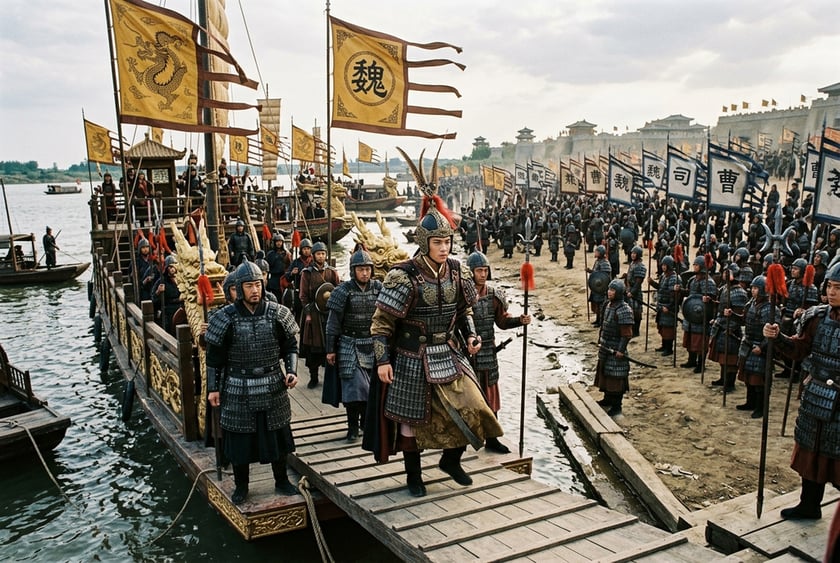
Strategic Background
The first year of Jianxing was the most precarious year for the Shuhan regime. Liu Bei had just suffered the crushing defeat at Yiling and had entrusted the orphaned heir at Baidituogu; the cream of Sichuan's forces had been cut down by more than half. Externally, Caowei was poised to strike; internally, the southern barbarians of Nanzhong were stirring; the newly estranged eastern Wu remained watchful; and the new ruler Liu Chan, just seventeen, had barely ascended the throne, leaving the old ministers at odds over the direction ahead. The "five-pronged assault" opening Chapter 85 of the Romance of the Three Kingdoms dramatizes this crisis in concentrated form — Cao Pi coordinated five directions launching simultaneously, determined to give Shuhan no breathing room. From strategic geography, the five threats blanketed every possible border of Shuhan: to the north, Yangpingguan and Hanzhong were the gateway; to the northwest, the Xiping Pass connected to the Qiang people of Longyou; to the northeast, the direction of Shangyong was Meng Da's former territory; to the south lay the Nanzhong tribesmen; to the east was Wu's gorge crossing — any single prong breaking through would immediately tear open a gap.
Deployments
The Wei deployment was "five routes in name, four genuine and one uncertain" — Cao Zhen, Meng Da, Meng Huo, and Ke Bineng each independently commanded their respective prong, while whether Sunwu would actually send troops or when remained unsettled; Cao Pi had only written to entice them. The Shu deployment was completed entirely by Zhuge Liang behind closed doors: the first prong — Ma Chao (a native westerner who commanded the deep trust of the Qiang people) would hold Xiping Pass, keeping still and refusing to engage Ke Bineng; the second prong — Wei Yan would feint left and appear right, creating phantom forces to confuse the Nanzhong's Meng Huo; the third prong — a forged personal secret letter from Li Yan would be sent to Meng Da, triggering Meng Da's doubts about his own position and causing him to plead illness and stay put; the fourth prong — Zhao Yun would hold the stronghold of Yangpingguan, showing weakness to Cao Zhen and refusing battle; the fifth prong — Guan Xing and Zhang Bao would each command thirty thousand mobile troops as a reserve. The subtlety of this arrangement lay in the fact that for each of the four prongs, the selection of commander was based on "knowing the adversary's psychology" — the Qiang trusted Ma Chao, the tribal soldiers feared phantom troops, Meng Da distrusted a friend's motives, Cao Zhen prized deliberateness — each threat was blocked at minimum cost.
Key Decision Points
The most critical single decision in this entire narrative is not any specific dispatch of troops, but Zhuge Liang's choice to "feign illness and refuse to let anyone know the deployment in advance." The novel repeatedly stresses this point: Dong Yun and Du Qiong come to his door and are not admitted; the court officials are in a panic; the Empress Dowager wishes to visit in person; the Emperor finally walks on foot into the third inner courtyard of the Chancellor's residence, where he finds the Chancellor alone by a small pond, gazing at the fish. This near-ritual delay is in essence an information lockdown — the four troop movements "had all been arranged without passing through Chengdu, so no one knew". In a situation where information asymmetry is the key to winning or losing, Zhuge Liang chose to freeze the visible portion of Shuhan's decision-making apparatus completely, leaving Wei's spies and local fence-sitters alike without a basis for judgment. The second key decision was the selection of the envoy to eastern Wu — the novel handles Zhuge Liang's identification of Deng Zhi from among the Board of Revenue officials with considerable dramatic flair, because this was the one prong that had to be handled by "words" rather than "troops," and what was needed was not a high-ranking elder statesman but a mid-level envoy who "grasped the big picture and could also read the moment on the spot."
Outcomes and Reverberations
According to the novel's account, when the Wei armies of the four prongs reached the border, they found Shu well defended at every point with no exploitable opening, and withdrew without engaging; on the Wu front, because of Deng Zhi's mission, Sun Quan reassessed the old account of Cao Pi's "three-pronged invasion of Wu" and the new political situation in Shuhan, and the Wu–Shu alliance was renewed. This episode serves three functions in the novel's narrative system. First, it firmly establishes "Zhuge Liang's takeover of the Shuhan government" as a dramatic fait accompli — the Emperor pays a personal call, the Chancellor-Father rises to receive him, establishing a template for the later narrative of "the powerful minister holding authority, the Emperor wearing the name." Second, it forcibly resets the Wu–Shu alliance from its post-Yiling rupture, paving the way for Zhuge Liang's later southern campaign and northern expeditions. Third, it maximizes the archetype of the "master strategist" — one man against five prongs, victory decided behind closed doors — the ultimate expression of the traditional Chinese military maxim of "the highest form of warfare is defeating the enemy's strategy."
Counterfactual Analysis
The counterfactual can be read on three levels. First, if Cao Pi had not launched five simultaneous prongs but instead sent a single elite force against Hanzhong, the pressure on Shuhan would have been far greater — launching four prongs at once actually diluted Caowei's own resources, leaving no single prong with decisive force and giving Zhuge Liang the space to "defuse each threat in turn." Second, if Deng Zhi's mission had failed and eastern Wu had actually advanced through the gorges into Sichuan, Shuhan would have had no mobile forces available on its northern, southern, and western flanks, and defeat would have been unavoidable; the novel casts Deng Zhi as a "minister of resourceful adaptability," in effect locking the entire episode's final risk into diplomacy rather than military force. Third, from the standpoint of historical reality, "Anjupingwulu — pacifying five prongs from a resting seat" is an episode the novel amplified to dramatize Zhuge Liang's political wisdom — in actual history Caowei never launched a simultaneous five-pronged offensive, Meng Da's wavering about returning to Shu came several years later, and the problem of Meng Huo was not taken in hand until after the southern campaign — but even stripping away these novelistic embellishments, the first year of Jianxing was genuinely a year Shuhan survived under the logic of "the Chancellor alone reconstructing the political order." Reading all the narrative elements together, one can understand why later generations would treat "Anjupingwulu" as the emblematic scene of "the Chancellor's administration reaching maturity": it answers in one episode the question of "can Shuhan survive after Liu Bei's death?"