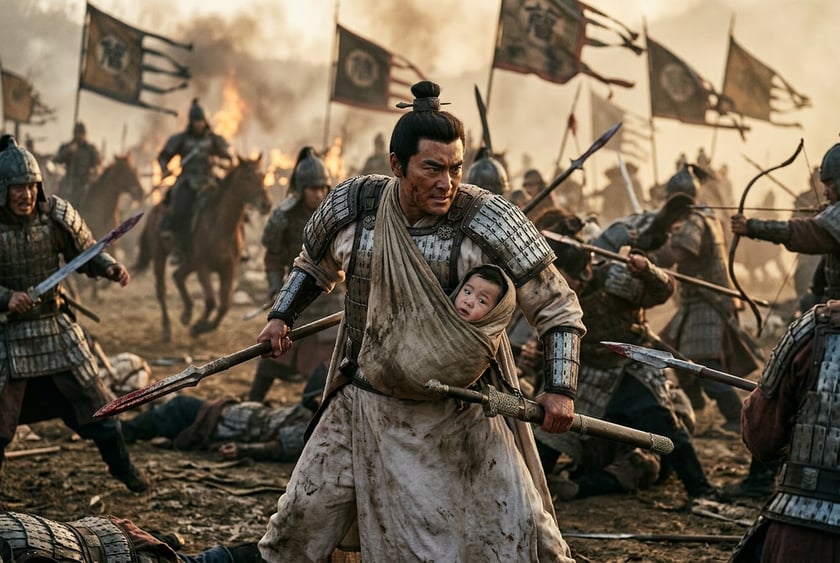
Strategic Background
The strategic significance of the Battle of Dongxing extended far beyond the battlefield itself — it was a "probe war fought during a power transition." In the fourth month of 252, Sun Quan died in Jianye; the Wu ruler Sun Liang was barely ten years old, and Grand Tutor Zhuge Ke held real power in his capacity as regent — the first governmental transition in Sunwu's history as an independent state. That same year, Cao Fang of Wei had been sidelined by Simashi for years; Sima Shi, now wielding authority as Grand General, urgently needed an external victory to consolidate his domestic prestige. Two newly installed power centers came face to face in the same year, and whichever could stabilize its home front first would reap the dividends of that confrontation. Sima Shi chose to march south, driven by the logic of "striking while they are newly established", but that choice was inherently risky: though Sunwu had suffered internal strife in Sun Quan's final years, its external defensive system — Ruxu fort and the Dongxing embankment — remained intact. Fu Gu explicitly opposed the campaign, arguing that "Wu has the barrier of the Yangtze; the late emperor's repeated expeditions all ended in failure; it is better for both sides to hold their borders" — a cool assessment grounded in the experience of past wars. But Sima Shi overrode all objections with the claim that "the way of heaven changes every thirty years; we cannot remain a three-legged standoff forever," and ordered the army to march. From the outset, then, this campaign was a "political war" that Sima Shi launched by force of will, in service of his own political needs.
Deployments
The Wei army's disposition was extremely heavy: Wang Chang led one hundred thousand men out of Nanjun to pin down Jingzhou; Hu Zun led another one hundred thousand in a frontal attack on Dongxing; Guanqiu Jian led yet another one hundred thousand from the flank toward Wuchang — three hundred thousand in all, with Sima Zhao commanding as supreme marshal. This was the first time the Sima family had led a great army south in their own family name, and it was itself a political declaration. Yet the deployment had a structural flaw: although the three-pronged advance was imposing in scale, the main axis of attack ultimately converged on the single point of Dongxing. Hu Zun was appointed vanguard to "oversee all three columns" and to lay a pontoon bridge to seize the Dongxing embankment, which was equivalent to staking the entire outcome of the battle on one man in one place. On the Wu side, Zhuge Ke directed operations from Jianye and mobilized swiftly; the front line was entrusted to Ding Feng, Tang Zi, Lv Ju, and Liu Zan, while Quan Yi held the left fort and Liu Lve the right. Rather than confront the Wei forces head-on at the pontoon bridge, the Wu army chose to let the enemy spread out across the embankment and wait for an opportunity to fight in the open — a deployment philosophy that clearly grasped that "the embankment is terrain, not a battle position."
Key Decision Points
The battle turned on two decisive decisions. The first was Hu Zun's blunder: after crossing the pontoon bridge, he did not immediately expand his foothold on the embankment; instead he "made camp at Xuzhou" and "held a grand banquet". While the front line gazed out on a distant snowstorm, his commander was drinking on the embankment — a textbook case of "victory hallucination," misreading a first-mover advantage as a guaranteed outcome. The second was Ding Feng's counter-intuitive judgment: not only did he not abandon a waterborne upriver assault, he issued a command that defied all convention — "strip off your armor and helmets, set aside your spears and halberds, carry only short swords". On the surface this was extremely reckless (shedding armor in the snow meant a single arrow wound could be fatal), but beneath the surface lay a triple calculation: first, unarmored soldiers would run far faster, shortening their exposed crossing time from boat to embankment; second, the Wei troops had been drinking, significantly widening the response window; third, "short swords" were suited for close-quarters fighting in the narrow space of the embankment, whereas spears and halberds would be cumbersome in a crowded formation. This was a textbook "trading equipment disadvantage for surprise advantage" decision.
Outcome and Reverberations
The battle ended with the Wei forces on the embankment cut to pieces; the pontoon bridge was severed by Wu reinforcements, cutting off their retreat. Tens of thousands drowned or were trampled to death; Huan Jia and Han Zong fell in battle; Hu Zun fled in disarray. The entire three-column offensive then ground to a halt — Wang Chang and Guanqiu Jian each withdrew as soon as they heard of the collapse at Dongxing. The most immediate political consequence was that Sima Shi's prestige from the southern campaign took a serious blow; he was forced to absorb Fu Gu's cold "I told you so" before the court, but at the same time the defeat gave him a convenient opportunity to transfer blame downward — Hu Zun was dismissed, while Sima Shi himself consolidated his position. On the Wu side, Zhuge Ke rode the great victory at Dongxing to rapidly build his regent's prestige, but in doing so he also cultivated a strategic hubris: half a year later he launched a siege of Hefeixincheng, committing two hundred thousand men to the investment of a small city, and returned empty-handed. He was ultimately struck down in a coup by Sun Jun — the victory at Dongxing had in fact become the starting point of Zhuge Ke's destruction. This is a classic case in political-military history of the "victory curse": an excessively decisive success can shatter the winner's own judgment.
Counterfactual Analysis
What if Hu Zun had not held a feast on the embankment and had instead immediately begun fortifying his position? The most likely projection is this: Dongxing would still have been taken, but at great cost; the left and right Wu forts could have continued to tie down the Wei main force for months; and once Wu reinforcements arrived in strength, Wei would have been forced to withdraw — resulting in "neither victory nor defeat" rather than a rout. That outcome would have allowed Sima Shi to maintain the political narrative of "the southern campaign, though inconclusive, was not a loss," without needing to shift blame onto his subordinates. A second, more radical projection: had Zhuge Ke not pressed his advantage to besiege Hefei after the battle, he might have used the prestige of Dongxing to sit securely as regent for ten years and avoid being killed in Sun Jun's coup. In that scenario, Sunwu might have maintained a relatively stable political structure between 255 and 260, forming a counterweight against the window in which Wei was mired in the internal turmoil of Simashi's displacement of the Cao family — and Sunwu's dynastic lifespan might have been extended by a decade. Both counterfactual paths remind us: the true historical significance of the Battle of Dongxing lies not on the battlefield, but in how it reshaped the political trajectories of the successor figures on both sides.