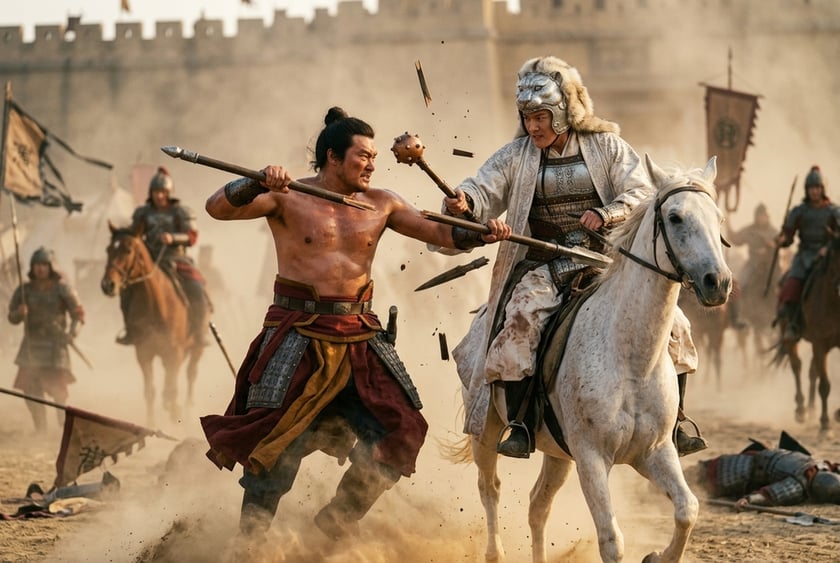
Strategic Background
Zhugekeweihefeixincheng took place in the summer of the fifth year of the Jiaping reign (253 CE), a mere five months after the great victory of the Battle of Dongxing. The previous winter, Zhuge Ke had crushed the three-pronged southward offensive of Wei forces at the Dongxing dike in a single stroke, with kills and captures in the tens of thousands; that victory pushed his personal prestige to its zenith and produced an excessively optimistic assessment of the Sunwu-Caowei balance of power. At the strategic level, Zhuge Ke's reasoning was: if a single engagement at Dongxing could repulse Wei's main force, the strategic possibility of pressing northward to take Hefeixincheng and thus open the strategic options in Huainan was real. But he underestimated three things. First, Wei had suffered a setback at Dongxing but its fundamentals were unharmed; the reserves of manpower along the Guanzhong, Luoyang, and Xu–Yu lines still far exceeded those of Wu. Second, since Man Chong's reconstruction, Hefeixincheng had become the core fortress of the Huai River defensive system, with engineering standards for its fortifications far superior to ordinary commandery seats. Third, in the Shuhan direction, Jiang Wei had simultaneously advanced on Didao — ostensibly to create a pincer from east and west with Wu — but Wei's response was swift enough: the strategy of "first resolve Guanzhong, then stall the eastern front," outlined by Yu Song's recommendation to Sima Shi, was put in place quickly enough to greatly diminish the coordinating effect of the Wu-Shuhan pincer.
Deployment of Forces
On Wu's side, Zhuge Ke mobilized the entire strength of the state for the northward advance — a "national gamble" sustained by his personal prestige. But this kind of "all-in mobilization" has an inherent structural weakness: large numbers mean large grain consumption and difficult coordination; if quick victory cannot be achieved, morale and logistics both collapse rapidly. The key figure in Wei's deployment was Sima Shi — he had only the previous year deposed the Wei emperor Cao Fang and was at a political juncture of "consolidating his authority through military success." Yu Song proposed that Wei should "hold and defend New Hefei, intending thereby to bring about a decisive engagement": since Zhuge Ke had come with his full striking force specifically hoping to settle things in one battle, Wei would do the opposite — hold firm, turning Sunwu's "full national mobilization" into "full national attrition." Sima Shi adopted this strategy and ordered Guan Qiujian and Wen Qin in the Hefeixincheng sector to "hold positions without engaging, yielding New Hefei to the Wu forces" — a very hard-edged judgment: betting the fate of New Hefei on the capability of the garrison commander Zhang Te, in exchange for strategic initiative across the board. He simultaneously ordered Guo Huai and Chen Tai to move all available Guanzhong forces to relieve the siege at Didao, first eliminating Jiang Wei's leverage on the western front. The key to this move was tempo: first pull Jiang Wei out of the game on the west, deprive the eastern-front Wu forces of outside support, and then let the eastern front slowly be ground down until provisions ran out.
Critical Decision Points
The campaign had three critical decision points. The first was Sima Shi's judgment to "yield New Hefei to Wu." This was highly counterintuitive — ordinarily, relieving a besieged fortress is a strategic obligation; failing to do so would undermine morale along the entire frontier. But Sima Shi held firm against the political pressure to "send relief" and bet everything on Zhang Te. If Zhang Te could not hold out, Wei would lose a fortress and Sima Shi would face political pressure; but if Zhang Te held, the Wu forces would be worn down to the point of collapse. This is a classic high-risk decision of "sacrificing a local position in exchange for global initiative." The second was Zhang Te's on-the-spot move of "using feigned surrender to buy repair time". With his three thousand garrison troops in a desperate state — "more than half of officers and men incapacitated by illness or killed in battle" — Zhang Te sent a man out of the city to negotiate with Zhuge Ke, citing the rule that "under Wei law, a city held for over a hundred days without relief may surrender without penalty to the garrison's clan," and requesting a few days' grace to allow his family members to make preparations. Zhuge Ke actually believed him; that night he suspended the offensive. Zhang Te spent the night dismantling timbers from houses to supplement the fortifications and constructing a second inner wall. The next day, when Wu forces resumed their assault, they found the defenses thicker than the day before — the momentum of victory was instantly reversed. This battle example of "the besieger being deceived by the besieged" is extremely rare in military history. The third was Zhuge Ke's response after being frustrated at New Hefei. Rather than adjusting his strategy — for example, shifting to another more accessible target, or proactively converting to a defensive posture to hold gains already made — he continued to press the assault on New Hefei until provisions ran out and troops were exhausted in the seventh month, forcing a withdrawal. This attitude of "refusing to accept defeat, refusing to acknowledge it" is a common trap for great commanders in their later years, but it was especially lethal in Zhuge Ke's case, because his political standing rested entirely on "the lingering prestige of the Dongxing victory." The moment he exposed the weakness of "unable to take it," the forces within Wu opposed to him would immediately coalesce.
Outcome and Echoes
At the tactical level, Wu's forces failed to capture any significant position. At the strategic level, Wu suffered heavy losses in elite troops and provisions, its national strength severely drained. At the political level, Zhuge Ke's standing with both the populace and the aristocratic clans utterly collapsed. On returning to Jianye, he attempted to maintain his authority by intensifying autocratic rule and purging political rivals — with the result that in the tenth month of that same year, Sun Jun and his brother Sun Liang jointly launched a coup and had him executed, his entire clan exterminated. The chain of causation traces directly to Hefeixincheng: had he been able to achieve even a modest success at New Hefei or withdraw intact, his political capital would have sustained him for at least another year or two. But he chose "to bash away, then bash out again," wagering his authority on a campaign he could not win. From a longer historical vantage point, Zhuge Ke's death opened the cycle of successive strong-man rule in Eastern Wu (Sun Jun, Sun Liang, Ding Feng, Lu Kang, Sun Hao); the political stability of Wu never recovered, and twenty-seven years later it was destroyed by Jin. The Siege of Hefeixincheng thus carries the historical significance of "the starting point of Sunwu's decline and fall."
Counterfactual Analysis
Two counterfactuals deserve extended treatment. The first: had Zhuge Ke lifted the siege of New Hefei after two fruitless months and shifted to another more accessible target — such as the Wancheng sector — to achieve some battlefield results before withdrawing, could he have preserved his political prestige? The answer is almost certainly yes. The court and officialdom of Eastern Wu never had high tolerance for the costs of northern campaigns, but "winning a battle then withdrawing" versus "failing to take an objective and retreating in disarray" differ as night and day in political effect. Zhuge Ke's true failure lay not in his strategic choice but in his inability to judge when to stop — what he needed was the wisdom to call off the operation at the right moment, but that quality was precisely absent from his personality. The second: had Wei not adopted Yu Song's "stall and exhaust" strategy and instead moved south proactively to relieve the siege, what would have happened? This path was actually what Zhuge Ke was hoping for — he needed Wei forces to come out and fight so he could replicate the Dongxing victory. Had Wei truly come to the rescue, Wu forces, waiting at ease for an exhausted adversary, might indeed have won another great battle. But Wei's brilliance lay precisely in "seeing through the opponent's expectations" — both Yu Song and Sima Shi clearly understood that Zhuge Ke was waiting for a decisive engagement with Wei, so they deliberately denied him that opportunity. This contest ultimately was not decided on the battlefield but in "reading the opponent's mind" — Wei read Wu's need; Wu failed to read Wei's restraint. This strategic wisdom of "meeting the dynamic with the static" was systematized by Sima Shi and his successors and gradually evolved into the core strategic philosophy by which Jin unified the San Guo.