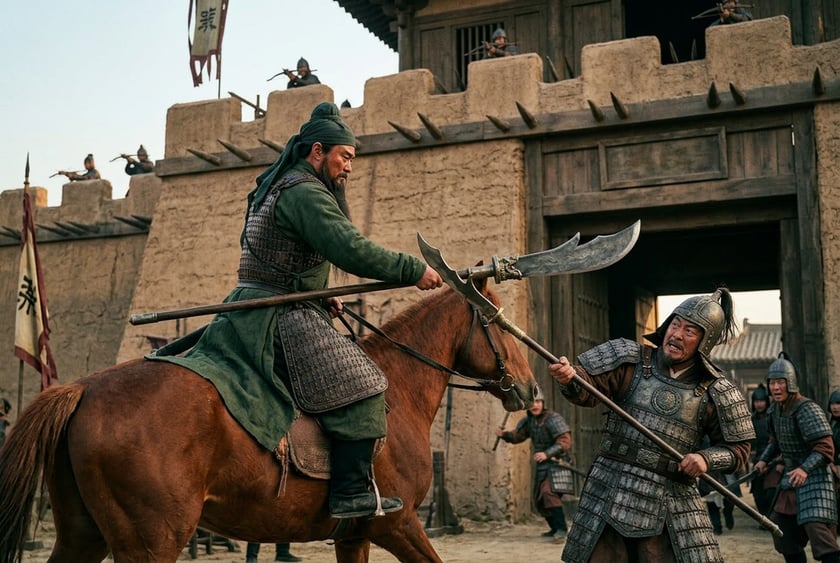
Strategic Background
The Battle of Xiapi was the "last mile" in Cao Cao's campaign to unify the eastern half of the Central Plains. Between 194 and 197, aided by Xun Yu and Cheng Yu, Cao Cao spent three years recovering Yanzhou, suppressing the Zhang Miao-Chen Gong rebellion, defeating Yuan Shu, and compelling the surrender of Zhang Xiu — leaving only two unresolved variables in the east: Yuan Shao to the north (four years remained before the decisive clash at Guandu), and Lv Bu to the east, who held Xuzhou and had joined forces with Chen Gong. Geographically, once Lv Bu consolidated his hold on Xuzhou, he could link northward to Yuan Shao, southward to Yuan Shu, and westward to the Taishan bandits, forming a strategic encirclement of Cao Cao [c:16076]. Cao Cao's personal campaign against Xiapi in the ninth month of 198 was aimed precisely at eliminating this eastern variable before Yuan Shao freed up his hands to move south. From a command-history standpoint, the most noteworthy aspect of this battle is not its outcome but the fact that Cao Cao, after two months of failed siege, was on the verge of ordering a retreat — and it was the earnest remonstrance of Xun You and Guo Jia that rescued him from a strategic blunder that was nearly made. Even a great ruler, it shows, can waver during a prolonged campaign. [c:16076]
Dispositions of Both Sides
The Cao forces were comprehensively staffed: Cao Cao commanded in person; Xun You, Guo Jia, and Xun Yu jointly managed deliberation and planning; Xu Chu guarded the central army; and although Xiahou Dun had been wounded in the eye by a stray arrow he remained at the front (the Romance mentions Xiahou Dun withdrawing after being struck by an arrow) [c:16076]. This was the strongest advisor configuration Cao Cao had fielded before unification — a team of counselors who cross-checked each other and left virtually no room for single-point errors. On Lv Bu's side, the deployment was structurally unbalanced: Lv Bu himself was brave but lacked strategic thinking and depended on Chen Gong for stratagems; Chen Gong did possess the capacity of "deliberate and measured planning," but was at constant odds with Lv Bu and was frequently overruled at critical moments; the mid-level commanders Zhang Liao and Gao Shun each had their own strengths but lacked unified direction; and the expected outside relief — from Zhang Yang, who had intended to march east — collapsed when Zhang Yang was killed by his own subordinate Yang Chou, who was then killed in turn by Sui Gu, so the entire relief chain self-destructed at the campaign's critical juncture [c:16076]. This condition of "no shortage of individual talent yet organizational dysfunction" was the fundamental reason the Lvbujituan lost battle after battle.
Key Decision Points
The battle's true watershed was the joint deliberation among Guo Jia, Xun Yu, and Xun You that produced the engineering proposal to "divert the Yi and Si rivers and flood Xiapi" [c:16076]. This is a textbook example of the cold-weapons-era tactic of "substituting engineering for combat": when a frontal breach is impossible, use the diversion of waterways to let natural forces do the work of human armies — converting the defenders' material advantages (grain, wells, city walls) into disadvantages (contaminated water supply, softened city foundations, collapsed morale). The decision had three layers of meaning: first, it acknowledged that frontal assault was no longer viable and that a change in approach was necessary; second, it transformed the campaign from a "rapid-decision" to a "siege plus psychological warfare" paradigm, shifting the time dimension from city-assault to water-attrition; third, it transmitted an "inescapable" signal to the city's interior, accelerating the disaffection of Lv Bu's subordinates — it was precisely under this psychological pressure that Hou Cheng, Song Xian, and Wei Xu later defected from Lv Bu and surrendered to Cao Cao. Once the decision was made the battle's outcome was simultaneously decided: the water siege transformed Xiapi from a "hold and wait for relief" situation into a "hold and certainly perish" situation — from the defender's perspective there was no solution.
Outcome and Resonance
The most immediate result was the capture and execution of Lv Bu, Chen Gong, and Gao Shun at the White Gate Tower [c:16077] — the "San Guo era's supreme warrior" thus exited the historical stage, and Cao Cao definitively eliminated the largest variable on his eastern flank. The second layer of impact was Zhang Liao's submission to Cao Cao: the Romance dramatizes this incorporation as "Liu Bei seizing his arm and Yun Chang kneeling before him," with Cao Cao "throwing down his sword, laughing, and releasing him" [c:16077]; whatever the historical truth, Zhang Liao's subsequent shattering of Sun Quan's one hundred thousand men at the Battle of Hefei and his emergence as the foremost of Caowei's Five Elite Generals was in itself the most powerful validation of that incorporation. The third layer of impact was the absorption of Xuzhou: Cao Cao incorporated Zang Ba, Sun Guan, Wu Dun, Yin Li, and the entire Taishan bandit network [c:16077], integrating a long-chaotic geopolitical fragment into an effective eastern frontier shield for Caowei — a standard case of Cao Cao's "carrot and stick" style of administration. The fourth layer operates on the level of political narrative: keeping Liu Bei "at rest in a residence near the Chancellor's mansion" [c:16077] appeared to be generous treatment but was in fact house arrest; Liu Bei subsequently used the "Yidaizhao — blood-stained-robe edict" as his pretext to flee, becoming Caowei's most intractable adversary in the future — and in that sense, the victory at Xiapi and the future defeat at Chibi were in the narrative already scripted at this very moment.
Counterfactual Reasoning
If Cao Cao had heeded the advice to "abandon the siege of Lv Bu and return to the capital" when two months of siege had yielded nothing, what would the outcome have been? One scenario: after Cao Cao lifted the siege and rested his troops, Lv Bu — linked with the remnants of Zhang Yang and with Yuan Shu — might have formed a continuous front, and in the 198–199 period the eastern flank might conversely have put strategic pressure on Cao Cao, making it necessary to divide forces to watch the east during the decisive 199–200 showdown at Guandu, with the outcome then unpredictable. A second scenario: if Zhang Liao had not been captured and incorporated but had instead died in battle or fled, Caowei might not have had at the Battle of Hefei in 215 a commander capable of routing one hundred thousand with eight hundred at the "Xiaoyaojin," causing the pressure of Sun Quan's campaigns on the Huainan region to intensify by orders of magnitude. A third, more far-reaching scenario: if Liu Bei had not been kept briefly near Cao Cao, he might not have evolved from "Governor of Xuzhou" into "General of the Left, Marquis of Yicheng Precinct," thereby forgoing the political capital that later enabled him to flee south to Jingzhou, enter Shu, and found his kingdom. On its surface the Battle of Xiapi was a siege; in reality it was the sole occasion on which Cao Cao as a unifier "gambled at the tactical level" and, with his strategist corps transforming that gamble into victory, produced a model that repays close reading by modern students of military and political science at every step of its decision-making.