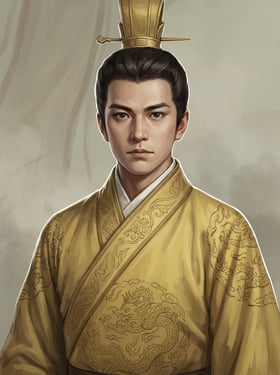
Historical Record
Sun Liang, styled Ziming, was the youngest son of Sun Quan, the Great Emperor of Wu. Because Sun Quan was advanced in years while Sun Liang was young, Sun Quan was especially attentive to him. His elder sister Princess Quan, having slandered Crown Prince Sun He and his mother, was uneasy in her heart and so, taking advantage of Sun Quan's inclination, wished to form a good bond with Sun Liang; she repeatedly praised Quan Shang's daughter and persuaded Sun Quan to take her as Sun Liang's consort. In the thirteenth year of Chiwu (250), Sun He was deposed, and Sun Quan thereupon made Sun Liang Crown Prince, with the lady Quan as his consort c:5082.
In the second year of Jianxing (253), Sun Liang took personal charge of government and proclaimed a general amnesty. He began to handle affairs of state, frequently questioning and probing the memorials submitted by Sun Chen. He also conscripted more than three thousand sons of military families aged between fifteen and eighteen, and selected the young and martial among the households of senior generals to serve as commanders. Sun Liang said: "I have established this force because I wish to grow up together with them." He trained them in person each day in the park c:9703.
Sun Liang was clever in his youth, and there is a record of his solving the case of the rat droppings in the honey. Once, while eating fresh plums, he ordered a eunuch to fetch honey-preserved plums from the central storehouse, and found rat droppings in the honey. He summoned the storehouse clerk and questioned him, and the clerk kowtowed and confessed his guilt. Sun Liang asked the clerk: "Did the eunuch ask you for honey?" The clerk replied: "He did ask, but I truly dared not give it." The eunuch would not admit it. The Palace Attendants Diao Xuan and Zhang Bin suggested putting both the eunuch and the clerk in prison for interrogation. But Sun Liang said: "This is easy to determine." He ordered the rat droppings cut open, and found them dry within. Sun Liang laughed heartily and said to Diao Xuan and Zhang Bin: "If the droppings had been in the honey first, they would be moist both inside and out; now the outside is moist but the inside dry, so this must be the eunuch's doing." The eunuch then confessed, and all around were struck with awe c:9703.
In the second year of Taiping (257), Sun Liang's attendant Sun Ji stole and rode an imperial horse and was taken into custody. Sun Liang asked the Palace Attendant Diao Xuan: "What is the penalty for stealing and riding an imperial horse?" Diao Xuan replied: "By law it warrants death. But Prince Lu (Sun Ba) died early; I hope Your Majesty will show pity and pardon him." Sun Liang said: "The law is what all under heaven observe in common—how can one be partial because of closeness? One should consider how he may be pardoned; why press with arguments of reason?" Diao Xuan said: "Past amnesties have been great or small—sometimes pardoning all under heaven, sometimes pardoning a thousand li, or five hundred li—it may be done as one wishes." Hearing this, Sun Liang pardoned those within the palace, and Sun Ji was thereby spared c:9704.
Because Sun Liang, after taking personal charge of government, did much probing, Sun Chen grew deeply fearful. After returning to Jianye, he claimed illness and did not attend court, and built a residence south of Zhuque Bridge. He had his younger brother, the General Who Subdues the Distant Sun Ju, enter the Canglong Gate as a guard, and his brothers—the Martial Guard General Sun En, the Auxiliary General Sun Gan, and the Changshui Colonel Sun Kai—each garrison their own camps, intending to monopolize court power and consolidate his own position. Sun Liang was inwardly displeased with Sun Chen, and so investigated the circumstances of the killing of Princess Sun Yu, blaming the Hulin Commander Zhu Xiong and his younger brother, the Outer Department Commander Zhu Sun, for failing to correct Sun Jun; he thereupon ordered Ding Feng to kill Zhu Xiong at Hulin and Zhu Sun at Jianye. Sun Chen entered the palace to remonstrate, but Sun Liang would not heed him. Sun Liang then conspired with Princess Sun Luban, the Grand Master of Ceremonies Quan Shang, and the General Liu Cheng to put Sun Chen to death. However, Sun Liang's consort was the daughter of Sun Chen's elder cousin, and she revealed the plot to Sun Chen. Sun Chen led troops that very night to attack Quan Shang, sent his younger brother Sun En to kill Liu Cheng outside the Canglong Gate, and then surrounded the palace c:1213.
Sun Chen sent the Superintendent of the Imperial Household Meng Zong to announce at the ancestral temple the deposition of Sun Liang, and gathered the ministers to deliberate, declaring that "the young emperor is dissolute, sickly, and deranged, and cannot occupy the great position or sustain the ancestral temple," and informing them that the late emperor (Sun Quan) had already deposed him. The ministers were all terrified and said, "We obey the General's command." Sun Chen then sent the Secretariat Gentleman Li Chong to seize Sun Liang's seal and ribbon, and proclaimed Sun Liang's crimes to all under heaven. The Master of Writing Huan Yi refused to sign, and Sun Chen in a rage killed him c:1213.
In the Novel
In Romance of the Three Kingdoms, Sun Liang appears in Chapters 108, 111, and 113. In the novel, Sun Quan reigned for twenty-four years and died of illness at the age of seventy-one, in the eighth month of the fifteenth year of Yanxi of Shu Han (252) c:1214. Before his death, Sun Quan summoned the Grand Tutor Zhuge Ke and the Grand Marshal Lü Dai to his bedside to entrust them with affairs after his death. After Sun Quan died, Zhuge Ke installed Sun Liang as emperor, proclaimed a general amnesty, changed the reign title to the first year of Daxing, and gave Sun Quan the posthumous title of Great Emperor c:5083. At this point, Sima Shi of Wei, hearing that Sun Quan had died and that Sun Liang was young and weak, judged that there was an opportunity to be seized, and deliberated raising troops to campaign against Wu c:5083.
The novel's shaping of Sun Liang's character also emphasizes his "cleverness." For example, during Sun Jun's monopoly of power, the lord of Wu Sun Liang, though clever, could do nothing about it c:5084. In the novel, Sun Liang conspires with Sun Jun and Teng Yin to put to death the power-monopolizing Zhuge Ke. Sun Liang said: "I too am greatly afraid of this man; I have long wished to remove him but have found no opportunity. Now that you gentlemen are truly loyal and righteous, you may secretly plot it." Teng Yin suggested setting a banquet to summon Zhuge Ke, secretly hiding armed men behind the wall hangings, and throwing down a cup as the signal to kill him at the feast. Sun Liang adopted this plan c:1215. This episode is not clearly recorded in the histories and is more a requirement of literary creation.
Key Relationships
* Eastern Wu (lord_of): As Sun Quan's youngest son, Sun Liang inherited the imperial throne of the Great Emperor of Wu and became the sovereign of Eastern Wu c:5082.
* Sun Chen (enemy_of): Sun Chen was the powerful minister who monopolized court power during Sun Liang's reign. Sun Liang once tried to join with Quan Shang, Liu Cheng, and others to put Sun Chen to death, but the plot failed because his consort leaked it, and he was at last deposed by Sun Chen c:1213.
* Zhu Xiong (enemy_of): Because Zhu Xiong failed to correct Sun Jun, Sun Liang ordered Ding Feng to kill him at Hulin c:1213.
* Zhu Sun (enemy_of): Because Zhu Sun failed to correct Sun Jun, Sun Liang ordered Ding Feng to kill him at Jianye c:1213.
* Princess Quan (ally_of): Princess Quan had slandered Crown Prince Sun He, and to protect herself actively brought about the marriage alliance between Sun Liang and the lady Quan, thereby promoting Sun Liang's installation as Crown Prince c:5082.
* Zhuge Ke (enemy_of, novel only): In Romance of the Three Kingdoms, Sun Liang conspired with Sun Jun and Teng Yin to put to death the power-monopolizing Zhuge Ke c:1215.
Iconic Scenes
* Solving the case of the rat droppings in the honey: While eating fresh plums, Sun Liang found rat droppings in the honey. By observing how dry or moist the droppings were, he cleverly saw through the eunuch's scheme to frame the storehouse clerk, displaying his youthful keenness and intelligence c:9703.
* Pardoning Sun Ji: When Sun Ji was arrested for stealing and riding an imperial horse, Sun Liang, on the suggestion of the Palace Attendant Diao Xuan, used the method of "pardoning those within the palace," thereby upholding the dignity of the law while avoiding bending it out of personal feeling, embodying his weighing of matters and wisdom in handling affairs of state c:9704.
* Plotting to put Sun Chen to death: Discontented with Sun Chen's monopoly of power, Sun Liang conspired with Princess Sun Luban, the Grand Master of Ceremonies Quan Shang, and the General Liu Cheng to put Sun Chen to death. However, because his consort leaked the plot, the plan failed, and he was at last deposed by Sun Chen c:1213.
* Ascending the throne as emperor (novel only): In Romance of the Three Kingdoms, after Sun Quan's death, Zhuge Ke installed Sun Liang as emperor, proclaimed a general amnesty, and changed the reign title to the first year of Daxing c:5083.
* Plotting with Sun Jun and Teng Yin to kill Zhuge Ke (novel only): In Romance of the Three Kingdoms, fearing Zhuge Ke's monopoly of power, Sun Liang conspired with Sun Jun and Teng Yin to plot Zhuge Ke's assassination at a banquet c:1215.
Portrait file
Character profile
- Character
- In his youth Sun Liang was perceptive and discerning, once displaying his cleverness by cracking the case of the rat droppings in the honey. Yet clever though he was, he remained held in check by the powerful minister Sun Chen.
- Life
- Sun Liang was the youngest son of Sun Quan. In the thirteenth year of Chiwu he was established as Crown Prince, and in the second year of Taiyuan (252) he took the throne. In the third year of Taiping (258) he was deposed by Sun Chen and made Prince of Kuaiji, at the age of only sixteen.
- Anecdotes
- He was the first of the 'three succeeding rulers,' the second-generation emperor of Wu. He once plotted with Sun Jun to put Zhuge Ke to death, and later, when his design to execute Sun Chen was leaked, was deposed by Sun Chen.
Relationships
8 relationships
Family4
Lord & vassal1
Friends1
Enemies1
Other1
Quotes
5 recorded lines · 3 featured
「吾立此軍,欲與之俱長。」
This line reveals Sun Liang's lofty ambition as a young man ascending the throne, of considerable historical significance.
「法者,天下所共,何得阿以親親故邪?當思惟可以釋此者,柰何以情相迫乎?」
These words embody Sun Liang's determination to uphold the impartiality of the law, showcasing his political wisdom.
「盜乘御馬罪云何?」
This question embodies Sun Liang's regard for the law, an important facet of his character.
Chapters8 回 ▸
- 史ch.47ch.48ch.50ch.59ch.64
- 演ch.108ch.111ch.113
Relationship timeline3 条 ▸
Inner monologues · AI-generated1 段 ▸
- I was named Zi Ming, and was my father emperor’s youngest son. My father was already advanced in age, and I was the youn
Life events11 ▸
- 0250-01-01 · JianyeDeposition of the Crown Prince and Execution of Prince of Lu Sun Ba· Witness
- 0252-01-01 · JianyeSun Quan's Deathbed Regency Decree· Witness
- 0253-01-01 · JianyeSun Jun and Sun Chen's Domination of Wu· Victim
- 0253-01-01 · JianyeSun Jun Kills Zhuge Ke· Witness
- 0253-01-01 · JianyeSun Jun's Execution of Zhuge Ke· Witness
- 0253-01-01 · Hefei XinchengZhuge Ke Attacks Xincheng· Witness
- 0258-01-01 · JianyeSun Liang's Failed Plot to Depose Sun Chen and His Own Dethronement· Instigator
- 0258-01-01 · JianyeDeposition of Sun Liang· Victim
- 0258-01-01 · JianyeSun Chen's Regency and Sun Xiu's Restoration· Victim
- 0258-01-01 · JianyeSun Chen Deposes Sun Liang and Installs Sun Xiu· Victim
- 0258-01-01 · ShouchunLu Kang Goes to Shouchun to Aid Zhuge Dan· Witness