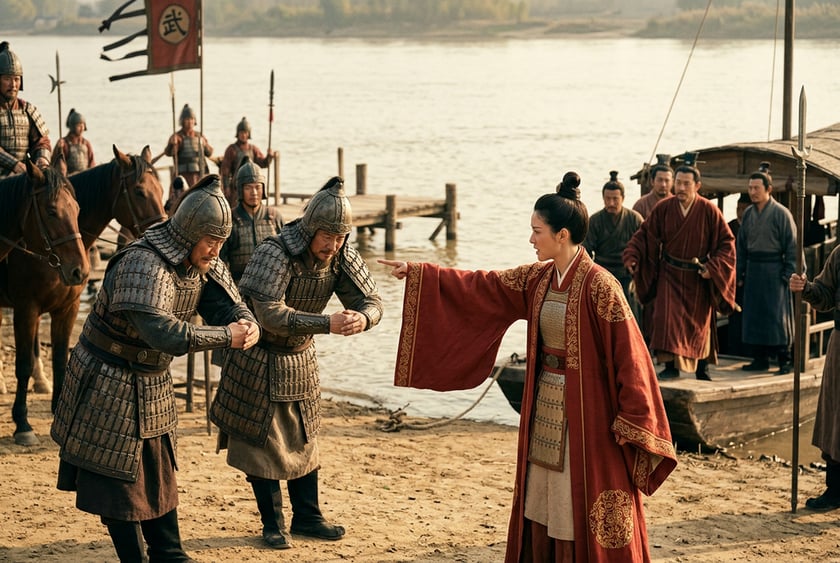
Background
Guchengjuyi is structurally one of the most pivotal "rebirth scenes" in the whole of San Guo Yanyi. Seen through the lens of cultural history, its position is analogous to the gathering at Liangshan in Shuihu Zhuan or the re-establishment at Flower-and-Fruit Mountain in Xiyouji—a ritualized turning point in which "the protagonist group goes from collapse to reconstitution." Returning to the story's internal timeline: in Jian'an year 4 (199), Liu Bei was routed at Xuzhou by Cao Cao and the three brothers were forced apart—Liu Bei fled to Hebei seeking shelter with Yuan Shao; Guan Yu, protecting the two sisters-in-law, was stranded in Cao Cao's camp, treated with respect but steadfastly determined to find his elder brother; Zhang Fei drifted through the forests and occupied Mangdang Mountain. This condition—"brothers separated, sisters-in-law entrusted to one, each wandering alone"—was, within the Confucian ethical framework, a temporary collapse of proper order. The significance of the reunion at Gucheng is that it reversed that collapse into a more solidly grounded order—through the ordeal of separation, the Peach Garden vow received a second confirmation.
The Vow's Substance
Strictly speaking, Guchengjuyi was not a covenant ritual with an explicit oath text like Taoyuanjieyi; it was a process of "reaffirming the vow through action." The most critical "moment of vow-renewal" is the resolution of the conflict between Guan Yu and Zhang Fei. When Zhang Fei saw Guan Yu coming from Cao Cao's camp, his first reaction was "a man who has surrendered to Cao Cao—how can I recognize him still as brother?" and he leveled his viper-halberd ready to fight. Guan Yu asked to be allowed to "behead whoever comes against us within three drum-beats to prove his true heart"—and before the words were finished, he had already cut down the pursuing general Cai Yang. This passage performs the narrative function of "renewing the vow": Guan Yu uses one enemy commander's head as proof of his pure loyalty to Liu Bei's camp; Zhang Fei's acceptance of that proof amounts to reinstating his identity as brother. The celebration afterward, when the assembled company was reunited, proceeded with "slaughtering oxen and horses, first paying homage to heaven and earth, then feasting the entire army"—this ceremony in its form closely mirrors the "offering to heaven and earth" at Taoyuanjieyi, creating a deliberate narrative echo.
Subsequent Impact
From the perspective of the story's internal plot chain, Guchengjuyi directly produced three changes. First, the core personnel of Liu Bei's camp were fully reassembled—Liu Bei, Guan Yu, and Zhang Fei, together with Zhao Yun, Guan Ping, Zhou Cang, Mi Zhu, Mi Fang, and Jian Yong—the basic roster that would carry through from Runan to Jingzhou and onward into the conquest of Shu. Second, Zhao Yun's joining was a structurally significant event. In the Romance's narrative, Zhao Yun had briefly crossed paths with Liu Bei earlier as a subordinate of Gongsun Zan, but his true enlistment came in the period around Gucheng—charging through the Runan fighting to attach himself to Liu Bei, from which point he became the fourth core military commander of Liu Bei's camp, compensating for the gap left by Guan Yu and Zhang Fei being "outwardly fierce but lacking inner finesse." Third, the partnership of Guan Ping and Zhou Cang as Guan Yu's "close-guard combat unit" took definitive shape for the first time, and this small cluster continued unbroken all the way to Guan Yu's defeat and loss at Maicheng. From the narrative's political significance, Guchengjuyi expanded the legitimacy base of Liu Bei's camp from "the Peach Garden three" to "a fraternal alliance radiating outward from the three as its core," strengthening the cohesion of the group through the ritual of reunion.
From the longer view of cultural history, Guchengjuyi has become one of the archetypal scenes of "loyal reunion" in Chinese folk literature. The fraternal-separation-and-reunion episodes in Ming-Qing novels such as Shuotang and Yangjiajiang trace their forms almost entirely back to Gucheng as prototype. The Peking opera Gucheng Hui (also known as Zhan Caiyang or as a sequel to Baimapo) is a classic entry in the repertoire of plays about Guan Yu; its performance conventions—Guan Yu galloping in on horseback, Zhang Fei's drums not yet silent, the pursuing general cut down—have fixed this image in the collective imagination. At the deepest level of cultural psychology, Guchengjuyi responds to the perennial question in traditional Chinese society: "how can friendship survive in an age of self-serving chaos?" After enduring rumors of betrayal (Guan Yu's surrender to Cao Cao), situational pressure (Cao Cao's pursuing forces), and a mortal test (Zhang Fei raising his halberd to fight), still arriving at mutual recognition—this "loyalty proven through ordeal" is more persuasive than the original sworn oath. This is why, though Guchengjuyi is less famous than Taoyuanjieyi, it carries equivalent narrative weight in the rhythm of the Romance. And it is precisely because of this that the three characters "Gucheng Hui" in the Chinese lexicon have transcended their specific geography to become a cultural symbol for "the lost finding one another again, trust restored."