Background
From the perspective of modern historical narratology, "Passing Five Passes and Slaying Six Generals" is one of the most important "image-building long takes" in Romance of the San Guo. The episode does not appear in Guan Yu's own biography in San Guozhi; the historical record of Guan Yu's departure from Xudou to rejoin Liu Bei is dispatched in a single sentence: "Guan Yu sealed up all that had been bestowed upon him, submitted a letter of farewell, and hastened to join his lord at Yuan Shao's camp." The novel expands this into five passes, six generals, and a dozen or more confrontations — in essence a form of "narrative reprocessing," transforming a simple event of leaving a military encampment into a heroic marathon of "loyalty above all else". What must be recognized is that this reprocessing was not an isolated literary invention: it built on folk "Guan Gong drama" that had been continuously refined from the Yuan dynasty onward and was given its definitive form only when Luo Guanzhong set it down.
Course of Events
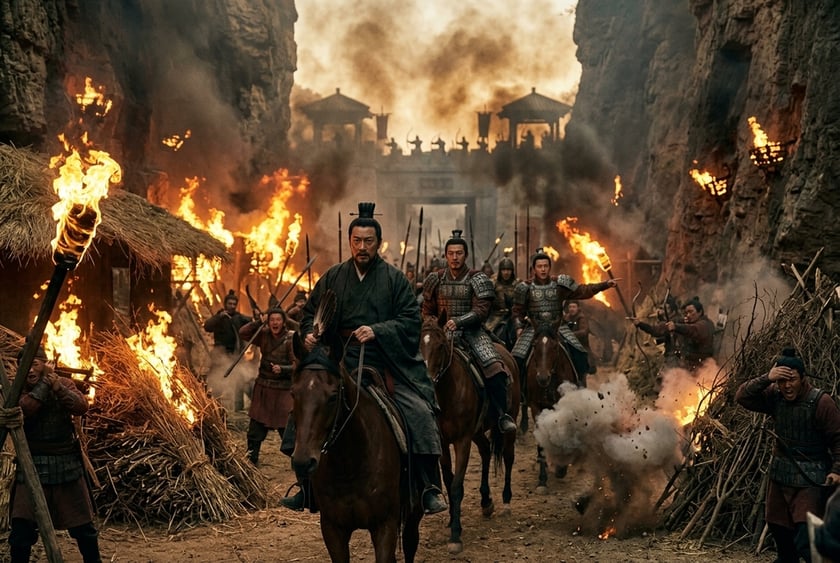
The overall structure of the narrative is remarkably regular: each pass follows the fixed rhythm of "blockade → negotiation → the opponent plots treachery or openly refuses → Guan Yu kills the general → passage through." At the Eastern Ridge Pass, Kong Xiu blocked the way on the grounds that "without a travel document you may not pass" and was slain by Guan Yu; at Luoyang, the prefect Han Fu and his deputy Meng Tan set up deer-antler barricades and fired arrows from ambush in an attempt to capture Guan Yu, who turned the tables after being struck by an arrow and killed both men; at Sishuiguan, Bian Xi — a former Yellow Turban bandit — had axe-wielding soldiers lying in wait in a temple to ambush Guan Yu, but a monk from the same hometown warned Guan Yu, who then killed Bian Xi; at Xingyang, the prefect Wang Zhi was related by marriage to Han Fu and attempted to burn Guan Yu to death in the official guesthouse, but his own officer Hu Ban — moved by a letter his father Hu Hua had written — warned Guan Yu instead, and Guan Yu fled and killed Wang Zhi; at the Yellow River ford, Qin Qi refused to ferry Guan Yu across and was killed so that the crossing could proceed. Two pivotal subsidiary episodes are the mid-journey enlistment of Liao Hua's contingent and the lodging at Hu Hua's manor, which established the letter-of-introduction connection with Hu Ban — two side plots that provide intelligence and personal networks for the subsequent "passage through," exemplifying the narrative's structural tidiness.
Outcome
Guan Yu ultimately left the zone of Caowei control after Zhang Liao relayed Cao Cao's message that pursuit was unnecessary; near Runan he met Sun Qian, learned that Liu Bei had already moved on, and proceeded to Gucheng for his reunion with Zhang Fei. Viewed through the internal logic of the novel's narrative, the outcome of "Passing Five Passes and Slaying Six Generals" is twofold. First, Guan Yu completed the ethical loop of "loyal to Liu Bei while not failing Cao Cao" — he did not slip away in secret but openly executed Guayinfengjin: hanging up his seal, returning all gifts in full, leaving behind a formal letter of farewell, and departing with only the two ladies-in-waiting and essential escort. Second, by pitting himself as a single fighter against the entire Caowei border-pass system, he elevated "personal martial valor + the bond of brotherhood" to a level that could virtually challenge the machinery of state violence.
Influence
The cultural influence this narrative episode exerted on later generations far exceeds its actual weight in the historical record of the Three Kingdoms period. First, it is the core component of the "Guan Gong loyalty and righteousness" narrative — without "Passing Five Passes and Slaying Six Generals," Guan Yu would simply have been a warrior who "first surrendered, then returned," a figure of fickle allegiance. It is this heroic marathon that makes the three-stage personality coherent: "the original surrender was forced upon me; the service rendered was repayment of a debt; the return to Liu Bei was finally coming home to my true self." The deification of Guan Yu as God of War and deity of loyalty that crystallized in the Ming and Qing dynasties has its narrative foundation precisely here. Second, from the perspective of institutional history, the episode itself reveals the existence of a "travel-document checkpoint" system in the late Han — Kong Xiu and Han Fu both initially blocked Guan Yu on the grounds that "without a travel document you may not pass", which was in fact a genuine practice of military checkpoints in the Han-Wei period. The novel converts it into a test of Guan Yu's moral resolve, but the underlying structure is historically real. Third, after killing Wang Zhi, Guan Yu lamented to himself: "I have no wish to kill people along the way, but circumstances leave me no choice. When Cao Cao learns of this, he will surely regard me as an ingrate". This soliloquy demonstrates the novel's nuanced handling of Guan Yu's inner conflict: he must complete his mission of departure and yet recognizes that killing Cao Cao's officials will brand him with the stigma of "ingratitude." This "ethical dilemma" construction elevates Guan Yu beyond the flat image of the typical novel warrior and makes him a hero with an inner life. From the perspective of novelistic engineering, this section is one of Luo Guanzhong's most successful chapters for layering "personal martial valor" with "ethical choice," and it furnished a replicable template for character construction in later classical fiction.