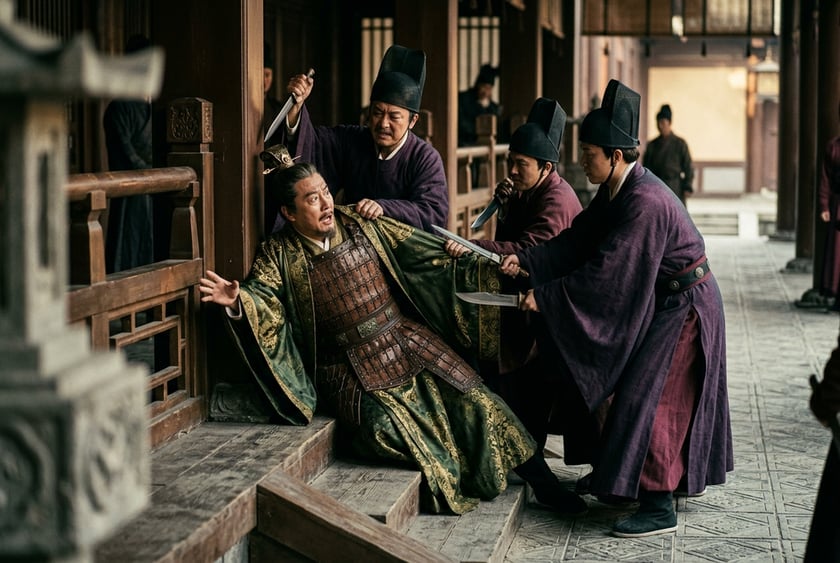
Background
Liubeichenghanzhongwang — Liu Bei's proclamation as King of Hanzhong — was the most critical political step-up before the founding of Shuhan. In the fifth month of the twenty-fourth year of Jian'an, Xiahou Yuan was killed at Dingjunshan, Cao Cao's personal campaign to Hanzhong failed, and he withdrew to Changan in the fifth month; by the seventh month all of Hanzhong had passed into Liu Bei's hands. This military victory was the first time Liu Bei possessed the political capital to stand as an equal with Cao Cao and Sun Quan — Cao Cao held the titles of Chancellor and King of Wei; Sun Quan was General of the Flying Cavalry and Marquis of Nanchang (becoming Inspector of Jingzhou and receiving the Nine Bestowments only the following year); Liu Bei's highest title up to this point was only "General of the Left and Marquis of Yicheng Ward," two full steps below both. After the Hanzhong victory the military gains had to be immediately converted into a political identity, or the dividends of victory would dissipate with time. At the same time, Liu Bei could not yet proclaim himself emperor — Emperor Xian was still at Xudou, and publicly proclaiming emperorship could not be justified morally; advancing to the rank of king, however, was consistent with the Western Han precedent of "an imperial kinsman with meritorious service being enfeoffed as king," comparable to the early Western Han examples of Han Xin, Peng Yue, and Ying Bu.
Key Figures
The core of this ceremony was the construction of the "Five Tiger Generals — Chancellor — Grand Tutor" triangular structure. The Five Tiger Generals — Guan Yu, Zhang Fei, Zhao Yun, Ma Chao, and Huang Zhong — were the most important military symbols before the founding of the state; their simultaneous enfeoffment signified the formal shaping of Shuhan's military system: Guan Yu to hold Jingzhou, Ma Chao to hold Liangqiang, Zhang Fei and Zhao Yun at the center, with Huang Zhong's place among them acknowledging his great merit in killing Xiahou Yuan in the Battle of Hanzhong. Zhuge Liang as Military Advisor directing military and state affairs was the actual manager of the administrative center; Xu Jing in the position of Grand Tutor represented "cross-dynasty opinion authority," providing literati endorsement for the new kingdom; Fa Zheng as Secretariat Director handled practical governance and was the greatest political beneficiary since the entry into Sichuan. The personnel layout clearly reflects the internal structure of Liu Bei's camp: original-followers faction (Guan, Zhang, Zhao) + Jingzhou faction (Zhuge Liang) + Eastern-province faction (Fa Zheng) + cross-dynasty literati faction (Xu Jing) + Yizhou native faction (Huang Quan gradually absorbed thereafter).
Core Issues
On the surface the issue was "advancing to the rank of king"; at a deeper level it was "the institutional transition from a prefectural-level command staff to a kingdom-level central government." Liu Bei's prior official establishment was only "the command headquarters of the General of the Left," and all officials were staff aides to that headquarters; after advancing to King of Hanzhong, the royal household established Chancellor, Secretariat Director, and Grand Tutor positions, the army established the Five Great Tiger Generals, and local administration established the Administrator of Hanzhong — this was a complete "proto-state" administrative skeleton, far more complex than the prior command-staff system. This skeleton had three layers of political significance: first, it caused Shuhan to evolve from a "military bloc" into an "administrative entity" capable of conducting regularized tax collection, personnel management, and legislation; second, it fixed the political status of meritorious officers in the form of "rank-and-title plus position," avoiding future internal disputes; third, it pre-established the complete official structure for the later imperial proclamation — when Liu Bei proclaimed himself emperor in 221, almost all of the official system was established during this advancement to king, merely substituting "King of Hanzhong" with "Emperor" and "Heir of the King" with "Crown Prince." In other words, the proclamation as King of Hanzhong was in institutional terms the true founding day of Shuhan; the proclamation of emperorship was merely "relabeling."
Political Consequences
The most immediate consequence was that the central administrative skeleton of the Shuhan regime took shape, and Guan Yu immediately launched the northern campaign from Jingzhou besieging Xiangfan — which can be viewed as a military celebration and strategic demonstration of the "advancement to king." The medium-term consequence was the intense unease this advancement provoked in Sun Quan: Liu Bei had in a single year consecutively "taken Hanzhong and advanced to king," causing Sun Quan to feel that a formerly weak ally had grown strong enough to potentially suppress Eastern Wu — this directly triggered the chain of events the following year: Sun Quan's seizure of Jingzhou and Guan Yu's death. From a power-structure perspective, the simultaneous enfeoffment of the Five Great Tiger Generals also planted seeds of internal tension — when Fei Shi traveled to Jingzhou to confer Guan Yu's appointment, Guan Yu initially refused to accept the seal, saying "Yide is my brother, Mengqi is a man of illustrious lineage, and Zilong has long followed my elder brother — he is as my own brother; their positions equaling mine is acceptable. But what kind of man is Huang Zhong, that he dares stand in the same rank as me? A true man of worth would never serve in the same file as an old soldier" — public expression of the founding bloc's resentment toward newly joined members. Fei Shi smoothed things over by invoking the examples of Xiao He and Cao Can, but this fracture would persist through the final period before Shuhan's founding. The long-term consequence was that this kingdom-level official system became the entire administrative foundation of Shuhan — Zhuge Liang's later Shixiao Memorial, Jiang Wei's northern expedition apparatus, Shuhan's central control over all localities, were all built on the skeleton laid down on this first day of the seventh month of the twenty-fourth year of Jian'an.
Counterfactual Analysis
Had Liu Bei not immediately advanced to king after the Hanzhong victory but delayed two to three years, what would the result have been? The most realistic projection is: Cao Cao died in the first month of 220 and Caopidaihan took place in the tenth month — Shuhan would have missed the opportunity to respond to Cao Pi's imperial proclamation with the corresponding political gesture of "King of Hanzhong," and would have been forced to leap directly from "General of the Left" to "Emperor," greatly undermining ceremonial legitimacy. Had Liu Bei at the time of advancement not placed Guan Yu first among the Five Tiger Generals but ranked Ma Chao or Huang Zhong first, the rift between Guan Yu and Huang Zhong might have been softened, but simultaneously Liu Bei would have lost the political mark of "designating Guan Yu as the strategic pillar of Jingzhou" — the frontline commander had to receive the greatest recognition in merit and rank. Had Shuhan at the time of advancement established its capital at Hanzhong rather than retaining Chengdu as its seat of government, pushing the political center north onto the axis of advance originally envisioned in the Longzhong plan, the entire strategic direction of Shuhan would have been very different — but digesting the local Yizhou forces under such an arrangement would have required considerably more time and was not realistic. Understanding this means understanding why "Liu Bei's proclamation as King of Hanzhong" matters not for its own ceremonial grandeur, but because it was the institutional founding day of Shuhan's transition from "guest general's bloc" to "state entity" — Shuhan's ability to found its state smoothly two years later relied entirely on the complete skeleton assembled on that day.