Historical Background
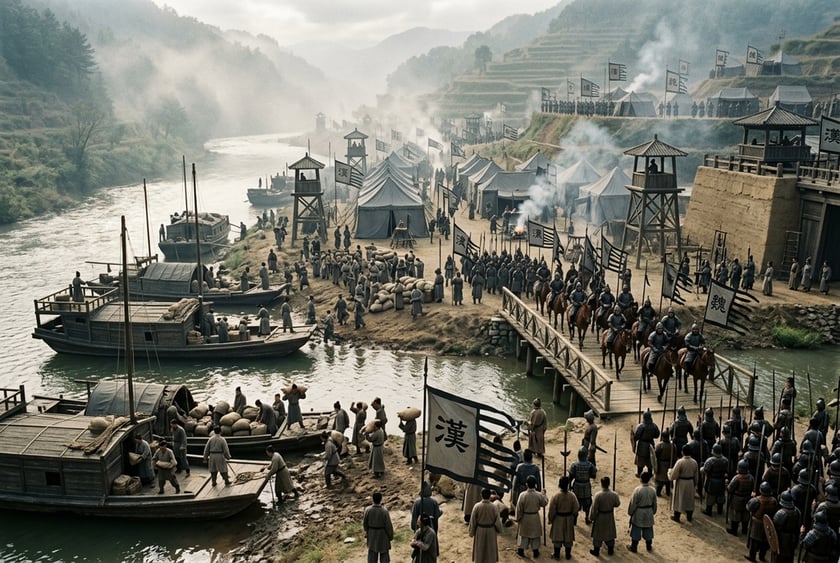
This scene is set at the juncture of Cao Pi Supplants the Han, when the new dynasty was establishing its authority. In the succession struggle during Cao Cao's lifetime, Cao Zhi had once been favored for his literary talent and at one point came close to the heir-apparent's seat; after Cao Pi took the throne, the old rivalry turned into a real political threat. The Romance externalizes this tension as a confrontation between mother and son: Lady Bian came out of the hall and tearfully begged Cao Pi to remember their brotherly bond and spare Cao Zhi, while Hua Xin, with the logic that "he is in the end no creature of the pond, and if not removed early will surely become a future menace," packaged the murderous intent as a workable plan. The tug-of-war between a mother's command and political calculation forms the stage on which the "seven steps" could take place.
The Ritual Process
The very form of this contest was a kind of "cultural verdict." Cao Pi did not take up the blade directly but set up an examination hall where talent decided life: pointing to an ink painting in the hall of "two oxen fighting by a wall, one ox falling into a well" as the theme, he demanded a poem composed within seven paces, with none of the words in the theme to be touched. The harshness of the rules lay in the double constraint—limiting both the number of steps (time) and the wording (content)—which utterly blocked any suspicion of "ghostwriting." Cao Zhi composed the poem on cue and passed on the spot, dissolving a preset execution through his own talent.
Cultural Symbolism
The seven steps and that poem, figuring brother boiling brother in the image of beanstalks scorching beans, crystallized into the sharpest image of "kin destroying kin" in Chinese literature. Its power lies in compressing a grand tragedy of power into a minute physical scale—within seven paces, in the time it takes to cook a meal—giving "great talent provoking envy" and "flesh and blood destroying one another" a tangible, memorable form. Hua Xin's design of "test him by his talent; otherwise demote him to silence the scholars of the realm" has also been read by later ages as a metaphor for the fate of the literatus: talent is both an amulet and a cause of calamity.
Transmission and Evolution
It must be noted that the seven-step poem is largely an embellishment of the Romance and the anecdote tradition; the official histories contain no clear record of Cao Zhi composing a poem within seven steps, and the episode, along with the attribution of that bean-boiling poem, has long been disputed. But precisely because of its dramatic tension, it broke free of historical-textual scrutiny and circulated on its own, becoming the idioms "the talent of seven steps" and "boiling beans by burning the beanstalks," a common allusion for gauging quick wit and for satirizing kin destroying kin. Its vitality proves exactly this: a scene retold again and again can embed itself in cultural memory more deeply than whether it truly happened.