Background
From the perspective of modern political history, the Wei-Jin abdication was the most fully mature execution of China's "template for formalized usurpation," and the capstone of the three-generation, seventeen-year political project the Simashi had pursued since the Gaopinglingzhibian. By the time Sima Zhao died, all the preconditions for abdication were already in place: the imperial clan princes had been stripped of power, the nine-rank system of the Nine-Rank Central Rectification had bound the scholar-gentry to the Simashi framework, the conquest of Shuhan had provided the "achievement that covers all under heaven" as a capital of legitimacy, and Cao Huan — the last Wei emperor — had long since retreated to idle seclusion, "not holding court for days on end". What Sima Yan needed to do was no longer to seize power, but simply to "complete the ritual." The Romance astutely draws a direct mirror-image comparison between this abdication and the process by which Caowei itself had replaced the Han — the text has Sima Yan ask Jia Chong "How does my father the King compare to Cao Cao?" and then assert "Cao Pi could perpetuate the Han line of succession; why can I not perpetuate the Wei line?" — a remark whose political significance far exceeds the dialogue itself: it reveals that the chain of abdications from Han to Wei to Jin formed, in legitimacy discourse, a complete closed loop.
Principal Figures
The two principal architects of the abdication were Jia Chong and Pei Xiu, the leading scholar-gentry figures among the legal-official faction. Jia Chong handled the construction of political discourse: the four-part comparative argument he provided Sima Yan — "Cao Cao's achievements covered China yet he lacked the virtue to hold it; Cao Pi rushed about east and west without a single year of peace; Xuanjing [Sima Yi and Sima Shi, posthumous titles] cumulatively built great achievements and spread grace and virtue; the Cultured King [Sima Zhao] unified western Shuhan, his achievement covering all under heaven" — was itself a carefully trimmed legitimacy proclamation. Pei Xiu oversaw the concrete design of the ceremonial procedures; as the senior minister who presided over cartographic and institutional reforms at the founding of Western Jin, his mastery of ritual process ensured that every element of the abdication ceremony conformed to the formal requirement of "following Han-Wei precedent." Sima Fu, Sima Yi's younger brother, played a role of sardonic irony in the affair — he persisted in identifying himself as "a subject of Wei" as he bid farewell to Cao Huan, the only member of the Sima clan to preserve an outward display of loyalty to the old dynasty. But even this display of loyalty served as a perverse proof of the new dynasty's legitimacy: if even internal dissent within the Sima family was permitted to exist, it demonstrated that the abdication's victory was already beyond doubt.
Central Issue
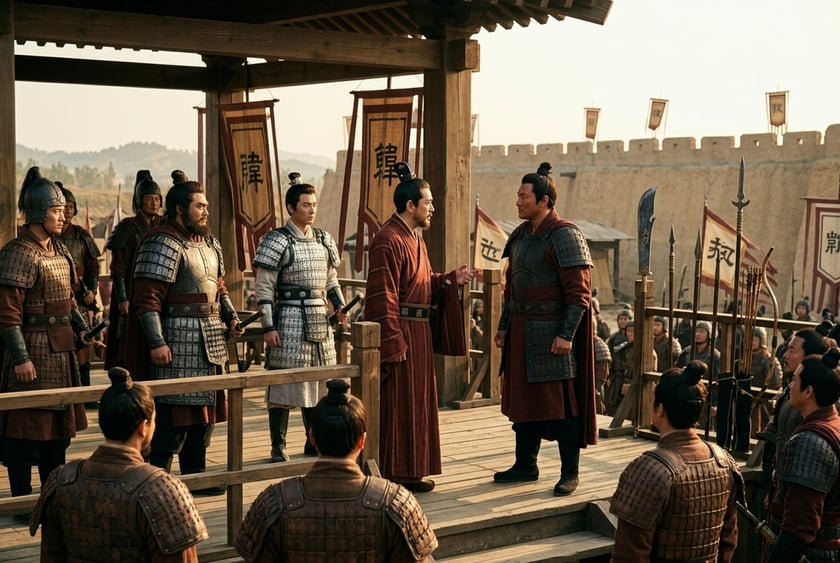
The core issue is "how armed seizure of power is legitimized through ritual procedure." The entire performance by which Sima Yan entered the Wei palace — entering while wearing his sword, conversing face to face with the Wei emperor, having Zhang Jie, who dared raise an objection on the spot, killed before the throne — was a precisely staged "procedural intimidation". Zhang Jie's role is especially worth analyzing: in the Romance he appears as a Yellow Gate Attendant who alone comes forward to argue in protest, invoking the founding legitimacy of "the Martial Emperor of the Progenitor [Cao Cao], who swept east and west, campaigned south and north," only to be ordered by Sima Yan's warriors to be struck down on the palace floor. The political-signal significance of this killing far exceeded its administrative consequences: it told every Wei official still watching and waiting that the abdication was an "invitation" that could not be refused. From that moment, no buffer remained between "unwillingness to cooperate" and "treason." Sima Yan's own response is also worth savoring — he did not simply declare "armed seizure is the natural way of the world," but said "my grandfather and father across three generations assisted Wei; it is not that the world was won by Cao's ability — it was in truth won by the Sima's strength," reframing the abdication as "cashing in accumulated merit" rather than "usurpation."
Political Consequences
The direct consequence of the abdication was the establishment of Western Jin and the end of Caowei. Sima Yan posthumously honored three generations as emperors, established the seven ancestral temples, changed the era name to Taishi, and lavishly enfeoffed his meritorious officials — He Ceng as Chancellor, Sima Wang as Minister of Works, Shi Bao as General Who Gallops in Chariots, Chen Qian as General of Chariots and Cavalry — completing the final distribution of interests to the scholar-gentry coalition. Cao Huan was enfeoffed as Prince of Chenliu and settled at Yecheng; he lived peacefully until the first year of Taian (302) — among the rarest of good endings for abdicated emperors, ranking alongside the Han emperor Xian's enfeoffment as Prince of Shanyang and Liu Chan's as Prince of Anle as the "three gracious endings of abdication." The medium-term consequences were that Western Jin inherited the entire stock of political contradictions left by Caowei: the distribution of power among the imperial princes (the distant cause of the War of the Eight Princes), scholar-gentry monopoly under the nine-rank system (the crystallization of aristocratic politics), and the failure of policies for settling northern minority peoples (the distant cause of the Yongjia Upheaval). Sima Yan completed the abdication, but what he inherited was a political structure that had already been battered by repeated strains.
Counterfactual Analysis
Several counterfactual lines are worth considering. First: had Sima Zhao not died but personally completed the abdication, he would have been unable to obtain the ideal legitimacy facade because of the moral stain of killing the Gaogui Township Marquis; the discursive construction of the abdication would have been far more difficult. Sima Yan, by virtue of being the "new generation," was able to sidestep that moral burden. Second: had Sima Yan initiated the abdication procedure one year earlier (the year after the destruction of Shuhan), the restorationist forces within Caowei might have been stronger — the fall of Shuhan provided the posture of "absolute victor" that was indispensable as legitimacy capital. Third: had Sima Yan chosen to accept Zhang Jie's protest during the abdication ceremony rather than ordering him killed, the new dynasty might have gained short-term moral credit by "tolerating dissent," but it would also have encouraged more fence-sitters to openly oppose the proceeding, shattering the closed logic of the entire ceremony — precisely the risk that any "procedural coup" must eliminate. Viewed from this angle, the blade that fell in the Luoyang great hall in the twelfth month of 266 was, in essence, "the indispensable intimidation step in the political science of abdication". In every abdication in later Chinese history — Liu Song replacing Eastern Jin, Southern Qi replacing Liu Song, Northern Zhou replacing Western Wei, right down to the Chenqiao military coup that founded the Song — the critical junctures each contain a Zhang Jie-type sacrificial figure. That role was not accidental; it was a necessary component of the procedure.