Background
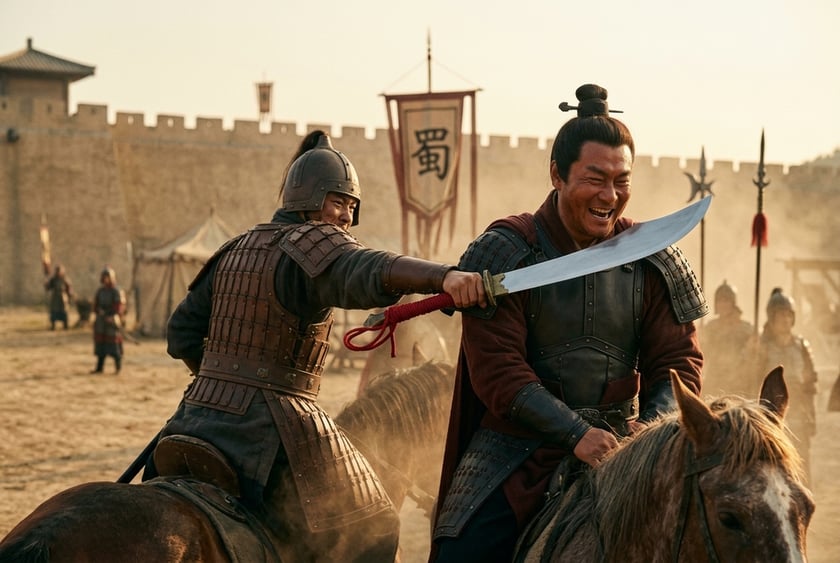
From the perspective of modern political history, the episode of "Wei Yan killing Han Xuan and surrendering to Liu Bei" functions in the Romance not merely as a tactical victory but as the foundational scene for the narrative of Zhuge Liang's "ability to read people," while simultaneously planting the dramatic seeds for the tragedy at Wuzhangyuan twenty-five years later. After Chibi, Liu Bei dispatched forces to take the four southern commanderies of Nanjun, Wuling, Lingling, Guiyang, and Changsha. When Guan Yu attacked Changsha he did not encounter an ordinary garrison but "the veteran general Huang Zhong" — the first truly grade-level veteran warrior of the former dynasty that Liu Bei's side had found in the Jing'nan region. Huang Zhong's political value already exceeded that of Changsha itself. The two mutual acts of forbearance between Guan Yu and Huang Zhong were, in essence, mutual recognition of each other's identity as warriors [c:18055]. In Han Xuan's eyes this recognition became evidence of "collusion with the enemy," and the political tensions within Changsha thus underwent a qualitative shift: the choice between defending and surrendering was forcibly reframed by Han Xuan, through "execute Huang Zhong," into a "loyalty test." This was precisely the moment when Wei Yan — as the "aggrieved faction within the army" — found the space to act as an internal catalyst.
Principal Figures
The four principal figures in the episode form two contrasting pairs. Guan Yu and Huang Zhong represent the pole of "mutual respect among warriors" — Guan Yu spared Huang Zhong, Huang Zhong shot back but struck only the plume of Guan Yu's helmet; between them existed a professional respect that transcended enemy and ally. Han Xuan and Wei Yan represent the other pole of "petty lord's paranoid suspicion versus subordinate's resentment." The Romance's portrayal of Han Xuan is relentlessly harsh: "cruel and inhumane, contemptuous of talent and scholars," trusting no one and treating his men poorly [c:18055]. Wei Yan is depicted as a mid-level officer who had long chafed under an incompetent lord and was perpetually looking for an opportunity to change allegiance. Worth noting: the Romance assigns Wei Yan no "self-interested" motive — he is not defecting for wealth or status, but is directly triggered by the immediate act of Han Xuan moving to execute Huang Zhong. This trigger transforms him into a moral actor performing a "righteous killing of a tyrant-lord to save a worthy man." That motivational framing earns him a "legitimate rebellion," but also affixes to him the label "capable of killing his own lord."
Central Issue
The substantive issue is how the "legitimacy of a surrendering general" is constructed. From Liu Bei's faction's standpoint, the gift Wei Yan brought had three components: Huang Zhong's life, Changsha's city, and a report of an uncontested entry into Nanjun without casualties. Any lord would have accepted this. The problem lies in Zhuge Liang's "bone of rebellion" argument: the Romance has Zhuge Liang insisting on executing Wei Yan when he enters camp, with Liu Bei intervening to spare him. This scene seems a dramatic cliffhanger, but it actually fulfills three narrative functions: first, establishing Zhuge Liang's status as a diviner who can "perceive the deepest recesses of human character"; second, branding Wei Yan with the label "bound to rebel eventually," making the Wuzhangyuan outcome feel preordained; third, highlighting Liu Bei's persona of "benevolent lord who values talent." But strip away the narrative filter and "killing one's lord to present a city" was actually a standard grey area in late Han political assessment: Mi Zhu and Mi Fang surrendering to Liu Bei, Meng Da surrendering to Liu Bei, Meng Da then surrendering to Caowei, Zhang Song presenting the maps to Liu Bei — all are fundamentally the same type of behavior, differing only in how historical narrative chooses its lens.
Political Consequences
In the short term, Wei Yan's killing of Han Xuan allowed Liu Bei to take Changsha at minimal cost and in one stroke recruit both Huang Zhong and Wei Yan as top-tier warriors — the single most productive talent-acquisition moment in Liu Bei's post-Chibi expansion [c:18055]. In the medium term, Huang Zhong went on to kill Xiahou Yuan in the Battle of Hanzhong, becoming the model for the "still vigorous in old age" narrative; Wei Yan was personally named by Liu Bei as Governor of Hanzhong after the battle, to the astonishment even of Zhang Fei. The political meaning of that appointment was enormous: Liu Bei took the man whom Zhuge Liang had once voted to eliminate, and entrusted him as the sole guardian of Shuhan's northern gate — the highest possible act of trust, overriding Zhuge Liang's judgment. In the long term, it was precisely the tension between this "bone of rebellion" verdict and Liu Bei's "exceptional trust" that ensured Wei Yan would never find true belonging within the Shuhan system: suppressed while the Chancellor lived, killed when the Chancellor died. A man who could have been Shuhan's most important front-line commander was ultimately trapped by a label planted over a decade before.
Counterfactual Analysis
Several counterfactual threads are worth exploring. First: had Han Xuan not moved to kill Huang Zhong, Huang Zhong would have continued defending Changsha, Wei Yan would have had no occasion to mutiny, and taking Changsha might have required a genuine siege — which in turn suggests that Han Xuan's misjudgment was an extra gift to Liu Bei. Second: had Zhuge Liang's motion to execute Wei Yan succeeded with Liu Bei's agreement, Shuhan would have lost the key candidate for Hanzhong's defense; the most likely outcome would have been Zhang Fei as Governor of Hanzhong, but Zhang Fei's temperament made long-term garrison command far less viable than Wei Yan's — Shuhan's northern defensive line might have shown cracks much sooner. Third: had Wei Yan, after surrendering, been assigned by Zhuge Liang to positions that built organizational loyalty gradually rather than keeping him in the role of "lone-wolf vanguard," the mutiny at Wuzhangyuan might never have occurred at all. But history delivered a version in which Zhuge Liang simultaneously suppressed Wei Yan's offensive proposals and used him as his vanguard, allowing his capabilities and frustrations to accumulate in tandem — and the true origin of that accumulation was the stroke of the blade with which Wei Yan killed Han Xuan beneath the walls of Changsha in the fourteenth year of Jian'an [c:18055].