Strategic Background
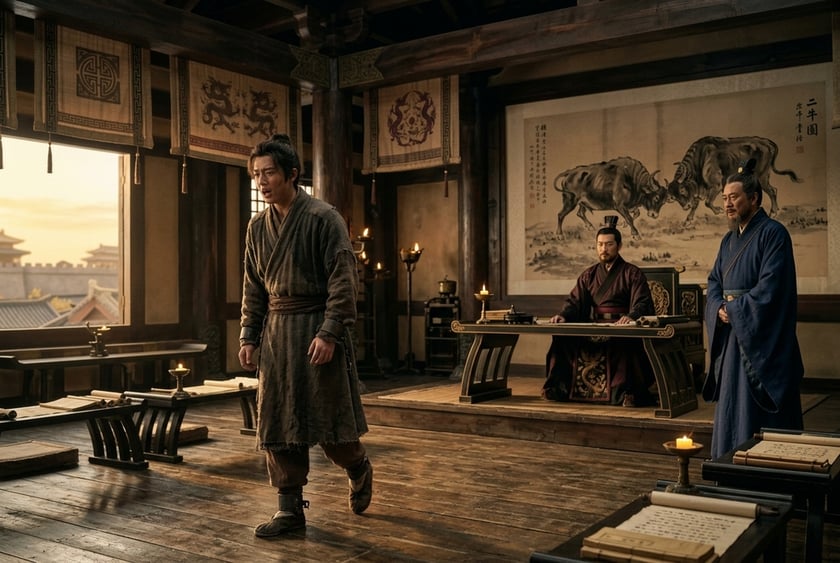
Guan Yu's battle against Huang Zhong for Changsha (Guanyuzhanhuangzhongquchangsha) was the final piece in the puzzle of the Liubeijituan's integration of the four commanderies of southern Jingzhou as portrayed in the novel. At the strategic level, Cao Cao had withdrawn northward after Chibi, and the Sun-Liu alliance was still in its honeymoon period. Using the window of opportunity created by Zhou Yu's campaign for Nanjun — which pinned down Cao Ren — Liu Bei rapidly expanded into the four southern Jingzhou commanderies (Wuling, Lingling, Changsha, Guiyang), converting the diplomatic talking point of "borrowing Jingzhou" into an accomplished fact. The key to this strategy lay not in the seizure of one city or one tract of ground but in quickly taking over an existing system of Han-era commandery governorships, thereby translating military victory into governing legitimacy. Changsha, as the largest and wealthiest of the four commandery seats in southern Jingzhou, was the capstone of the entire design.
Disposition of Forces
On Liu Bei's side, the deployment was "divide and advance simultaneously, each taking its own commandery" — Zhang Fei to Wuling, Zhao Yun to Guiyang, Guan Yu to Changsha. This arrangement carried an unmistakable flavor of "distributing credit": Liu Bei needed his core generals all to accumulate military merit during the strategic expansion in order to stabilize the internal power structure of his group. Guan Yu's volunteering to take Changsha himself carried a further connotation of "I too can stand on equal footing with Yide and Zilong" — the sort of healthy internal competition that is a common driver of energy in a rising regime.
On the side of Han Xuan, the Governor of Changsha, the deployment exposed a problem typical of local governments in the late Han: a lack of trust between the civilian administrator and his celebrated warrior. Han Xuan was "habitually impatient and quick to execute; all despised him"; toward Huang Zhong, a famous local fighter he could neither do without nor fully trust, his attitude was one of simultaneous reliance and suspicion. When the battle opened, he first sent the military school officer Yang Ling out to seek distinction by challenging the enemy — only for Yang Ling to be cut down by Guan Yu in a matter of exchanges — and only after that did he summon Huang Zhong. This pattern of "using a man while keeping him in check" was a classic harbinger of the dissolution of a locally entrenched small polity.
Key Decision Points
The campaign had three key decision points. The first was Yang Ling's overconfident request to go out and fight. Yang Ling declared: "There is no need for the old general to take the field — I will capture Guan Yu alive with my own hand", reflecting the atmosphere among Changsha's younger officers of eagerness to seize merit — an atmosphere that is a source of drive in peacetime stability but a recipe for disaster on the eve of battle. The second was the series of exchanges between Guan Yu and Huang Zhong in which each held back from delivering a killing blow. The novel presents this as a model of "righteousness": when Huang Zhong's horse stumbled Guan Yu did not kill him; in the next bout Huang Zhong shot only Guan Yu's helmet tassel by way of a warning rather than taking his life. In essence this "mutual restraint in single combat" meant that both sides were keeping political space open for the other to join the new camp. From a tactical standpoint, Huang Zhong's decision not to kill Guan Yu was an extraordinarily shrewd political calculation: he understood that Han Xuan would sooner or later settle accounts with him, so killing Guan Yu would have cut off his own line of retreat. The third was Wei Yan's battlefield defection. By "killing Han Xuan and opening the gates to surrender," Wei Yan completed the identity shift from "subordinate general of Changsha" to "core field commander of the Liu Bei camp" — a decision driven not by impulse but by a clear-eyed judgment that Han Xuan was beyond saving.
Results and Reverberations
The immediate result was that Changsha passed to Liu Bei and that Huang Zhong and Wei Yan entered Shuhan service. But the deeper reverberations were threefold. First, the Liu Bei camp's expansion through "political realignment rather than violent conquest" preserved the administrative system of the four southern Jingzhou commanderies almost intact, avoiding the governance vacuum that bloody replacement would have created — and this was the critical reason why tax revenues from southern Jingzhou remained stable and its population suffered no major disruption. Second, Huang Zhong thereafter became one of Shuhan's "Five Tiger Generals"; his subsequent feat of killing Xiahou Yuan at Dingjunshan in the Hanzhong campaign confirmed that the Liu Bei camp's logic of "winning people through righteousness" could indeed yield high-quality human assets. Third, the inclusion of Wei Yan — the "disloyal-boned general" in the novel's characterization — gave Shuhan its most important garrison-type commander beyond Guan Yu and Zhang Fei: Wei Yan later became the linchpin of Shuhan's northern defense as Governor of Hanzhong, and without him the stability of the Hanzhong front line would have been inconceivable. But the manner in which Wei Yan killed his lord and surrendered left a stain of "fickle and faithless" in later narrative — a political account in which early gains and late costs coexisted — as subsequent events during Zhuge Liang's death and Wei Yan's conflict with Yang Yi made plain.
Counterfactual Analysis
What would have happened if Han Xuan had not moved to execute Huang Zhong? The most probable outcome: Huang Zhong would have continued fighting Guan Yu, and the fall of Changsha would have been only a matter of time; but Wei Yan would not have defected, and Changsha would not have changed hands by means of a coup. Under this fork, Shuhan would still have taken Changsha, but would likely have suffered greater manpower losses and missed a time window; Wei Yan might also never have joined Shuhan. A second counterfactual: if Guan Yu had killed Huang Zhong without mercy in the first round, the Liu Bei camp would have lost a future commander who would slay Xiahou Yuan, significantly weakening Shuhan's military configuration, and the Five Tiger Generals system would never have taken shape. Seen from this angle, the narrative episode of "releasing Huang Zhong in righteousness" — though it may lack full historical corroboration (San Guozhi's record of how Huang Zhong came over to Han is exceedingly brief) — does capture a mode that was genuinely central to Liu Bei's governance wisdom during his Jingzhou expansion: a model of acquiring people through righteousness, exchanging low-intensity absorption for long-term human assets.