Strategic Background
Diyicibeifa (the First Northern Expedition, spring of 228) had fallen short because of Ma Su's loss of Jieting, forcing Zhuge Liang to retreat to Hanzhong and demote himself three ranks. In the winter of that same year, the Wei general Cao Xiu was defeated by Lu Xun at Shiting, drawing Caowei's eastern forces to the eastern front and leaving the military posture in the Guanlong direction relatively weakened. Zhuge Liang seized this strategic window and in the winter of Taihe 2 (228) decided to launch Diercibeifa (the Second Northern Expedition). This time he abandoned the flanking route through Qishan, instead taking the Sanguan road to strike directly at Chencang — Chencang stands beside the Wei River commanding the western approach to the Guanzhong plain, and capturing it would provide a springboard toward Jieting and Changan. However, after Diyicibeifa Caowei had grown alert to Shuhan's intentions; Sima Yi advised the Wei emperor to preemptively fortify the mouth of the Chencang road, and recommended Hao Zhao — known for his skill at holding cities — as the Chencang garrison commander. Before the campaign began the Chencang city had already been reinforced in advance; the Shu army faced a city that was ready and waiting.
Dispositions
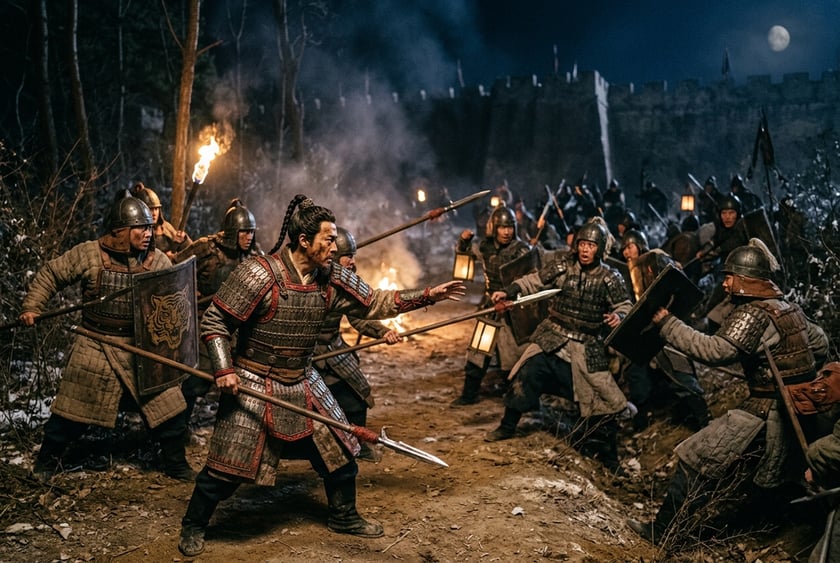
The Shu side had Zhuge Liang commanding approximately tens of thousands of main troops out of Sanguan; the vanguard, upon reaching Chencang, discovered that "at the road's entrance a city had already been built, with deep moats, high ramparts, and a dense array of deer-antler obstacles." Zhuge Liang first sent an old acquaintance of Hao Zhao's, Yin Xiang, into the city to attempt a persuasion to surrender, which failed, then ordered Wei Yan to mount a frontal assault and progressively escalate the siege methods. On the Wei side, Hao Zhao had barely a thousand men, but his city defenses were extraordinarily thorough: large quantities of fire arrows to burn siege towers, boulders that could be hurled to smash battering rams, inner cross-moats to intercept tunneling, and plans prepared in advance to counter each type of assault — ladders, battering rams, underground tunnels. The rear under Cao Zhen's main force held the various roads into Changan, coordinating reinforcements; the Wei emperor subsequently ordered Wang Shuang to lead a cavalry vanguard in a rapid relief, while Zhang He was also ordered to move south from Luoyang. The entire Wei force structure in the Guanlong direction formed a "solid interior, external relief, tiered defense in depth."
Critical Decision Points
The real contest of this siege lay at the level of offensive and defensive tactics. Zhuge Liang's assault methods represented the most advanced combination available at the time: he first deployed one hundred siege towers simultaneously to scale the walls from multiple sides — Hao Zhao burned them with fire arrows; he switched to battering rams to force the gates — Hao Zhao smashed them with millstones rolled on hemp ropes; he switched to filling the moats and tunneling in underground — Hao Zhao intercepted the tunnels with pre-dug transverse inner moats. In twenty-odd days of continuous assault, Zhuge Liang exhausted every conventional means, and Hao Zhao had a counter for each one. This confrontation of "attacker exhausting all methods, defender nullifying each in turn" is extraordinarily rare in ancient Chinese siege warfare. Zhuge Liang's critical decision error lay not at the tactical level but the strategic: he underestimated the degree of Hao Zhao's preparation and underestimated Chencang's material reserves, trapping the Shu army in a protracted war of attrition that was ultimately strangled by its own supply line. When Wang Shuang's relief force arrived, even had Zhuge Liang wished to continue the siege it was no longer possible.
Outcome and Resonance
Zhuge Liang actively lifted the siege and returned to Hanzhong, but on the retreat laid an ambush and killed the Wei vanguard commander Wang Shuang — this tactical victory partially recovered morale, but the strategic failure could not be undone. Cao Zhen's exertions in this campaign damaged his health; he fell ill not long after. The Wei emperor confirmed the value of the Chencang–Jieting defensive line in depth and ordered Guo Huai, Sun Li, and Zhang He to guard the various roads into Changan. Hao Zhao's reputation soared for his defense of Chencang, but he too died of illness not long after the battle. The failure of the Second Northern Expedition sent Zhuge Liang a clear signal: against a prepared Caowei on the Guanlong front, Shuhan's siege capabilities alone could not achieve a breakthrough. Thereafter Zhuge Liang's northern campaigns gradually shifted direction toward eastern Longxi, Wudou, and Yinping, and then in the fourth and fifth expeditions toward the Qishan–Wuzhangyuan front, effectively abandoning any direct attempt to break through at Chencang–Changan.
Counterfactual Analysis
If Zhuge Liang had, within the first ten days of the siege, identified Hao Zhao's tactical system of "using small force to constrain large, using preparation to constrain attack" and promptly shifted to a strategy of "besieging without assaulting, cutting his supply lines" — a war of attrition — he could have avoided the costly expenditure of elite troops. If the Wei emperor had not heeded Sima Yi's advice after Diyicibeifa to preemptively fortify Chencang, and had not deployed Hao Zhao there in advance, the Shu army might have quickly routed a small garrison force at the entrance of the Chencang road in open field fighting and gone on to threaten Changan. If Shuhan had succeeded in capturing Chencang, the shock to Guanzhong would have forced Caowei to pull troops from the eastern front westward, indirectly easing pressure on Sunwu from that direction. Looking at the longer arc, Chengcangzhiwei is the earliest example in the entire sequence of Shuhan's Northern Expeditions of "tactical victory being incapable of reversing strategic disadvantage," and provides classical instruction for later siege warfare showing that "when the defending side is fully prepared, there is no path to breaking through by assault."