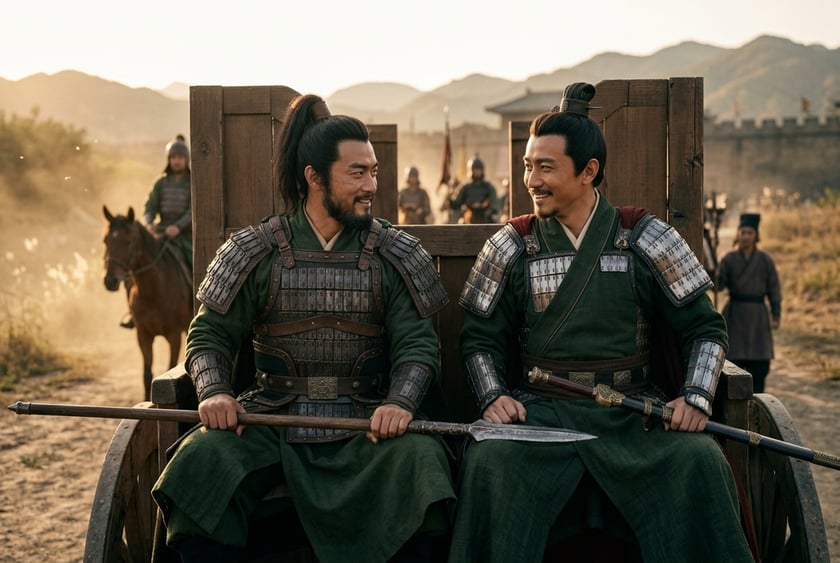
Strategic Background
The true nature of the Battle of Changbanpo, as presented in the Romance, was a decisive pursuit engagement before the climactic battle of Chibi — not an independent pitched battle. In the seventh month of 208, Cao Cao launched his southern campaign to conquer Jingzhou; in the eighth month Liu Biao died of illness; in the ninth month Liu Cong surrendered the entire province — Cao Cao gained nearly all of northern Jingzhou with almost no fighting, but Jiangling still held enormous "military stores," meaning vast quantities of war matériel [c:17965]. If Liu Bei reached Jiangling first, he would still have been capable of organizing sustained resistance, backed by Jingzhou's naval forces, boats, and supplies. Cao Cao astutely recognized how scarce this time window was, and so "abandoned his supply train, moved light to Xiangyang, and learning that the lord had already passed, took five thousand picked cavalry and pursued in a forced march of over three hundred li in one day and one night" [c:17965] — a high-risk maneuver that traded speed for strategic advantage, betting everything on breaking Liu Bei's core forces before he could take Jiangling. Wen Pin, as a surrendered Jingzhou general, led the vanguard alongside Cao Chun with intimate knowledge of the terrain, forming the command layer of the cavalry pursuit [c:17964].
Dispositions
On Cao Cao's side: Cao Chun commanded approximately five thousand Tiger-Leopard Cavalry; Wen Pin led the surrendered Jingzhou troops to open the way; Cao Ren, Xiahou Dun, Xiahou Yuan, Le Jin, Zhang Liao, Zhang He, and Xu Chu with the main force followed in close support — the entire pursuit operated on a two-tier configuration of vanguard cavalry plus following main body [c:17976]. Liu Bei's dispositions had nearly collapsed — burdened by more than a hundred thousand civilians withdrawing southward, covering only ten-odd li per day, organization was already half-paralyzed [c:17969]. When the Cao army caught up that night, Liu Bei had only about two thousand effective troops at his side, along with core advisors including Zhuge Liang, Zhang Fei, Zhao Yun, Mi Zhu, Mi Fang, and Jian Yong [c:17971]. With such a disparity in strength, open battle was utterly impossible; Liu Bei's only viable option was to "abandon the baggage and save his own life" — the historical records state plainly that "the lord abandoned his wife and children, and fled with Zhuge Liang, Zhang Fei, Zhao Yun, and several dozen cavalry" [c:17965].
Critical Decision Points
The entire engagement had three critical decision points. The first was Liu Bei's decision to "withdraw with the civilian population." Tens of thousands of civilians from Xinye and Fancheng had voluntarily followed; Jian Yong divined the auguries and said "tonight will bring great calamity," advising Liu Bei to "quickly abandon the people and flee." Liu Bei refused: "The people followed me all this way from Xinye. How could I bear to abandon them?" [c:17970]. This decision was tactically wrong — it directly caused the withdrawal speed to collapse and allowed the cavalry to overtake them — but politically it was correct: it established the image capital of "Liu Bei who carries his people with him," which became the core narrative that later attracted Jingzhou local scholars to his side. The second was Zhao Yun's decision to protect Gan Furen and the future emperor. The historical record tersely notes: "When the Cao army arrived and pursued the lord to Changban in Dangyang, in that moment of desperate crisis he abandoned his wife and heir; it was thanks to Zhao Yun's protection that they escaped danger" [c:17966] — a passage of cool historical prose that the Romance expanded into an entire chapter of Danqijiuzhu (a single rider saving his lord) as a standalone sub-event. The third was Zhang Fei's decision to hold the bridge and cover the rear. "Hearing that Cao Cao's forces had arrived suddenly, the lord abandoned his wife and children and fled, ordering Fei to lead twenty cavalry to hold the rear. Fei took position at the river, cut the bridge, glared with wide eyes and leveled his spear, crying out: 'I am Zhang Yide — who dares come and fight to the death with me!' None of the enemy dared approach, and so they were able to escape" [c:17968] — a successful act of psychological warfare in which single-man intimidation substituted for actual force deployment.
Outcome and Resonance
In terms of tactical results, Liu Bei's side suffered a crushing defeat: core baggage, numerous family members, and the more than hundred thousand accompanying civilians were all lost; only a few dozen cavalry broke through to Hangjin, where they fortunately encountered Guan Yu's fleet in time, joining forces with Liu Qi's troops before finally steadying their footing at Xiakou [c:17965][c:17967]. But viewed strategically, the defeat at Changban actually catalyzed three critical turning points. First, Liu Bei was forced to abandon Jiangling as a strategic objective and concentrate entirely on alliance with Sun Quan — Lu Su happened to travel north to Dangyang at precisely this moment to meet Liu Bei, urging him to "send a trusted envoy to forge ties with the east," after which Zhuge Liang went on his mission to Wu [c:17965]. Second, Liu Qi's force of over ten thousand Jiangxia troops provided the legitimate military foundation for the Sun-Liu joint army. Third, although Cao Cao had seized the population and supplies, his cavalry had raced three hundred li without supply train and was already exhausted — this laid the groundwork for the vulnerability of Cao Cao's forces at Chibi in the form of "unfamiliar territory plus pestilence." From the Romance's visual storytelling dimension, the episode of Zhang Fei holding the bridge was dramatized to the utmost — a single roar of "Swallow-man Zhang Yide stands here! Who dares come and fight to the death?!" reportedly frightened away a million Cao troops, causing Xiahou Jie's gallbladder to burst so that he fell dead from his horse [c:17977][c:17978] — this image no longer belongs to military history but has entered the shared memory of folk opera, woodblock prints, and Peking opera.
Counterfactual Analysis
If Liu Bei had not brought the civilians southward but instead ridden at cavalry pace alone, could he have outrun Cao Cao to Jiangling? By speed estimates, if Liu Bei's core force of roughly ten thousand, without civilians, marched at fifty li per day, it would need about six days to cover the roughly three hundred li from Fancheng to Jiangling; Cao Cao's main force needed about three days to reach Xiangyang from Fancheng and another four days to reach Jiangling south — giving Liu Bei a lead window of one to two days, making it theoretically possible to enter Jiangling first. Had that happened, the Battle of Changbanpo would never have occurred; Cao Cao would have faced a Liu Bei holding Jiangling, commanding tens of thousands of naval troops, and directly in communication with Sun Quan — the strategic initiative at Chibi might from the outset have rested with the Sun-Liu side. But the price was "abandoning the people" — fundamentally at odds with Liu Bei's political narrative, so in practice he could never have chosen that path. A second counterfactual: if Zhang Fei's stand at the bridge had failed to intimidate the Cao forces, Liu Bei himself would very likely have been captured that very night at Changban — and if so, the entire latter portion of San Guo history would never have existed. That is the true weight of "Zhang Yide taking an enemy commander's head in the midst of a million troops": the Romance exaggerates the image, but the historical record in its own stark brevity already acknowledges the strategic gravity of that single act of intimidation.