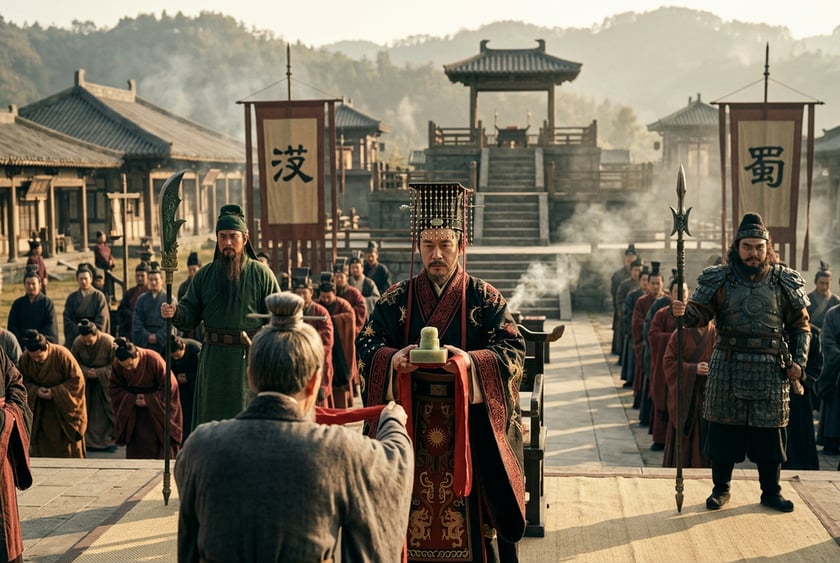
Strategic Background
Danqijiuzhu occurred in the ninth month of Jian'an year 13, after Cao Cao swept south to take Jiangling and turned his forces to pursue Liu Bei, scattering Liu Bei's baggage train and civilian column at Dangyangchangban. Grasping the true weight of this rescue requires seeing two strategic lines clearly. First: from the moment Liu Bei began retreating south from Fancheng he had been moving slowly, carrying more than a hundred thousand soldiers and civilians—caught and overtaken by five thousand Cao Cao light cavalry riding three hundred li in a single day and night, a compound crisis of "failed reassembly plus defensive collapse." Second: Liu Chan, as Liu Bei's only surviving male heir at the time (Liu Feng was an adopted son), was directly tied to the political continuity of the Liubeijituan. Had A-Dou fallen into Cao army hands, Liu Bei could still have crossed the river and allied with Sun Quan, but he would have lost the single most critical succession asset. This is the real reason this seemingly individual act of heroism has been retold so continuously—what Zhao Yun saved was not an infant but the future of Shuhan.
Disposition of Forces
On Cao Cao's side were five thousand elite Tiger-and-Leopard cavalry personally commanded by Cao Cao, with leaders including Cao Chun, Wen Pin, Zhong Jin, and Zhong Shen—at that time the most mobile strike cavalry force in all of northern China. Liu Bei's side was entirely reactive: Liu Bei himself fled south with a small personal retinue; Guan Yu took the water route to rendezvous at Hanjin; Zhang Fei held the rear guard; Zhao Yun was responsible for protecting the household column carrying Gan Furen and Liu Chan. When the column was scattered, Zhao Yun was left with only thirty or forty riders. By the numbers, the encounter Zhao Yun faced was not a single concentrated enemy force but Cao army units and individual pursuers dispersed across the Changban battlefield—the difficulty lay not in "fighting outnumbered in a hard battle" but in "with an extreme minimum of men, riding back and forth into enemy-held ground to search out and extract the objective"—an extreme mission of penetration and exfiltration.
Critical Decision Points
The first critical decision is Zhao Yun turning back into the enemy to search rather than following Liu Bei south. The Romance records his inner monologue: "My lord entrusted Lady Gan, Lady Mi, and the young master A-Dou to my protection; today I have lost them in the army's chaos—with what face can I appear before my lord?"—elevating the rescue from a military action to a personal commitment of honor. The second decision is Zhao Yun actively calling out his own name when challenged by Cao Hong: "I am Zhao Zilong of Changshan!". This seemingly reckless act was in fact tactically shrewd: it made Cao Cao want to take him alive and therefore issue an order forbidding cold arrows, inadvertently handing Zhao Yun a safe corridor. This is a key moment in the Romance's sculpting of Zhao Yun's image—he is not a brute warrior but a commander who knows how to use the enemy's psychology as leverage. The third decision is reaching Changban bridge and decisively abandoning his horse on foot, relying on Zhang Fei's last-stand holding action to buy the time to escape. The three decisions interlock to constitute one complete high-risk infiltration-and-extraction operation.
Outcome and Resonance
Tactically, Zhao Yun rescued Gan Furen and Liu Chan, slew several Cao commanders including Zhong Jin and Zhong Shen, seized the sword Qinggang that was said to have been Cao Cao's personal blade (a Romance element), and finally broke through at Changban bridge to link up with Zhang Fei. Strategically, Liu Chan's preservation meant that Liu Bei, in his negotiations with Sun Quan after withdrawing south, was not encumbered by an heir crisis; the historical record shows Liu Bei was able fairly quickly thereafter to forge the Chibi alliance with Sun Quan, and the continuity of his core personnel structure was indispensable to that. Politically, this rescue gave Zhao Yun within the Liubeijituan the permanent label of "loyal bulwark"—the famous scene of Liu Bei hurling A-Dou, though its authenticity is disputed, precisely captures the political posture of "a lord who values his general above his own blood". Later appraisal went further: starting with San Guo Yanyi, Zhao Yun was fixed as the complete exemplar of "wisdom, valor, and loyalty" combined, placed alongside Guan Yu's "righteousness" and Zhang Fei's "ferocity," yet closer than either to what a modern sensibility would call "an officer worthy of unconditional trust." This cultural archetype continues to shape the Chinese popular imagination of the "ideal warrior" to this day.
Counterfactual Analysis
First counterfactual: had Zhao Yun failed to save A-Dou, Liu Bei would have faced a severe succession crisis in and around the Chibi period. Liu Chan was barely over one year old at the time and Liu Bei's only living biological son; had he died at Changban, Liu Bei could only have relied on Liu Feng (adopted son) as heir—yet Liu Feng's later fate, executed for failing to relieve Guan Yu, signals how ill-suited he was to carry the burden of political consolidation. The legitimacy of Shuhan's dynastic succession would almost certainly have fractured severely. Second counterfactual: had Zhao Yun himself fallen at Changbanpo, Shuhan would have lost a stable military pillar spanning three generations—Liu Bei, Zhuge Liang, and Jiang Wei. That Shuhan's core commander group maintained continuity through four major campaigns—Jingzhou, the conquest of Shu, Hanzhong, and the eastern expedition—owed in no small part to Zhao Yun's longevity and loyalty. Third counterfactual: had the Cao army not issued a "take him alive" order and instead applied a dense rain of arrows, no level of individual tactical brilliance could have gotten Zhao Yun out—a detail that reminds us that the heroic achievements of Romance characters often depend on some form of self-binding constraint by the adversary. From the military-history standpoint, Danqijiuzhu is simultaneously a historically grounded epic amplification and a mirror: it reflects how "loyalty and righteousness" in the San Guo era were constructed, disseminated, and ultimately crystallized into a cultural paradigm.