Strategic Background
The Battle of Dongxing was the first great test for Zhuge Ke after Sun Quan's death left him newly in charge of Wu's government. The Dongxing dike had been built in Sun Quan's earlier years to dam Chao Lake and control the Ruxu waterway, but it had later been abandoned and left unrepaired after the defeats in Huainan; when Zhuge Ke rebuilt the great dike in the first year of Jianxing and raised two cities flanking it with garrison troops, it was as if he had driven a fresh nail into the Wei–Wu frontier. Wei regarded the Wu army's intrusion into its territory as a disgrace and resolved to pull out the two fort-cities and demolish the dam. For Zhuge Ke this was both a project to shore up frontier defense and an opportunity to establish prestige for the new regime—victory would greatly enhance his standing, defeat would shake his foundations.
Forces Involved
Wei applied pressure along three routes: the main assault, under Hu Zun, Zhuge Dan, and others, brought seventy thousand foot and horse to besiege the two forts of Dongxing, while Wang Chang attacked Nan Commandery and Guanqiu Jian marched on Wuchang, the aim being to tie Wu down on multiple lines so it could not protect head and tail at once. The Wu army's main force was Zhuge Ke himself, leading forty thousand to the rescue day and night; the eastern and western cities were held by Quan Duan and Liu Lue with a thousand men each, and the vanguard was entrusted to the four generals Liu Zan, Lü Ju, Tang Zi, and Ding Feng. It is worth noting that Han Zong, commander of the Wei vanguard, had originally been a defector from Wu, and in this battle he ran straight onto the blades of his former lord's old troops.
Key Turning Point
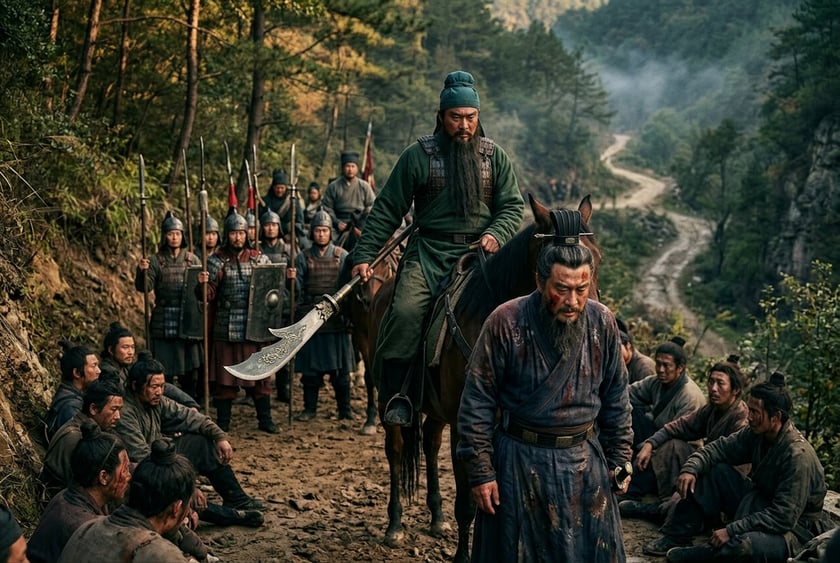
The turning point was catalyzed entirely by battlefield psychology and the weather. The Wei army's siege of the two cities had stalled, and its main force was arrayed on the pontoon bridge and the dike; with the weather bitterly cold and the snow heavy, the generals, seeing how few the Wu vanguard were and having themselves removed their armor to feast, grew careless and did not at once put their troops on alert. The Wu vanguard seized on this slackness and made the choice to cast off their armor, carry only blades and shields, and scale the dike lightly equipped—trading away protection for speed of assault. Once they had mounted the dike, beating their drums and hacking wildly, the Wei army turned in an instant from contempt for the enemy to panicked rout; they scrambled across the pontoon bridge until it broke and gave way, falling into the water and trampling one another. From "seventy thousand besieging forty thousand" to "tens of thousands drowned," the reversal of fortune hinged on the single question of whether the Wei army had taken precautions.
Suppression and Outcome
In this engagement the Wu army won a great victory, cutting down Han Zong, Huan Jia, and others; the Wei dead numbered in the tens of thousands, and they captured thousands of carts, oxen, horses, donkeys, and mules, with supplies and equipment piled high, before returning in triumph. For his achievement Zhuge Ke was advanced to Marquis of Yangdu, made Governor of Jing and Yang Provinces, given supreme command of all military affairs within and beyond the capital, and richly rewarded with gold, horses, and silks, his personal prestige reaching its zenith. Among these events, Ding Feng's Snow Attack with Short Weapons—his storming of the dike—is, as a sub-event of this battle, the single most representative blow of the entire reversal.
Historical Resonance
The halo of the great victory at Dongxing soon became Zhuge Ke's death warrant. Victory fed his arrogance, and the following year he disregarded all counsel and threw the whole nation's strength into besieging Hefei Xincheng; unable to take it after a long siege, his soldiers ravaged by plague and casualties, his prestige turned from peak to decline, and on his return home he was at once ensnared and put to death by Sun Jun. Looked at from this angle, the Battle of Dongxing was both one of the rare exhilarating victories of Wu's later period and the starting point of Zhuge Ke's slide from his peak to ruin—a beautiful defensive counterstroke that failed to translate into sustainable strategic restraint and instead became a psychological springboard for recklessness. This is the deepest warning Dongxing left to posterity: victory itself can sometimes be more dangerous than defeat.