Background
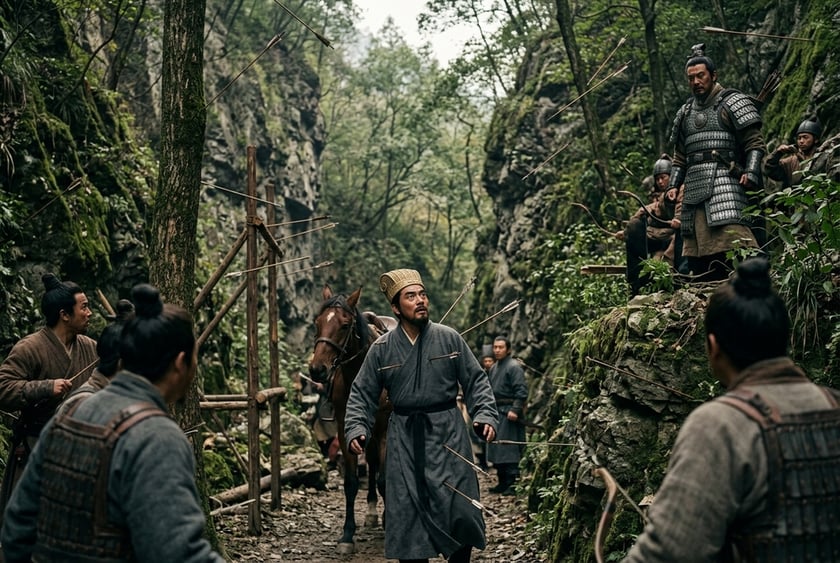
Yuanshubaiwang — the fall and death of Yuan Shu — occurred two years after he had usurped the title "Zhongshi." He proclaimed himself emperor in Jian'an year two (197) and perished in Jian'an year four (199); the entire Zhongshi regime lasted only two years, making it the shortest-lived and most rapidly collapsed of all the separatist regimes of the late Han. The structural causes were embedded at the very moment of his proclamation: he attempted to force legitimacy through "imperial seal plus prophecy" when "his strength was insufficient to support the imperial title," and the result was to drive every potential ally into opposition [c:17689]. Immediately after the proclamation he launched a war to attack Xuzhou in an attempt to expand his strength, only to be repelled jointly by Lv Bu and Liu Bei; he then appealed to Sun Ce for troops and was met with a stern rebuff. Cao Cao personally campaigned against Lv Bu in the ninth month of Jian'an year three and took Xiapi, then immediately turned his forces toward Huainan; Yuan Shu faced simultaneous pressure from west, north, and east, and to the south the Yangtze was a natural barrier making it impossible to cross and seek refuge with Liu Biao — his strategic options had essentially been reduced to zero from the moment of his proclamation.
Principal Figures
The most critical figure is of course Yuan Shu himself. But the true "main characters" of the period surrounding his fall were several supporting figures acting in concert. The first was Yuan Shao: at the end of his road, Yuan Shu wanted to "go north and take shelter with his elder brother," and he proposed to "yield" the imperial title to Yuan Shao in exchange for protection — a deeply ironic turn in which the man who had once looked down on Yuan Shao when the Runan Yuan clan divided their inheritance now came begging for his life. But the route was blocked by Liu Bei, Guan Yu, and Zhang Fei in Xuzhou; Yuan Shao could not respond, and Ji Ling died in battle at the front while Lei Bao and Chen Lan set themselves up as mountain bandits in Songshan and plundered Yuan Shu's supply train — former subordinates instantly stripping their lord of his last reserves [c:17689]. The second was Liu Bei: his final "active sortie" mission before the Yidaizhao plot's exposure was this campaign against Yuan Shu, and through it he was able to leave Xudou; the episode objectively propelled Liu Bei from "guest general of Cao Cao" to "independent warlord." The third was Xu Qiu — a former official of Runan who seized the imperial seal from Yuan Shu's body in the chaos and presented it to Xudou. That seal remained in Cao Cao's hands for twenty years, ultimately put to use when Cao Pi replaced the Han, constituting the seal-transmission chain of "Yuan Shu's usurpation — Caopidaihan."
Core Issue
The real issue of Yuanshubaiwang is not "why does a self-proclaimed emperor fall" but "why does a self-proclaimed emperor fall so quickly and so completely." The three figures who actually proclaimed themselves emperors during the late Han and San Guo period — Cao Pi, Liu Bei, and Sun Quan — each spent at least ten years of groundwork before the act: Caowei went through "Duke of Wei — King of Wei — replace the Han" in three stages; Shuhan proclaimed continuation of the Han line under the name of "imperial kinsman"; Eastern Wu waited until Caowei and Shuhan had worn each other down to the point of having no energy to look south before formally claiming supremacy. The fundamental difference between Yuan Shu and these three was not ambition but the capacity to "judge timing." What he failed to secure was a series of "prerequisites for imperial proclamation": a consolidated base territory, deep elite-clan loyalty, tacit acceptance from external allies, and the patience to "build substance first, then speak of titles." When none of these prerequisites were in place, the proclamation did not accumulate legitimacy — it became the fuse that accelerated collapse, since all who had been wavering instantly gained moral grounds for going to war.
Political Consequences
The cascading consequences of Yuan Shu's death were far-reaching. First, the power vacuum in Huainan allowed Cao Cao to consolidate the southeastern central plains; between Jian'an years four and five, Cao Cao successively absorbed Shouchun, Hefei, and Runan, laying the strategic depth he would later need to resist Sun Quan and check Guan Yu. Second, the imperial seal passed to Cao Cao — reinforcing the prohibition that "those who replace Han are doomed," and causing Cao Cao in his own lifetime never to dare proclaim himself emperor; he repeatedly declined his ministers' proposals to "add the Nine Dignities and advance his noble rank," leaving the replacement of Han to his son Cao Pi. Third, Liu Bei broke entirely free of Cao Cao's system and entered the phase of independent building; the year of Yuan Shu's death was also the eve of the Yidaizhao plot's exposure, and from then on Liu Bei walked a twenty-year road of wandering as "orphan of the Han house, seeking a new base." Fourth, while Lv Bu and Cao Cao's conflict escalated, Sun Ce was able to focus on consolidating Jiangnandong and pave the way for the coalition that would later fight at Chibi. Yuanshubaiwang appears on its surface to be merely the fall of one warlord, but it actually reshaped the configuration of all the major forces in the latter half of the late Han.
Counterfactual Analysis
Two counterfactuals in the retrospective analysis are most worth developing. The first: had Yuan Shu proactively renounced his title in the early phase of his failed proclamation and returned to the name of "serving Han," could he have halted the collapse? From the novel's narrative and the clues in Pei Songzhi's annotations, once a title is established it can hardly be withdrawn — renouncing it would amount to publicly admitting "the heavenly-destiny narrative was false," and the entire Zhongshi regime's legitimacy base would instantly crumble. This is the worst "sunk-cost problem" a usurper regime faces: once a wrong beginning has been made, withdrawal is more dangerous than continuation. The second counterfactual: had Yuan Shu, instead of trying to flee north to Yuan Shao just before his death, held Shouchun and fought to the last — would he have had a more honorable end? The critical factor in this path is whether Huainan could still mobilize resources. From what the novel records, Huainan in Jian'an year four had already been bled dry by warfare — "the army lacked grain, the reclamation farms had failed" — even his own lord could not get a sip of honey water [c:17689]. Fighting to the death would only have made the end more gruesome, but at least would have preserved the honor of "sharing the fate of Huainan." Yuan Shu chose to flee north, seeking survival, and in so doing forfeited his final shred of dignity — which is the fundamental reason virtually all later historians hold him in contempt. The reason Yuanshubaiwang is so repeatedly used in literary narrative as the iconic image of "the end of a greedy usurper" is not that he made so many mistakes, but that he carried each mistake to its most theatrical, most wretched extreme.