Strategic Background
The Diyicibeifa of spring 228 was Shuhan's first offensive strike since the defeat at Yiling. Zhuge Liang chose to march from Hanzhong via Qishan toward Longright, aiming first to seize the five commanderies of Longright (Longxi, Nanan, Tianshui, Anding, and Guangwei) as a forward base, then to use the Long highland to threaten Guanzhong. This route skirted the heavy Wei concentrations on the Guanzhong front (the Chencang–Changan line) and used the natural barrier of the Longshan range to split the main Wei force between Guanzhong and Longxi — a carefully calculated strategic layout. At the outset, execution went remarkably well: Nanan, Tianshui, and Anding surrendered without a fight [c:17630][c:17634]; Wei's "court officials knew not what plan to adopt" [c:17630], and "the court and countryside were terrified, Longright and Qishan above all" [c:17634], prompting the Wei emperor Mingdi to travel personally to Changan to oversee the defense. But the entire strategic skeleton rested on one specific point — Jieting. Jieting, at the eastern foot of the Longshan range, was the throat connecting Longright to Guanzhong: so long as it stayed in Shuhan hands, Wei reinforcements from Guanzhong could not break through, and the newly submitted three commanderies would have time to consolidate; once Jieting fell, Longright would reconnect with Guanzhong, and the three surrendered commanderies would collapse for lack of a secure rear. Zhuge Liang's overall strategy was sound, but every degree of soundness was compressed onto a single point.
Deployment
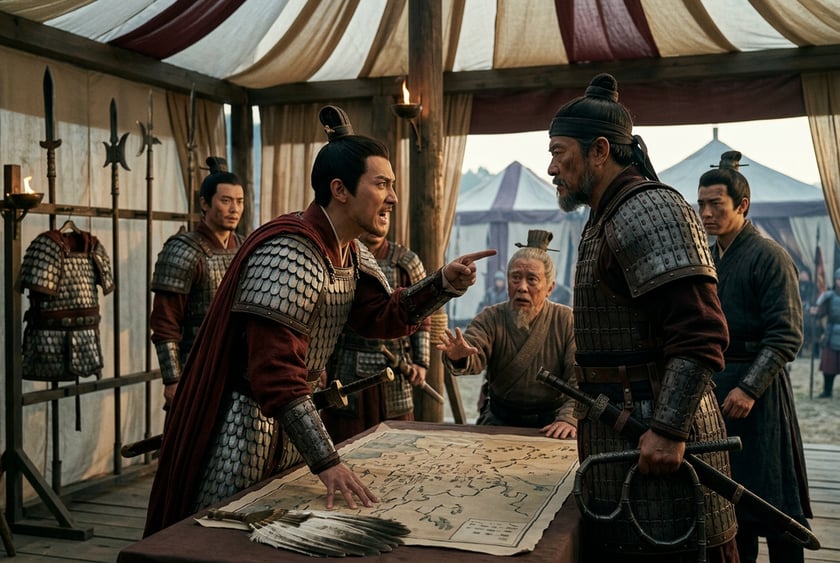
On the Wei side, Zhang He was the real commander. San Guozhi states explicitly: "Right General Zhang He struck Liang at Jieting and routed him" [c:17630]; "He resisted Liang's general Ma Su at Jieting. Su relied on the south mountain and refused to descend to hold the town. He cut off his water supply and attacked, routing him utterly" [c:17631]. Zhang He at this time was one of the last surviving veterans of Caowei's founding generation; from the Huangchu reign onward he had held independent commands, and he knew the Longshan terrain and the northwest border armies thoroughly. Cao Zhen supervised Guanright overall while Zhang He bore sole responsibility for the front line — the strongest combination Wei could field. On the Shuhan side, the greatest controversy was the choice of vanguard commander. "There were at the time veteran generals such as Wei Yan and Wu Yi; commentators all said one of them should be made vanguard" [c:17636], yet Zhuge Liang defied the consensus and chose Ma Su. Ma Su was abundantly talented and skilled in deliberation; he had earlier proposed the celebrated "win hearts first" strategy before the southern campaigns [c:17636], but had never commanded large-scale field operations independently. The late emperor Liu Bei had warned Zhuge Liang on his deathbed that "Ma Su talks beyond his abilities and must not be entrusted with great responsibilities" [c:17636] — a warning Zhuge Liang did not then believe. Wang Ping accompanied Ma Su as deputy general, his role being to check Ma Su's decisions and provide a second judgment; Gao Xiang garrisoned Liucheng as flank support, and Wei Yan held a rear position behind Jieting as a reserve — a quite prudent three-layered structure (as the novel records) [c:17644]. The problem lay at the front: upon reaching Jieting, Ma Su abandoned the road and moved up onto the south mountain, rejecting Wang Ping's advice to encamp astride the main road [c:17645].
The Critical Decision
The entire battle's outcome hinged on one decision — Ma Su forsaking the water source and climbing the hill. From a military-geographic standpoint, Jieting's critical function was to "block the road and prevent Wei forces from passing"; the correct tactic was therefore to encamp across the road, build fortifications, and seal the eastern passage of Longshan [c:17645]. Ma Su's choice to "seize the heights and look down" reframed Jieting from a "chokepoint stronghold" into a "field-ambush ground," expecting to strike downhill and destroy the enemy. This was a textbook error of "substituting one's own preference for the task's requirement" — he grafted his inclination for "unconventional schemes" onto a position that demanded "engineered blocking action." Zhang He's response upon recognizing this was devastatingly precise: rather than attacking the hilltop, he cut off the water supply [c:17631]. Once the water ran dry on the hill, the Shuhan army quickly found "the army unable to eat, the camp in chaos" [c:17648]; morale collapsed faster than combat attrition could account for. This is an iron rule that applies to any force encamped on a ridge: the high ground confers positional advantage but logistical disadvantage; as long as time favors the besieger, the force on the hill is simply trapped. Ma Su's miscalculation lay not in tactical detail but in failing to understand the strategic mission that Jieting as a position was meant to fulfill — it needed to hold, not to win. Wang Ping's conduct, by contrast, showed a different level of mastery: after Ma Su's rout, Wang Ping led his own thousand men in orderly drumming and slow withdrawal, consolidating the scattered remnants of the other camps, whereupon Zhang He suspected an ambush and dared not press close [c:17638] — the same terrain, the same numerical disadvantage, and a capable commander could turn "retreat" into "an orderly withdrawal with the force intact."
Outcome and Aftermath
Once Jieting fell, the entire Diyicibeifa collapsed immediately. Zhuge Liang was forced to withdraw more than a thousand households from Xixian back to Hanzhong [c:17635], and the three commanderies were gained only to be lost again — "Nanan, Tianshui, and Anding had responded to Liang; He broke and pacified them all" [c:17631]. Back in Hanzhong, Zhuge Liang did three things. First, he executed Ma Su along with Zhang Xiu and Li Sheng, and stripped Huang Xi and others of their troops [c:17638] — he had to apply the sternest law to the man he had personally chosen against the crowd's counsel, in order to sustain his accountability for "defying the majority." Ma Su's dying memorial declared "Su regards the Illustrious Duke as a father; I pray you deeply consider the meaning of punishing Gun in order to raise Yu" [c:17636]; Zhuge Liang came in person to mourn and cared for Ma Su's orphans as in life — yet he allowed no exception in law. Second, he personally petitioned to demote himself three grades as acknowledgment of fault [c:17635] — attributing to himself the responsibility for "employing Ma Su against the crowd's advice" so that a culture of blame would not spread downward to subordinate commanders. Third, he elevated those who had performed well at lower levels: Wang Ping was specially honored, promoted to staff officer, given command of five units including his own camp, advanced to the rank of general of military suppression, and enfeoffed as a village marquis [c:17638]. The combined effect of these measures stabilized army morale: "Thus he assessed minor merits, distinguished the gallant and the brave, took personal fault upon himself, announced his failures to all under heaven, drilled the troops and studied warfare with a view to future action; the soldiers were well trained, and the people forgot the defeat" [c:17635]. But the strategic damage was irreversible — Wei had ample warning of Shuhan's northern campaigns from this point on. Emperor Mingdi afterward issued a proclamation throughout the realm that "Liang, that small one, has alarmed my armies" [c:17630], and within six years had rebuilt the Longright defense line so thoroughly that Zhuge Liang's second, third, fourth, and fifth northern expeditions could never again reproduce the stunning effect of "three commanderies surrendering without a fight."
Counterfactual Analysis
Two counterfactuals in the retrospective analysis are most worth developing. The first: had Zhuge Liang heeded the consensus and appointed Wei Yan or Wu Yi as vanguard, what would have happened? Wei Yan at that time held a vital post in Hanzhong and was the most capable general in the Shuhan army for hard fighting; had he reached Jieting, he would almost certainly have encamped astride the road — Wei Yan's consistent style was to hold key points securely and not to act rashly — and even if Zhang He had tried to bypass him, he could not have cut the Long corridor. The worst case for the Diyicibeifa would have become "failing to take Longright but holding Jieting," leaving the question of the three commanderies open to further contest while preventing strategic collapse. Zhuge Liang's true motive in defying the consensus to use Ma Su was his desire to cultivate a "successor-type strategist" capable of independent command — a motive not wrong in itself, but the wrong proving ground was chosen. The second counterfactual: had Ma Su at Jieting heeded Wang Ping and encamped on the road, what would Zhang He have done if he bypassed? In fact Zhang He would not have bypassed — going around Jieting would have left his supply line exposed to the Shuhan force, a risk he would not have accepted. The most likely outcome is that Zhang He would have stalemated with Ma Su at the Jieting line for more than ten days, giving Zhuge Liang's main force at Qishan time to consolidate Longright and push the front line toward Longguan, allowing the Diyicibeifa to capture at least Longxi commandery as a permanent forward base. Both counterfactuals converge on the same judgment: the defeat at the Battle of Jieting was not a failure of strength but a structural misassignment in Zhuge Liang's use of personnel — he placed a man inclined toward elaborate improvisation in a position that required methodical, engineered blocking. Only by understanding this can one understand why his subsequent response was so severe: not to punish Ma Su personally, but to declare to the entire Shuhan military and civil system that "the price of deploying someone against the crowd's counsel falls on the commander, but the price of failing in execution falls on the person responsible" — this was Zhuge Liang's defining moment of rule by law, and the heaviest act of "self-correction" in his personal political career.